I'm going to build a loft bed in my bedroom that will "hang freely" in the room and need some help with certain technical aspects.
The idea is to construct a frame out of beams like a box to place a bed inside, with one short side attached to the wall and the other short side supported by posts either from the ceiling or the floor.
Both long sides of the bed should be free and along one wall I plan to build a shelf that will function as a staircase.
The idea comes from an episode of Äntligen hemma http://www.tv4.se/äntligen-hemma/artiklar/så-gör-du-björns-smarta-loftsäng-4fbff10d04bf725194009be1
What's the best/simplest way to attach the beam to the wall?
I think it would look best if the posts supporting the bed at the end not attached to the wall come down from the ceiling so the bed hangs instead of standing on posts that go down to the floor.
Could this work well?
How would I best accomplish this? (Angle brackets in the ceiling with expansion bolts or something similar?)
I'll add some information.
Both the wall and ceiling are concrete, and the floor is parquet.
Reason for the build: I have a small apartment of 41 and my girlfriend is moving in a month, so we're going to have a space shortage (we are 23 and 21 years old).
The plan is to place a desk under the bed and have one of our computers there.
Measurements: The bed is 20x120x200cm, the room is 350x270cm, and the ceiling height is 260cm.
The plan is for there to be about 70cm from the bed to the ceiling, I'm assuming the construction itself will be 30cm, so we'll have 160cm of free space under the bed.
I am grateful for any help I can get and am open to changes in the construction or similar ideas, such as raising or lowering where the bed is placed.
Putting together the shelf doesn't seem like a problem, but I'm unsure how to attach the shelf/staircase to the wall it will stand against.
The wall in question is drywall, so I'm wondering if it would be sensible to screw in expanders into the wall and attach small angle brackets to these to keep the shelf/staircase in place?
Hello and welcome to the forum!
I want to start by saying that I am absolutely not an expert in construction drawings, strength calculations, carpentry, etc. But I saw an episode of Äntligen hemma a few years ago where they built a loft bed. As I remember, the loft bed went across the room so that one short side was at each wall, but the long side of the loft/bed ran along a third wall (from your description it sounds like only the short sides should meet walls and that none of the long sides should run along a wall – but I might be misunderstanding?)
In any case, they said then (if I remember correctly) that walls have better strength than ceilings when it comes to supporting weight from, for example, a loft. They placed beams along the walls that the bottom of the loft rested on, then there was a staircase or ladder that provided extra support at a part of the long side, but the weight rested primarily on the beams that were attached to the wall.
I have tried to make some sketches in paint to better illustrate how the bed is intended to look.
The first image is from above and the second image from the side.
As you can see, the bed will only be attached with one short side to the wall, and two or more posts on the other short side that are either attached to the ceiling or standing on the floor.
In the side sketch, I chose to position the posts on the floor, but that's only because it was easiest to draw that way.
In the first post, you write that both the wall and the ceiling are concrete, and in post 2 you say the wall is gypsum?
If it's gypsum, you can completely forget about making the attachment with expanders (molly plug?), as the stairs will definitely collapse. However, there are certainly studs in the wall, and you can then make the attachment in these.
If it's concrete, I'm no expert, but I'm convinced that it's possible to make sufficiently stable attachments in both the wall and the ceiling.
Sorry if I'm a bit unclear.
The wall that both the short sides of the bed and the stairs meet is concrete.
The wall that the long side of the stairs meets is gypsum.
I am not planning to attach the stairs on the short side but only on the long side, where it is gypsum.
The staircase should not hang on the wall brackets in any way; instead, it should be constructed to support itself (step pyramid). The idea of attaching it to the wall is only to ensure it stands steadily and cannot tip sideways.
I think of two things right away that don't have to do with the construction itself. It becomes a bit inconvenient to have to close the door every time you go up the stairs, but maybe there aren't many other ways to do it? If you're going to build to live together, I would aim to at least make the platform so that it fits a 140-160cm bed. Furthermore, I would invest in legs down to the floor, even if it can be made to hold, the consequences are too great if it would fail.
I would also definitely go for posts down to the floor (or all the way ceiling to floor). It's certainly possible to make a mounting that holds hanging from the concrete ceiling too, but personally, I wouldn't be able to sleep soundly without just lying there worrying about whether the expansion bolts (or whatever the solution is) will hold even tonight...
But really, I think 2.60 is on the small side to get a sensible loft bed solution. I had a loft bed in an apartment with a ceiling height of 3 m, and I had 1.80 meters under the loft and about 1 m of free height above the mattress. It felt (to me) like a minimum for such a permanent solution.
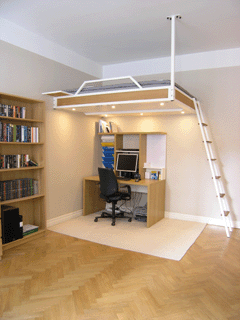
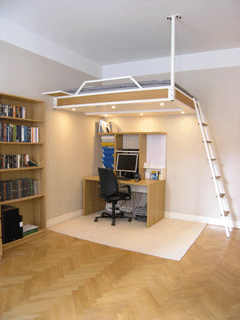
I borrowed the design from a loft bed in a furniture store and adapted it for my first little apartment in Stockholm. It turned out great with a corner hanging from the ceiling and integrated brackets for a desk. I sold that apartment in 2005 but I'll see if I can find a picture. Back then, we barely had the internet. I think the hanging corner was brilliant since no legs were sticking out into the room. Airy and stylish. I had about 95 cm between the top of the mattress and the ceiling so you wouldn't risk hitting your head on the ceiling when sitting up.
I lived in a 100-year-old house and used two heavy-duty French screws. Rock solid. We tested it with two people hanging from that leg, and it worked great. It never fell during my three years there, and I sold the bed with the apartment.
This was the exact variant, except I had legs in the corner and the desk was freestanding (90 degrees to the pictured desk). I went with the same design and in black powder coating from a company that made strength training equipment.
First of all, the bed should rest ON the beam.
Then, I think a 120 bed seems a bit narrow, but it works.
Lastly, I'm doubtful about the ceiling height from the bed. I was considering a loft bed myself and concluded that 130cm was reasonable. You don't just sleep there; you have to make the bed too, and maybe you want to sit and read or do something else in bed...
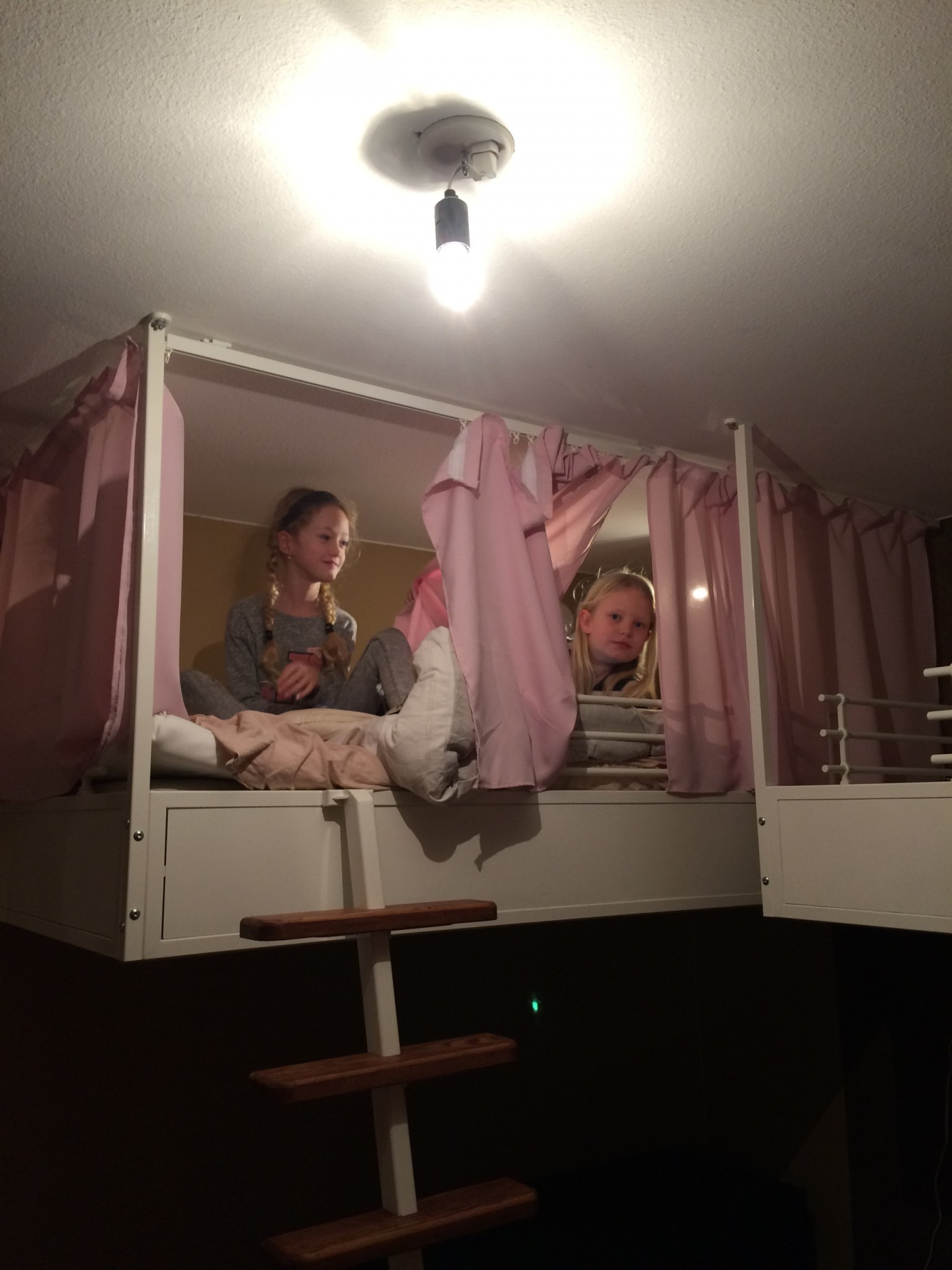
I built two beds for the girls. Installed spotlights underneath with butterflies. Really satisfied. Super sturdy, so they each get a desk underneath, etc. Low ceiling height. But they were really happy. And so was I. Posting some pictures.