I am going to build a fence that is about 2.2m high. Now I am planning to attach the horizontal beams and am considering how to anchor them in the ground.
I have previously built lower fences and used concrete shoes poured in concrete that I mixed myself in tubes. I didn't find it particularly sturdy at all. Neither in the ground nor the shoe and the concrete. Also, the beams easily became unstable in the shoe as well.
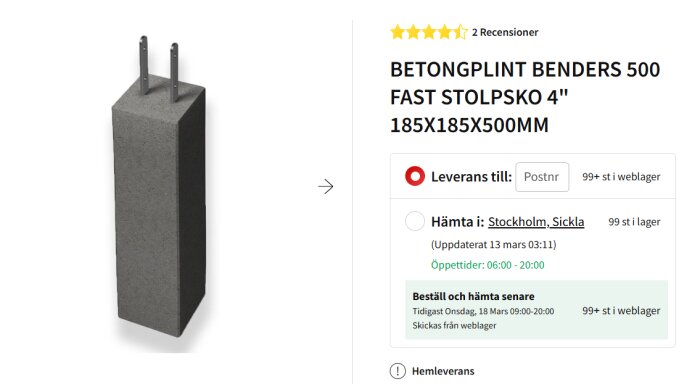
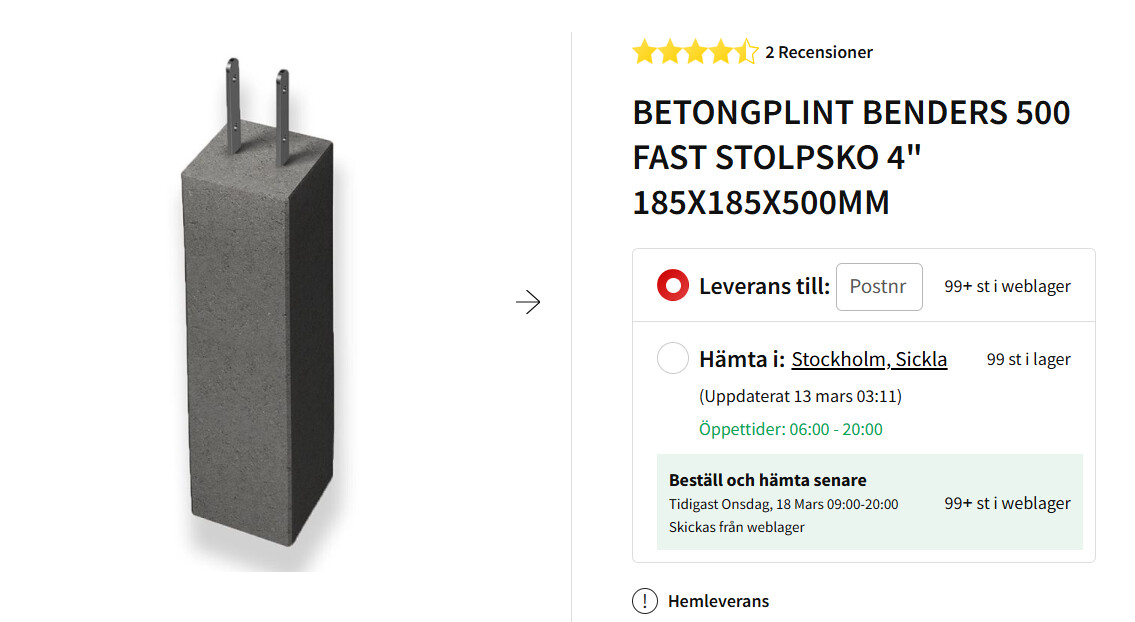
Therefore, I am considering buying these instead. What suggestions do you have for me?
1) You probably shouldn't attach horizontal ledgers to the ground at all, perhaps you mean vertical posts?
2) Choose foundation iron instead of a simple post shoe that is only anchored in the concrete with a round iron. Two foundation irons in the footing (as in your picture) do not bend nearly as easily as a single round iron, especially not in the direction perpendicular to the iron's smallest thickness, so place the footing rotated in the appropriate direction. Wind pressure on a fence can be quite substantial.
3) If the ground is soft, you may need to pack larger stones around your footing (regardless of whether you cast or buy ready-made). And a proper depth is of course also needed, preferably over half a meter.
Incorporating some angles into the straight plank contributes greatly to its stability. Kind of like "pockets" along the plank, where it goes inward maybe 20cm over a 100cm stretch or whatever fits aesthetically.
The alternative to diagonal braces could be, for example, planter boxes, benches, trellises, alcoves, and/or pergolas. In this way, support can be integrated from the start in terms of both construction technique and design, and as a bonus, one can make more use of the fence. The alternative to plinth iron if you cast yourself is metal profiles such as U- or I-profiles which can be made sturdier and longer.
With a 2.2 meter high fence, there are significant forces when it is windy. It's important to anticipate these forces either by allowing airflow through or by having very sturdy posts.
I would not focus on digging deep, but rather wide. If you are standing in half a meter of snow with your feet tied together when the ground starts shaking, it's not very effective. However, if you stand with your feet half a meter apart when it starts shaking, you'll stand much more steadily.
The simplest and best option is to dig, fix the post, and then cast around it. Usually, I dig the posts 4-600mm deep, but when you need such a tall fence as you do, I would go for 1000 deep.
The easiest and best option is to dig, fix the post, and then cast around it. I usually dig down the posts 4-600mm, but when you're going to have such a high fence as you, I would go 1000 deep.
Yes, NTR-A-classified posts can be cast directly into concrete. The high pH of the concrete effectively protects the posts from rotting inside the plinth. It is not a very popular construction today but has the advantage of being very stable. When the posts do eventually rot, they do so above the casting after perhaps 50-100 years. But that is for the next generation to deal with, and by then, the rest of the planks will probably be ready for demolition anyway.
The absolute easiest way is to dig a hole, put some gravel at the bottom, set up the post/rule in the hole, and fixate. Then you pour in concrete, use a hose so it gets wet, stir a bit with a rebar in the hole and let it dry. It won't move for 100 years. I've built my fence this way and nothing happens. You will probably need to get an excavator if you ever want to remove it again.
Vi vill skicka notiser för ämnen du bevakar och händelser som berör dig.