I am going to start building a fireplace in the garden this summer.
I understand the details around building permits/notifications, neighbor permissions, etc., however,
I am seeking information on the construction technical details.
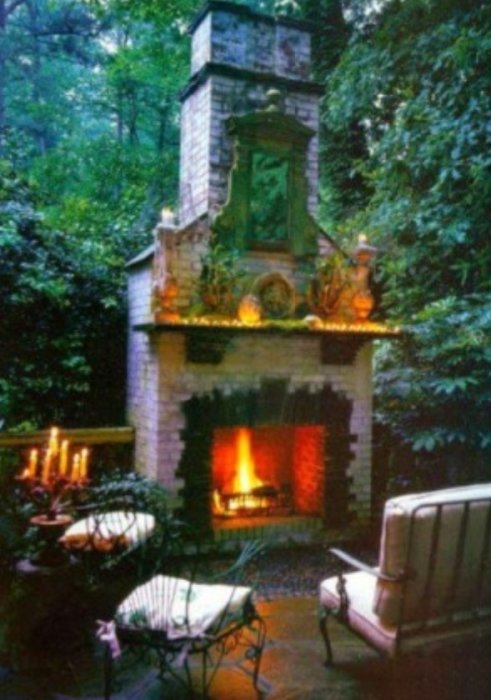
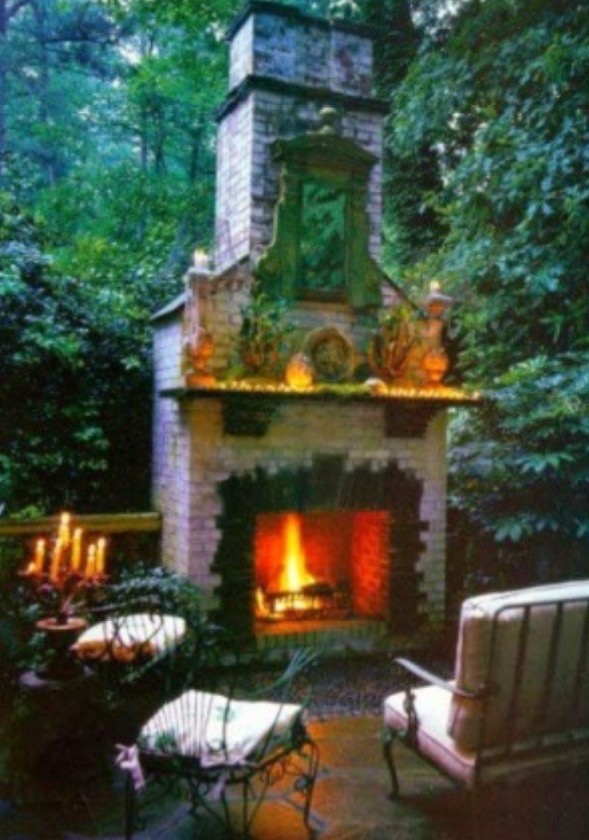
The model I plan to build is this one (image from the internet).
My questions:
Regarding materials.
-Is it correct that any type of brick or stone can be used for the "construction" and that only the inside and bottom of the actual hearth need to be lined with fireproof brick? That is, for everything except the material closest to the fire, it is fine to use anything from ordinary brick to natural stone or mexi as long as it is frost-proof?
-Same question regarding mortar, can I also use ordinary mortar for joints that are not closest to the fire? What type of mortar should I use where there is a need for fireproof brick?
-Are fireproof bricks and fireproof mortar frost-proof or is a special type of brick required for applications that need to withstand both cold/dampness and high heat?
Regarding construction technique.
-How do you think this model is designed inside? Has a straight high chimney been built with a hearth at the bottom and then "wings" have been bricked on the sides? Meaning these side wings are most likely hollow and mostly for show, alternatively also for stability?
-Is it necessary to brick in a pipe in the chimney or is the natural square channel formed by the brick courses sufficient when building upwards?
-If my assumption about the material is correct, how high should the fireproof brick be used? I assume that not the entire inside of the chimney needs to be lined?
-Does the open side of the hearth account for all air intake or should a gap or similar be left at the back for intake? Is there any other type of opening/air intake/ventilation in any other part of the construction, the hearth or the chimney?
-Will the fire/smoke according to this plan actually seek its way up into the chimney in all weather or is there a risk that the smoke seeks its way out through the opening? Can anything be done (construction-wise) to help the smoke choose the path through the chimney? I am thinking of, for example, suitable diameters for the channel, natural "ejector function" in the construction at the crown, or similar?
Many questions, if anyone has the answer to any of the questions, I would greatly appreciate it if that knowledge is shared or discussed.
My questions:
Regarding materials.
-Is it correct that any type of brick or stone can be used for the "construction" and that only the inside and bottom of the actual hearth need to be lined with fireproof bricks? That is, for everything except the material nearest the fire, anything from regular brick to natural stone or mexi will do as long as it is frost-resistant?
Yes. Frost-resistant bricks such as façade bricks, chimney bricks, etc., are fine as far as I know.
Voh said:
-Same question regarding mortar, can I also use regular mortar for joints that are not nearest the fire?
I would use B-mortar as it withstands more than C-mortar, which would also work...
Voh said:
What type of mortar should I use where fireproof bricks are needed?
Fireproof mortar, go to the mortar specialist in Göteborg if you're nearby, they have good knowledge and a wide range of products.
Voh said:
-Are fireproof bricks and fireproof mortar frost-resistant, or is a special type of brick required for applications that need to withstand both cold/damp and high heat?
I believe fireproof is generally frost-resistant, but I'm not entirely sure.
Voh said:
Regarding construction technique.
-How do you think this model is constructed inside? Have they built a straight high chimney with a hearth at the bottom and then bricked on "wings" on the sides? That is, are these wings on the sides most likely hollow and mostly there for appearance, alternatively also for stability?
Most likely the entire piece is bricked from the bottom up at the same time, the pattern goes all the way. Hollow on the sides? No idea, but if it's solid it stores more heat that can radiate out for a while in the summer night after the evening's grilling and revelry.
Voh said:
-Do you need to brick in a pipe in the chimney, or is the natural square channel formed by the brickwork sufficient?
Natural brick channel is sufficient.
Voh said:
-If my assumption about the material is correct, how high should the fireproof brick be used? I assume that not the entire inside of the chimney needs to be lined?
Just around the hearth itself, it's beneficial to, after brickwork, apply a layer of fireproof mortar a few decimeters above the edge of the opening on the inside where the fireproof stones end, and on the underside of the vault and in the hood.
Voh said:
-Does the open side of the hearth account for all air intake, or should a gap or similar be left on the back for intake? Is there any other type of opening/intake/ventilation in any other part of the build, hearth, or chimney?
If it's designed as a traditional open fireplace, there's often nothing but the front opening that provides air intake.
Voh said:
-Will the fire/smoke according to this plan actually seek upwards into the chimney in all weather, or is there a risk that the smoke will find its way out through the opening? Can anything be done (construction-wise) to help the smoke choose the path through the chimney? I'm thinking of suitable diameters for the channel, natural "ejector function" in the construction at the crown, or similar?
The most important thing I know here is the opening area versus flue area. It should be 10:1, and there should be a space above the hearth that inwardly slopes up forming a kind of funnel towards the flue, called a hood.
Voh said:
Many questions, if anyone has the answer to any of the questions, I'd greatly appreciate it if that knowledge is shared or discussed.
Thank you for reading!
You're welcome. My reflections are just my reflections and not absolute truths. Good luck!
Yes. Frost-proof bricks such as facade bricks, chimney bricks, etc. are fine as far as I know.
I would use B-grade mortar as it withstands more than C-grade, which would also work...
Fireproof mortar, go to the mortar specialist in Gothenburg if you are nearby, they have good knowledge and a wide range of products.
I think fireproof is generally frost-resistant, but I'm not entirely sure.
Most likely the entire piece is built from the bottom to the top at the same time, as the bonding is consistent all the way. Hollow on the sides? No idea, but if it's solid, it stores more heat that can radiate a while in the summer night after an evening of grilling and fun.
A masonry duct is sufficient
Just around the firebox, preferably after building up, apply a layer of fireproof mortar a few decimeters up above the opening on the inside where the fireproof bricks end, and on the underside of the arch and in the hood.
If it is designed as a traditional open fireplace, there is often nothing but the front opening providing airflow.
The most important thing I know here is the opening area versus the flue area. It should be 10:1, and there should be a space above the firebox that slopes inward forming a kind of funnel up towards the flue, called the hood.
You're welcome. My reflections are just my reflections and not absolute truths. Good luck!
Thank you for your reflections!
-You mentioned that the flue area should be about 10% of the opening area. Does this 10% area refer only to the chimney's mouth, or should the entire channel maintain this width upwards? I think there may be some turbulence in the flue gases, hindering the flow upwards if the channel doesn't have a consistent design? My question here is based on how I should plan the part from the hearth to the start of the chimney (the hood?) and whether it causes issues to narrow a slightly too wide channel at the mouth to achieve the correct area. For example, the flue gases could hit the ledge/narrowing and as the path changes, block the flow. Or if it even creates a suction in the narrower part, creating an ejector effect and thereby helping the smoke out?
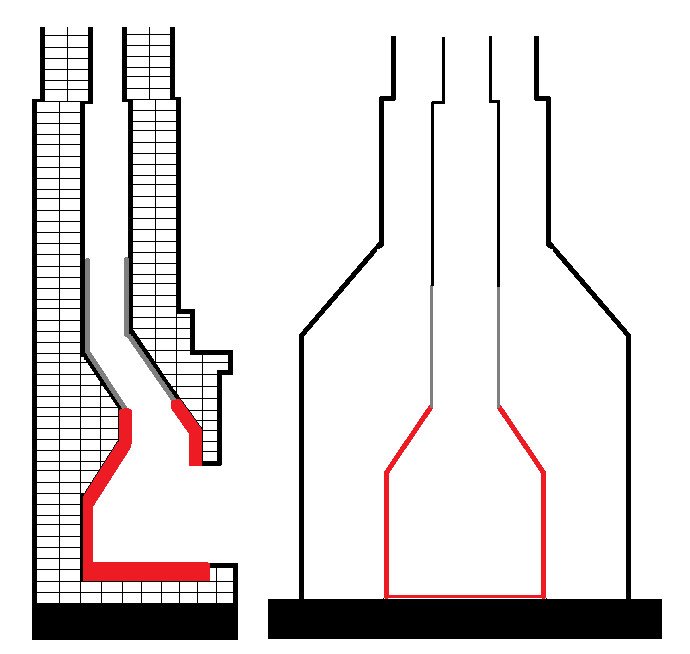
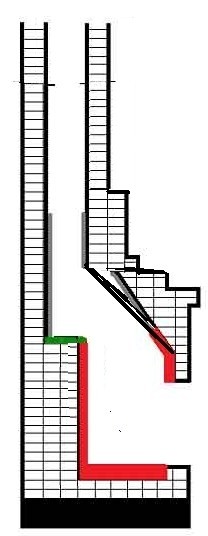
-I sketched a picture in paint based on how I interpreted your instructions. It is of course not to scale or exact, the purpose is just to show how I imagined the principle so it can be evaluated by you and others. Do you think this design would work?
(Red marking shows fireproof bricks, grey marking above the red shows an extra layer of fireproof mortar)
Sorry about the Norwegian alphabet, I'm abroad and the keyboard settings tend to lock on this computer when I switch to Swedish, and it's not very appreciated
A smoke shelf is used to minimize cold drafts in indoor fireplaces. For a fireplace outdoors, I don't know if a smoke shelf would have any reasonable benefit, but you might want to build a house around the piece sometime in the future
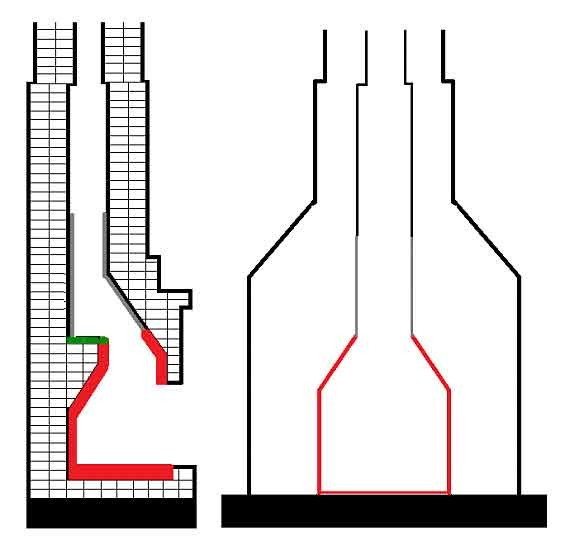
My slightly sloppy cut-and-paste version of your drawing, with a smoke shelf:
The hood is at the front and the back wall is straight. The flue's area, meaning the area it has after the hood and the smoke shelf and all that should be 10% of the opening at the front. As you can see, I've brought the hood forward a bit; your drawing had an overhang that doesn't serve any function. Additionally, I've kept the flue area constant. Narrowing it at the top meter has no advantage, quite the opposite...
A smoke shelf is used to minimize downdraft in fireplaces indoors. I don't know if it has any reasonable use in an outdoor stove, but perhaps you plan to build a house around the piece in the future
Here's my somewhat sloppy cut-and-paste version of your drawing, with a smoke shelf:
The canopy is at the front and the back wall is straight. The flue gas channel's area, that is, the area it has after the canopy and smoke shelf and all that, should be 10% of the opening at the front. As you can see, I have brought the canopy forward a bit; your drawing had an overbite that doesn't serve any function. Additionally, I've kept the flue channel's area constant. Narrowing it at the top meter has no advantage, quite the opposite...
I understand, thank you. Then it will definitely be a smoke shelf. I will probably never build a house around the piece, but the absence of that plan is not a valid reason to build "wrong," so smoke shelf it is.
The reason the rear wall of the hearth itself was tilted forward was that I saw a somewhat similar drawing where it was tipped slightly forward toward the opening, with a smoke shelf placed on top. The advantage this gives is that the front of the piece can be kept straighter, as the photo of the model I wish shows, instead of tapering backward. Sure, it can certainly be built straight as well, but that involves a significant amount of extra material and weight.
Speaking of weight. When I cast the foundation, my plan is to dig out the ground where the piece will stand and + about one meter on each side. The idea is to dig deep, up to a meter, and then fill most of it with gravel and crushed stone, to then cast the top portion with a rebar mesh. The reason for the large depth is that I don't want the surface of the foundation at ground level; I want it around 20 cm below.
-Does the foundation plan sound reasonable?
-How thick should I cast it, and which specific material should be used?
-Do I need to put some type of insulation underneath to protect against frost?
While sketching, a question arose regarding the firebrick...
Should I use these bricks as the other stones, actually load-bearing, but clearly, these are used closest to the hearth, i.e., should they be part of the actual construction? Or should I start by constructing the lower part of the structure (e.g., the first not quite a meter/height of the hearth) with regular brick and then just clothe the inside with firebrick, as one sets tiles on walls in kitchens and bathrooms? Also, if I should just "clothe" the inside with firebrick like tiles, can I then place the flat side of the firebrick against the wall (also like tiles), or should I lay the narrow long side against it? And finally... When laying firebrick, should the joints be as thick as with regular masonry? About 12 mm?
You can pour the foundation with concrete (a recipe is 1+2+3 cement, sand, gravel/ballast); a reinforced slab of 10-15 cm on well-compacted draining ground should suffice. Dig as deep as you want, but ensure it is compacted correctly. If you have a small 250kg compactor, for example, it reaches down about 25 cm in the ground, so if you're filling more, you need to compact in stages.
Regarding the fireproofing: Cover the finished masonry hearth with fireproof brick, as you say "like tiles." You attach them with fireproof mortar, and in the joints, you have the same. The joints should be as narrow as possible because the fireproof brick withstands more than the fireproof mortar. It's not uncommon to have 2mm joints.
I understand the details regarding building permits/notification, permission from neighbors, etc., however,
I am seeking information about the construction details.
!
Hi, I hope your fireplace is done and has provided many pleasant evenings. I'm starting my project and am having a lot of trouble finding answers specifically regarding building permits and neighbors. I've searched the forum and wonder if you can share what you know. I know the rules for indoor fireplaces, but I can’t find anything regarding outdoor fireplaces. Strange.
A few questions:
1. Is any type of building permit/permission needed for a freestanding outdoor fireplace?
2. Is permission needed from neighbors if placed adjacent to the property line?
3. Are there requirements for the chimney height?
Hello!
Unfortunately, it ended up with a bunch of other projects instead. Many pleasant evenings have happened, but not around the fireplace that never came to be.
1. I don't know, it's very unclear. I think it depends on how skilled you are at arguing if the question arises. But aside from loopholes, I actually think it's needed. However, I wouldn't have applied.
2. Better to ask than not to ask regardless. Even if you would have the right on your side, it's better to have clarity with your neighbor. Informing them about your plan fosters good neighborliness and gives the neighbor an opportunity to voice their opinion/suggestions before there's suddenly a fireplace there that for some reason perhaps should have been a meter to the side.
3. No idea. I wouldn't care...
oskar8889 said:
Hello, hope your open fireplace is finished and has provided many pleasant evenings. I'm starting my project and am having great difficulty finding answers specifically regarding building permits and neighbors. I've scoured the forum and am wondering if you can share what you know. I know the rules for indoor stoves but can't find anything about outdoor stoves. Strange.
A few questions:
1. Is any form of building permit/permission needed for a freestanding outdoor fireplace?
2. Is consent from a neighbor needed if placing it adjacent to the property line?
3. Are there requirements for the chimney's construction height?
Thanks for the help!
Click here to reply
Vi vill skicka notiser för ämnen du bevakar och händelser som berör dig.



oskar8889 said:
Hello, hope your open fireplace is finished and has provided many pleasant evenings. I'm starting my project and am having great difficulty finding answers specifically regarding building permits and neighbors. I've scoured the forum and am wondering if you can share what you know. I know the rules for indoor stoves but can't find anything about outdoor stoves. Strange.