
24,010 views ·
23 replies
24k views
23 replies
Build a cantilevered balcony
Hi.
I have demolished a quite large balcony on my old house. It was built with support legs going into the ground. I tore it down because I thought it was out of proportion to the house, plus we have built a pool below. What remains now are a couple of nice balcony doors. I intend to build a balcony that is not wider than the doors, approximately 1.2m total, and as deep as the doors, so maybe 0.7-0.8m. But I want this to be cantilevered, i.e., without support legs. How do you securely attach it to the house? I was thinking of having a wrought iron railing and potentially building the balcony itself in wood. Do you have any good tips on construction and attachment for my ideas?
Thanks in advance
I have demolished a quite large balcony on my old house. It was built with support legs going into the ground. I tore it down because I thought it was out of proportion to the house, plus we have built a pool below. What remains now are a couple of nice balcony doors. I intend to build a balcony that is not wider than the doors, approximately 1.2m total, and as deep as the doors, so maybe 0.7-0.8m. But I want this to be cantilevered, i.e., without support legs. How do you securely attach it to the house? I was thinking of having a wrought iron railing and potentially building the balcony itself in wood. Do you have any good tips on construction and attachment for my ideas?
Thanks in advance

To be able to answer your question, more information about your house is needed, especially how the facade is constructed. Information about the construction year is always helpful.
J justusandersson said:
Hi.
I should have understood that.
The house is from 1875 but underwent a major renovation in 1980. It is an old wooden house. I am attaching a picture taken from outside tonight where you can see parts of the old balcony. I am also attaching an idea of how we think it could look.
Is this enough?
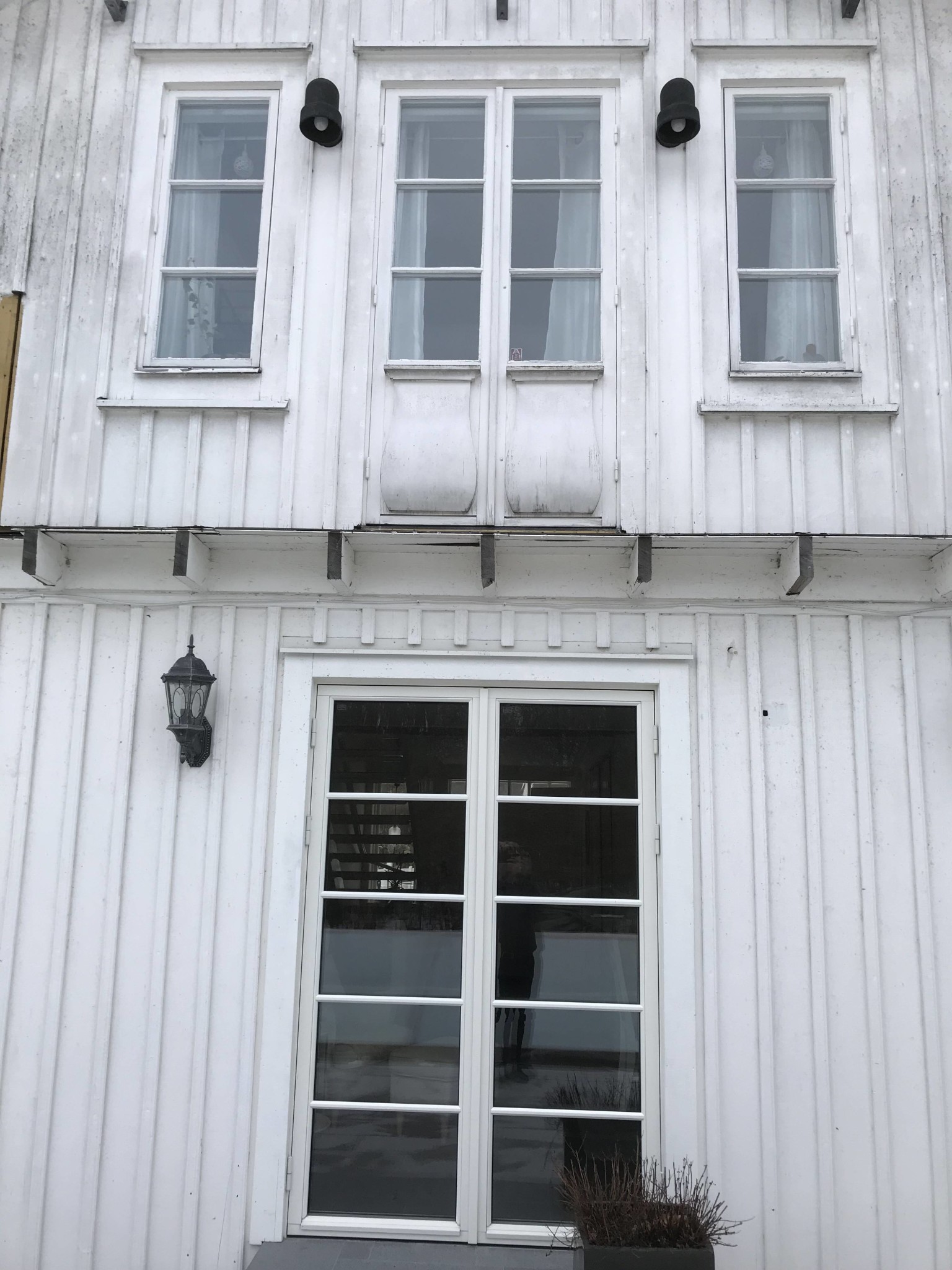
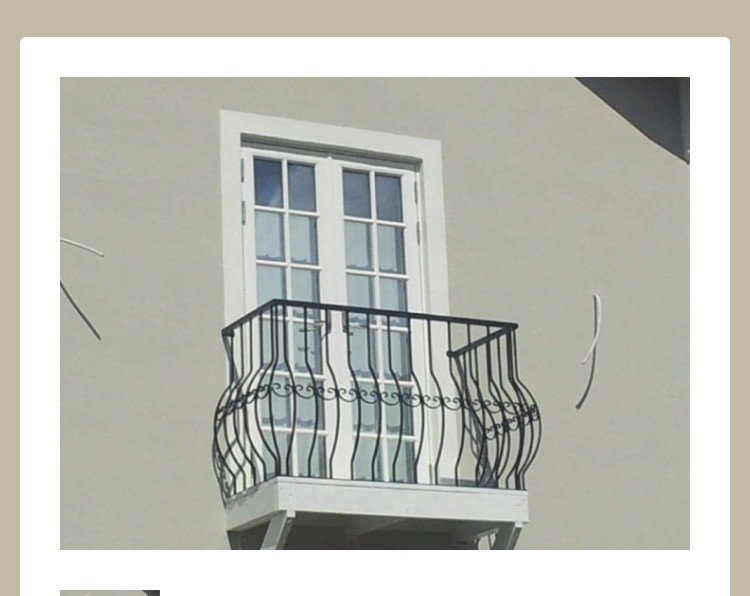
As you can see in your reference image, they have used brackets for the balcony... If you also do that, you'll get a much better construction and can make the construction much more "sleek." But when you say cantilevered, do you mean without brackets?
Where in Blekinge is this beautiful house located?
Is the facade of the upper floor overhanging?
Since the house was built in 1875, the exterior walls are made of timber. It is most likely constructed with horizontal timber. I don't think there's an alternative to a console solution in this case. With horizontal timber, the wall should be reinforced with some form of posts to distribute the loads from the balcony's consoles. It might be done in an attractive way, but it's not entirely certain. A photo showing the entire facade would make that assessment easier.
Is the facade of the upper floor overhanging?
Since the house was built in 1875, the exterior walls are made of timber. It is most likely constructed with horizontal timber. I don't think there's an alternative to a console solution in this case. With horizontal timber, the wall should be reinforced with some form of posts to distribute the loads from the balcony's consoles. It might be done in an attractive way, but it's not entirely certain. A photo showing the entire facade would make that assessment easier.
Thank you, it's located in Karlskrona a bit out in the countryside.. I plan to build the balcony now in the spring before I paint the house.
No, the upper floor is not cantilevered if I understand correctly.
I'm attaching a photo that shows more of that side. I'm also attaching a photo from that wall from the inside when we renovated a few years ago, and just as you said, the house consists of horizontal logs.
Thanks for the help.
No, the upper floor is not cantilevered if I understand correctly.
I'm attaching a photo that shows more of that side. I'm also attaching a photo from that wall from the inside when we renovated a few years ago, and just as you said, the house consists of horizontal logs.
Thanks for the help.

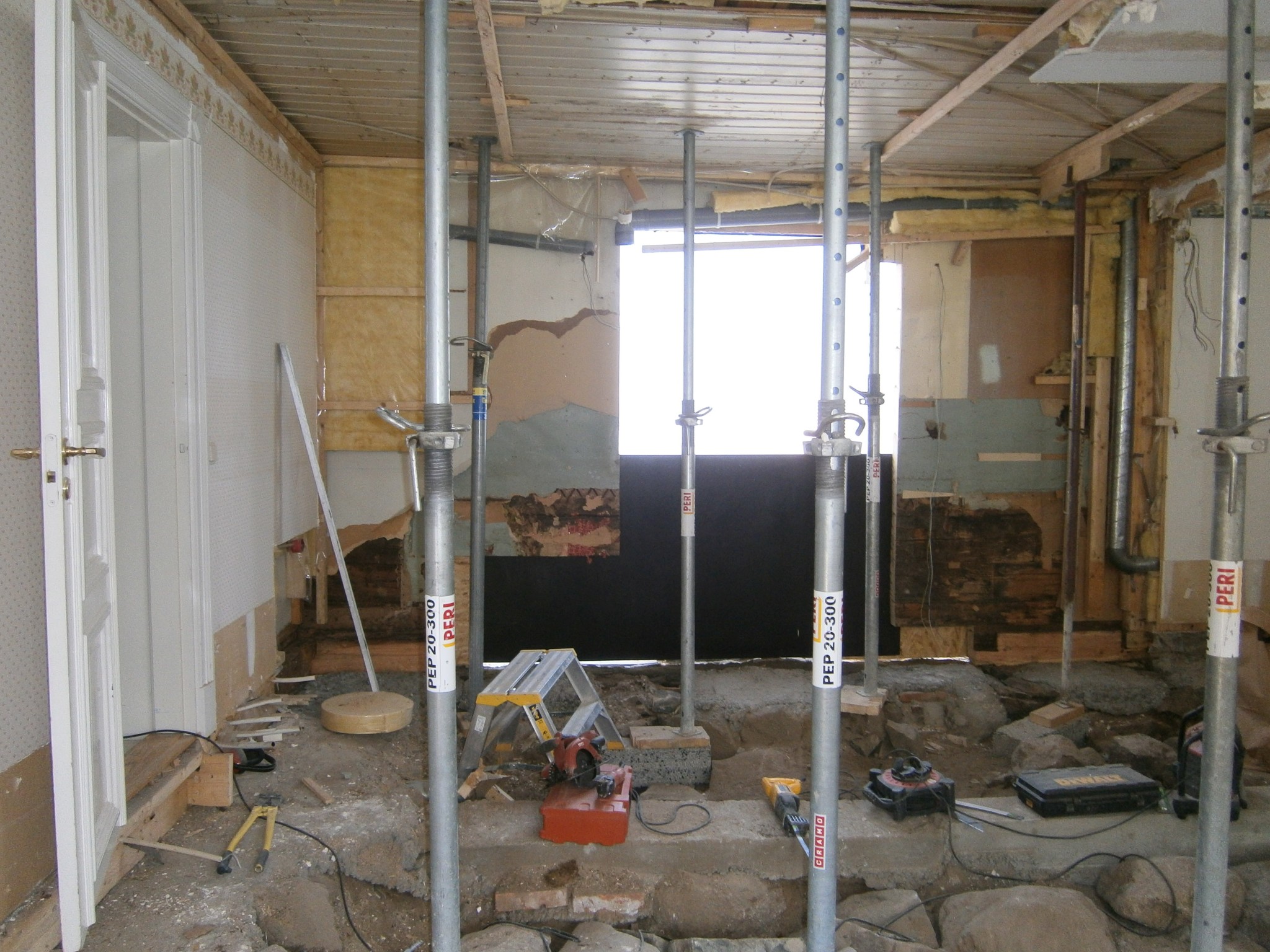
If your balcony is only as wide as the double door above, the brackets will collide with the double door below. Otherwise, brackets in wrought iron can be beautiful in a classic environment.
Another idea is to have the balcony protruding and then have it suspended by diagonal braces from above. A good example is the newly built BoKlok houses in Karlskrona, Blå port, on the height opposite Jeppson's car.
Another idea is to have the balcony protruding and then have it suspended by diagonal braces from above. A good example is the newly built BoKlok houses in Karlskrona, Blå port, on the height opposite Jeppson's car.
My idea was to build the balcony a little wider than the double doors below for the proportions. Then it works with stylish brackets down the wall. You can then choose to install a wrought-iron railing just inside the upstairs windows. This way, it will be easy to clean those windows too and it can look quite nice. Thanks for the tip about Boklok. I'll look into that. But it would definitely look nice with fine wrought-iron brackets at the bottom. I suspect they did something when they built the old balcony. We'll see when I open it up. How do you calculate the dimensions for such brackets?
Will try to provide some input later during the day.
Once you have decided on the balcony's dimensions, calculating the forces affecting the different parts becomes a fairly simple mechanics task. Calculate with 3.5 kN/sqm in so-called useful load and add a self-weight of about 0.5. Regardless of whether you choose steel or wood (or a combination), there will be no large dimensions if the balcony depth is at most 1 m. However, the log wall requires reinforcement in the form of two external columns (pilasters). Their dimensions also do not need to be large. You can clad them with paneling. Boklok houses, as well as some other kit houses, have built-in reinforcements of steel columns that the balconies hang from. Similarly, when renovating balconies in older multi-family buildings, external steel columns are installed. Such balcony renovations are very common, just look around.
Thank you for your input.
Is there any way to avoid visible pilasters?
I don't want to ruin the look of the facade with 2 visible columns.
Can we do some magic?
Regarding the pilasters, I made a simple sketch. Is this something you're thinking of?
Does the design have potential for improvement as you can see?
Thank you for your help
Is there any way to avoid visible pilasters?
I don't want to ruin the look of the facade with 2 visible columns.
Can we do some magic?
Regarding the pilasters, I made a simple sketch. Is this something you're thinking of?
Does the design have potential for improvement as you can see?
Thank you for your help

I would think that you don't need any pilasters. You have horizontal logs, right? They can carry quite a lot. The balcony doesn't protrude very much, and dimensioning for 350 kg per square meter as mentioned above feels a bit excessive. I hardly think anyone would want to place 350 kg on such a small balcony. That would correspond to 4 people with accessories.
You can easily screw the back edge of the balcony into the old balcony brackets, and then a sleek console or diagonal brace that is bolted with a proper mounting plate in the logs.
You can easily screw the back edge of the balcony into the old balcony brackets, and then a sleek console or diagonal brace that is bolted with a proper mounting plate in the logs.
3.5 kN/sqm is the standard requirement for balconies. Liggtimmer are not designed for horizontal forces and are often spliced in the same layer. Definitely need reinforcement. However, the reinforcement does not need to go all the way down but can be integrated into the console. If you want it to be invisible, you have to do it on the inside. I will try to draw a sketch later today.

The problem with the load from consoles on horizontal logs is that the top log is pulled out and the bottom one is pushed in. And the wall risks becoming deformed. You have to secure against precisely this. If the log courses are properly notched (or doweled) at a 90° angle nearby, this likely offers sufficient stability.