I am in the process of mounting a ceiling hook in a room on the upper floor of our house. The hook will be used to attach either a hanging chair for adults or, for example, gymnastic rings for children.
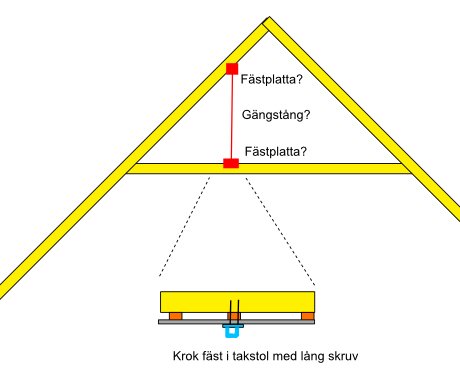
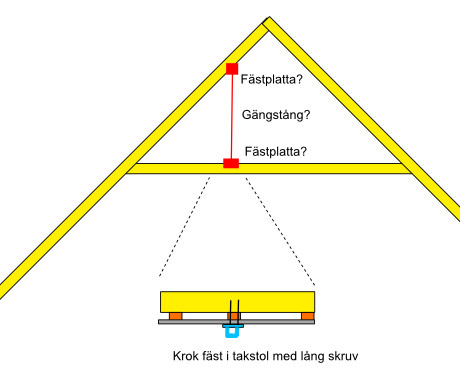
Since I don't want the newly made gypsum ceiling to crack due to possible bending of the collar beam if, for instance, someone sits violently or children swing on the rings, I am thinking of reinforcing the collar beam by mounting a threaded rod between the collar beam and one of the rafters as shown in the image below.
Do you think this will work? And if so, can anyone advise on the best way to fasten the threaded rod to the truss? Are there smart brackets to use? Unfortunately, I haven’t found anything smart when I searched a bit. The rafter is 70mm wide, and the collar beam is 45mm (2pcs).
Would, for example, an M12 rod work? It will be at most 1 meter long.
The question is whether the högbenet can withstand the extra load? In any case, it should be checked. Then I think that in that case, it's a better solution to make a symmetrical arrangement that loads both högbenen.
The question is whether the högbenet can withstand the extra load? It should at least be checked. Then I think that in such a case, a better solution would be to make a symmetrical arrangement that loads both högbenen.
Thanks for your response!
It should hopefully not be impossible to access and reinforce the högbenen as well, at least in the attic. I can also add that I have removed a heavy ceiling (about 30 mm plaster + planks), so I hope that the reduced weight can at least compensate for the static load of a person sitting in the chair.
The högbenen are about 190x70 mm cc 100 cm, but I don't really know the easiest way to calculate if they can take the load as they are. (The house is from 1953, so the timber dimensions are different and a bit odd)
Then I agree that a solution with two braces might be better to distribute the load on the two högbenen.
At that time (and long thereafter) thumb measurements were used for lumber dimensions. The most logical is that they are 8x3 inches. If an estimate is to be made, some additional details are needed, namely the total length of the rafters, the roof pitch, the roofing material, the snow zone, and the estimated load of the swing. Preferably the measurements of the collar beam as well.
At that time (and long afterwards) people used inch measurements for timber dimensions. The most logical is that they are 8x3 inches. To make an estimate, a bit more information is needed, namely the total length of the high beams, roof slope, roofing material, snow zone, and the swing's calculated load. Preferably the dimensions of the collar beam as well.
The total length according to an old drawing is 608cm, Support beams are 190 cm from the bottom of the high beams, roof slope about 35 degrees, concrete tiles on 17mm roof boarding, and let's say 1kN static load (how much dynamic load is it when an adult sits in a chair?)
The collar beam is two pieces of 45x170 that sit on either side of the high beam.
The drawing says 2"x6" for the high beams, but that's not correct as I went up there to take a look. More like 70 mm wide x 170-190 mm.
The strongest point is of course where the rafters meet, but maybe you can't place the hook in line with the ridge?
Unfortunately, the placement of the hooks is determined by the room's furnishing. However, it's quite close to the ridge horizontally. So it might be possible to arrange a mounting there after all.
If each truss carries a load of about 30 kN, then naturally an additional 1 kN doesn't mean much in that context. You don't have to hang there when it snows the most. However, it is quite clear that the top chords are subjected to rather considerable loads in relation to their limited construction height.
If each truss bears a load of about 30 kN, naturally an additional 1 kN doesn't mean much in this context. You don't need to hang there when it snows the most heavily. However, it is quite clear that the king posts are subjected to quite substantial loads relative to their limited construction height.
Indeed! We'll simply have to avoid it during a snowstorm. However, I'm not quite sure I understand how you arrived at 30 kN. It seems quite a lot (as you say..)
I'll make a clumsy calculation attempt below with numbers I've found in the Wood Guide's dimensioning tables, which I have scoured through now inspired by all the good answers I've received in the thread!
We are in snow zone 2.0, and assuming 0.65 kN/m2 for concrete tiles with decking, I calculate about 14 kN external load on a 6m roof slope, regardless of the beam's own weight and the ceiling's impact. The ceiling and insulation add about 0.25 kN/m2 (also from the Wood Guide's tables), so it becomes an additional 0.625 kN to share between two king posts. I haven't gotten so far as to see how to use the tables to calculate conditions for buckling of the king post, maybe it will go better tomorrow after some sleep!
But if you think it looks weak, perhaps one could brace at least parts of the king posts by screw-gluing K-plywood? Or is that just silly?
Once again, thanks to everyone who has responded in the thread and helped me. It is truly appreciated.
30 kN referred to an entire truss from outer wall to outer wall. If you have 14 kN on one half, it's essentially the same. These are the total vertical loads that somehow need to be transferred down. When studying the deflection of the rafters, you are interested in the load perpendicular to their length, which depends on the roof slope and the placement of the support beams. When I test various figures, I see that you're on the borderline, but this doesn't require any action. Snow loads have been systematically increased over the years. In SBN 67, the snow load in Östergötland was 100 kp/m2. Snow load is calculated in the horizontal plane unlike deadweight. However, it isn't wrong to be aware of the weaknesses.
30 kN referred to a whole truss from outer wall to outer wall. If you have 14 kN on half, it's the same thing. These are the combined vertical loads that in some way need to be transferred down. When studying the deflection of the rafters, the focus is on the load perpendicular to their longitudinal direction, which moreover depends on the roof slope and the placement of supports. When I test some different figures, I see that you're on the borderline, which, however, doesn't require any actions. Snow loads have been systematically increased over the years. In SBN 67, the snow load in Östergötland was 100 kp/m2. Snow load is calculated in the horizontal plane as opposed to dead weight. It is not wrong to be aware of the weaknesses.
Thank you very much for all the great answers. It is much appreciated.
I am thinking that I will get a suitable threaded rod with appropriate mounting devices and try to achieve a symmetrical load on the rafters.




useless said:
The top half from one of these on each end perhaps?