Preparing to lay EPS concrete, but unsure how close to the walls I should chisel out (so they're not undermined)?
Should you take the last bit up to the wall on the current layer so you get a continuous floated surface later, or should you just leave it like this:
If you want feedback, you must provide significantly more information. House type, construction method, year built, are you operating in the basement? Preferably drawings.
In the basement of a single-story house with a basement. Built in the late 60s. Outer walls and middle wall are load-bearing. Interior walls made of lightweight concrete/reinforced Siporex blocks, stand on the concrete floor.
Note that I am only chipping away the fine layer, 5-6cm. Planning to chip off the edges, wall by wall, and pour new support where needed. Mainly want to remove the top surface layer so I can have a continuous leveling compound up to the wall.
The pipes have been replaced previously, but the pipe shafts are now cast into the slab.
In the basement of a single-story house with a basement. Built in the late 60s. Exterior walls and center wall are load-bearing. Interior walls made of aerated concrete/reinforced Siporex blocks, standing on the concrete floor.
Note that I am only chiseling away the fine layer, 5-6cm. I plan to chisel away the edges, wall by wall, and pour new support where needed. I mainly want to remove the top surface layer, so I can have a continuous leveling compound up to the wall.
The pipes have been previously replaced, but the pipe shafts are now cast into the slab.
[image]
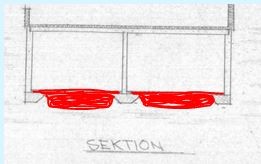
You should basically be able to remove the red, and leave the concrete sills:
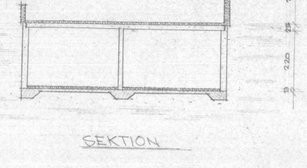
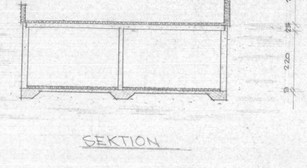
The most common foundation method for houses with basements during the 50s and 60s was spread reinforced slabs (commonly called sulor). Between the sulor, a thin unreinforced slab was then cast, often with a thick plaster layer on top that also covered the visible parts of the sulor. The sulor were cast on unexcavated soil, so do not go below the lowest level of the sulor, and do not touch the sulor.
Yes, excuse me - I might be unclear here - we are not going to "chisel out the slab" - we are chiseling away the fine surface and will cast EPS concrete on top of the rough slab. I still want to know how close to the wall, the inner wall (lightweight concrete blocks with an air gap behind) I can go. Mainly, I want to be able to self-level all the way to the wall, but maybe that's completely unnecessary. I will lay floor heating coils, and they won't reach all the way out to the wall anyway.
The most common foundation method for small houses with basements during the 50s and 60s was spread reinforced slabs (commonly called footings). Between the footings, a thin unreinforced slab was then cast, often with a thick plaster layer on top, also covering the visible parts of the footings. The footings were cast on unexcavated ground so do not go below the lowest level of the footings, and do not touch the footings.
btw my construction has previously been discussed and what I have is apparently called voter, and I've had a construction firm that advised against breaking up the slab.
KJD said:
Yes, sorry - perhaps I'm unclear here - we are not "breaking up the slab" - we are removing the fine concrete layer and will pour EPS concrete on top of the rough slab. I still want to know how close to the wall, the inner wall (lightweight concrete blocks with an air gap behind) I can go. Mainly, I want to be able to self-level right up to the wall, but that might be completely unnecessary. We're laying floor heating and it doesn't go all the way to the wall anyway.
Does anyone have any opinions?
Additionally, I've realized that the lightweight concrete blocks in the walls rest on the rough slab, and the "fine concrete" layer is cast to that height. I have now removed the wall piece by piece and cast new support for the inner walls to be on the safe side.
Slowly, slowly, I'm approaching the casting of the EPS concrete.
Click here to reply
Vi vill skicka notiser för ämnen du bevakar och händelser som berör dig.



KJD said:
In the basement of a single-story house with a basement. Built in the late 60s. Exterior walls and center wall are load-bearing. Interior walls made of aerated concrete/reinforced Siporex blocks, standing on the concrete floor.