
11,410 views ·
22 replies
11k views
22 replies
Balcony with drip-free carport below

Don't know if this is the right category but thought it was the closest, moderator can move it if there's a more suitable one.
I'm building a balcony of about 30m2 (7*4m). Underneath this, I will have a carport. Since I don't want it to drip from the decking onto the car, I was thinking of placing a metal/plastic roof under the decking with a slight slope away from the house. How do I do this most easily? Should I install the under-roof before laying the decking? The slope will be about 200mm from the house to the outer edge.
Attaching some pictures of how it looks currently.
/Samuel
I'm building a balcony of about 30m2 (7*4m). Underneath this, I will have a carport. Since I don't want it to drip from the decking onto the car, I was thinking of placing a metal/plastic roof under the decking with a slight slope away from the house. How do I do this most easily? Should I install the under-roof before laying the decking? The slope will be about 200mm from the house to the outer edge.
Attaching some pictures of how it looks currently.
/Samuel
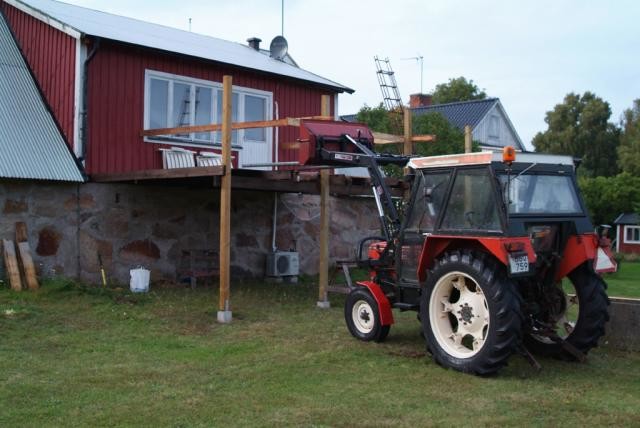
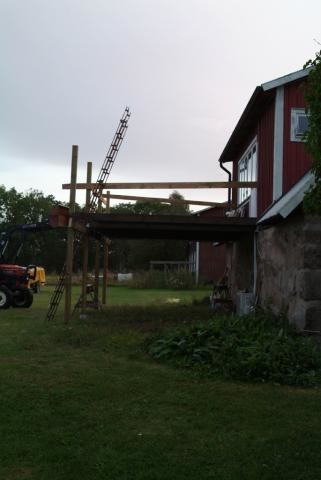
Haha can believe you've copied my project 
My balcony ended up being the same size 8.5x4m and I simply cut 5 joists at 2 degrees and increasing height, which I then screwed to the underside of the joist framework and then attached regular roofing sheet (silver-colored) underneath.
In my case, the slope was from the wall outwards, and the drop over 4m was about 100mm.
This works excellently and I can't see any problem except during spring/autumn when there might be a bit of ice formation, but nothing that has caused any issues for me anyway.
My balcony ended up being the same size 8.5x4m and I simply cut 5 joists at 2 degrees and increasing height, which I then screwed to the underside of the joist framework and then attached regular roofing sheet (silver-colored) underneath.
In my case, the slope was from the wall outwards, and the drop over 4m was about 100mm.
This works excellently and I can't see any problem except during spring/autumn when there might be a bit of ice formation, but nothing that has caused any issues for me anyway.
Well, I certainly haven't copied it consciously, it just shows that I'm not the only one on this forum with some unusual ideas...Tossegubbe said:Haha, I can believe you copied my project
My balcony ended up the same size, 8.5x4m, and I simply did it by cutting 5 beams to 2 degrees with increasing height, which I then screwed to the underside of the joists and then attached regular roofing sheets (silver-colored) under them.
In my case, the slope was from the wall outward, and the fall height over 4m was about 100mm.
This works excellently, and I can't see any problems except in the spring/autumn when there may be some ice formation, but nothing that has caused any issues for me anyway.
However, I do have a few follow-up questions; What spacing did you use for the beams you put up, and how did you attach them? Did you use through screws directly from below into the joists or did you use angle brackets? If you could show pictures of your construction, I would be very happy.
By the way, did you use pressure-treated wood for the beams?
/Samuel
I don't have any pictures at the moment but I'll see if I can find some, too much snow to take photos now
But I can answer the questions anyway, and yes, it was pressure-treated timber in class A (i.e., for docks, etc.) because it will be a damp environment there.
I drilled and countersunk through-bolts 8x180 in the highest beam but using angles works just as well if you prefer, though it's more fiddly.
The center-to-center distance was about 90cm, but it's probably not wrong to have it closer either. I reasoned that there would never be any snow load or the like on the sheet.
Then it's good if you can borrow a sheet lift when the sheet goes up, wouldn't have managed without one.
Feel free to ask if you have any other questions.
But I can answer the questions anyway, and yes, it was pressure-treated timber in class A (i.e., for docks, etc.) because it will be a damp environment there.
I drilled and countersunk through-bolts 8x180 in the highest beam but using angles works just as well if you prefer, though it's more fiddly.
The center-to-center distance was about 90cm, but it's probably not wrong to have it closer either. I reasoned that there would never be any snow load or the like on the sheet.
Then it's good if you can borrow a sheet lift when the sheet goes up, wouldn't have managed without one.
Feel free to ask if you have any other questions.
Thanks for the info!d^_^bTossegubbe said:Do not have any pictures at the moment but I'll see if I can find one, too much snow to take photos now
But I can answer the questions anyway and yes, it was pressure-treated timber in class A (i.e., for docks, etc.) since it will be a damp environment there.
I drilled and countersunk through-going lag screws 8x180 in the highest beam but angles work just as well if desired, though it's more fiddly.
The CC distance ended up being about 90cm, but it's probably not wrong to have it closer either, I reasoned that there would never be any snow load or such on the roof.
Then it's good if you can borrow a sheet lifter when the roof is going up, wouldn't have managed without one.
Just ask if you wonder about anything else.
I went to the local building supplier this afternoon to get a quote for the rest of the materials for the balcony, I'll get it tomorrow. It will be exciting to see if they can beat the prices from Byggmax that I calculated myself. I do want to support the local shopkeeper, but not if it is unreasonably expensive...
In any case, the seller didn't think I would need class A for the beams, although he agreed to calculate it.
With 5 beams I'll have a CC of 80cm. I'm also torn between buying 2.5 or 4-meter roofing pieces. It will be about 600 SEK more expensive (according to Byggmax) with 4-meter pieces, but it's less work to install. With 2.5m pieces, I'll have a joint that I probably should have a beam under...
I think I can manage without a sheet lifter if there are just a couple of people. Otherwise, you can always build a T-support to press the roof up before screwing it fast.
@ Arne: I looked at Til-Tak, really smart system! It's just a shame it's so expensive. I called one of their retailers in the capital city to get more info and prices. For my deck build, it would cost twice as much as the decking and railing and five times as much as a plastic roof, so it was no longer interesting :x
General question:
They did have a variant (Til-Tak light) that you could install after laying the floor, consisting of some kind of plastic sheet attached in an arch between each beam. Couldn't you make a version of that with just a regular tarpaulin? It would be insanely cheaper than putting up a plastic/metal roof.
/Samuel
Hmm how can it be more expensive with 4m sheet metal than 2.5 meters?
There must be something wrong there?
What are you paying for the sheet metal? I usually pay 55kr/m2 unless there is second-rate that you can get for about 35kr/m2.
The price for class A pressure-treated is the same as for class AB (typical decking), but it's more toxic to handle.
Roof drainage is in progress but hasn't happened yet, there is supposed to be a gutter at the end, but in my case, it's not a big problem as I have pretty coarse gravel where it drips, so it doesn't splash up badly and causes no damage.
Another thing you should consider is that you have to be able to clean the top of the sheet metal occasionally from leaves and such that collect there. I solved it by leaving the innermost decking board loose so you can just lift it and spray from above with, for example, a pressure washer.
There must be something wrong there?
What are you paying for the sheet metal? I usually pay 55kr/m2 unless there is second-rate that you can get for about 35kr/m2.
The price for class A pressure-treated is the same as for class AB (typical decking), but it's more toxic to handle.
Roof drainage is in progress but hasn't happened yet, there is supposed to be a gutter at the end, but in my case, it's not a big problem as I have pretty coarse gravel where it drips, so it doesn't splash up badly and causes no damage.
Another thing you should consider is that you have to be able to clean the top of the sheet metal occasionally from leaves and such that collect there. I solved it by leaving the innermost decking board loose so you can just lift it and spray from above with, for example, a pressure washer.
The cheap roof (2.5m) is only 0.8mm thick and costs 38.95kr/m2 or 100.42kr/sheet. The expensive one (4m) is 1mm thick and costs 59.95kr/m2 or 249.39kr/sheet. If I go up to 1mm on the 2.5m width, it becomes the same price as the 4m piece but with more waste and work.:@
It was nice to hear that the price is the same for class A as AB, thought it would be outrageously much more expensive with A. Toxic with class A? Pah! I have about thirty old railroad ties lying behind the barn waiting for me to find a suitable use for them... Now that's what I call toxic with creosote and stuff:blushing:
How are you going to install the gutter? Inside or outside the posts. So, what I'm really asking is whether the sheets end inside or outside the posts...
My roofing sheets (although they will be plastic...) will end inside the posts because the main beam is on the inside and because it feels like a lot of extra work to cut into the sheets where the posts are.
Your idea with the removable inner board was smart, but I'm wondering if it's not enough to be able to rinse from the long side. There will be a gap between the main beam and the decking since I don't (right now anyway) intend to cover the frame with decking all around.
See image below.
Black is post, red is main beam, blue is joist, and pink is the underroof.
It was nice to hear that the price is the same for class A as AB, thought it would be outrageously much more expensive with A. Toxic with class A? Pah
! I have about thirty old railroad ties lying behind the barn waiting for me to find a suitable use for them... Now that's what I call toxic with creosote and stuff:blushing:How are you going to install the gutter? Inside or outside the posts. So, what I'm really asking is whether the sheets end inside or outside the posts...
My roofing sheets (although they will be plastic...) will end inside the posts because the main beam is on the inside and because it feels like a lot of extra work to cut into the sheets where the posts are.
Your idea with the removable inner board was smart, but I'm wondering if it's not enough to be able to rinse from the long side. There will be a gap between the main beam and the decking since I don't (right now anyway) intend to cover the frame with decking all around.
See image below.
Black is post, red is main beam, blue is joist, and pink is the underroof.

Hmm 1mm? I guess you mean the plastic then because it can't be 1mm sheet metal? Mine are 0.6 and hard as hell.
I probably wouldn't want plastic because it will get dirty over time and you won't be able to clean it directly either, since there will be shade under the decking and a lot of algae etc. will grow there.
My construction differs a bit at the front edge because I have a steel beam and no middle post like you do, so my gutter will end up between the posts, you could say.
I probably wouldn't want plastic because it will get dirty over time and you won't be able to clean it directly either, since there will be shade under the decking and a lot of algae etc. will grow there.
My construction differs a bit at the front edge because I have a steel beam and no middle post like you do, so my gutter will end up between the posts, you could say.
I came to think that you could have the gutter inside the bearer if you want to hide it a bit and have a more discreet placement.
I don't have a bearer underneath like you do; instead, my joist is level with the steel beam/bearer at the front because I wanted as much headroom as possible since I have a regular floor underneath.
I don't have a bearer underneath like you do; instead, my joist is level with the steel beam/bearer at the front because I wanted as much headroom as possible since I have a regular floor underneath.
Yes, it was the plastic roof I meant, trying to build as cheaply as possible without compromising too much on quality. So you mean that plastic roofing would encourage algae growth faster than sheet metal roofing? Or is it that the plastic roof takes more damage from algae than the metal roof? I haven't even considered that it could be so; do you have your own experiences or can you refer to any sources? It would be interesting to know "for real"Tossegubbe said:Hmm 1mm? I assume you mean the plastic because it can't be 1mm sheet metal? Mine are 0.6 and hard as hell.
I probably wouldn't want plastic because it'll get so dirty after a while and you won't really be able to wash it either, given that it gets shaded under the decking, there'll be a lot of algae growth there.
My build is a bit different at the front because I have a steel beam and no middle post like you do, so my gutter will end up between the posts, you could say.
.The gutter I intended to have inside the bearer if I end the sheets inside. It's not really for aesthetics but more practical as I mentioned before, because I avoid having to cut the sheets at the posts.
Where do you get second-grade sheet metal roofing? Regular hardware stores or from sheet metal workers?Tossegubbe said:
All major sheet metal companies usually have incorrectly sized and transport-damaged sheet metal lying around that you can buy as second-class at a good price even though there's actually nothing wrong with it. My experience is that it doesn't really grow much more on a plastic sheet than on regular sheet metal, but it is much more visible on transparent plastic than on sheet metal. It's pretty given that there will be more on our type of roof since it will be much more humid there, as the sun will never directly shine on the sheet metal. But if you google algpåväxt, you might find more scientific info; my opinion is solely based on practical experience from various patio and conservatory constructions over the years.