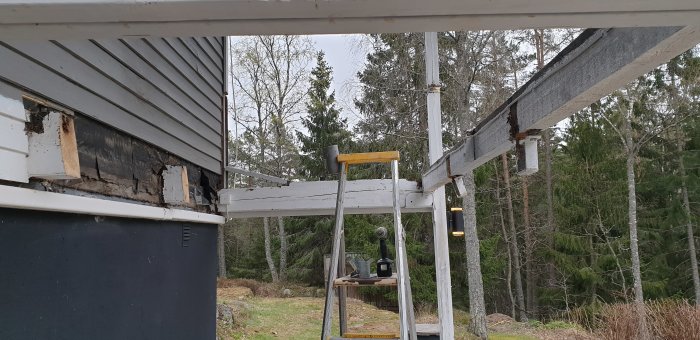
Then it's time to renovate the balcony that is rotten.
Length approximately 8m
Depth 1.8m
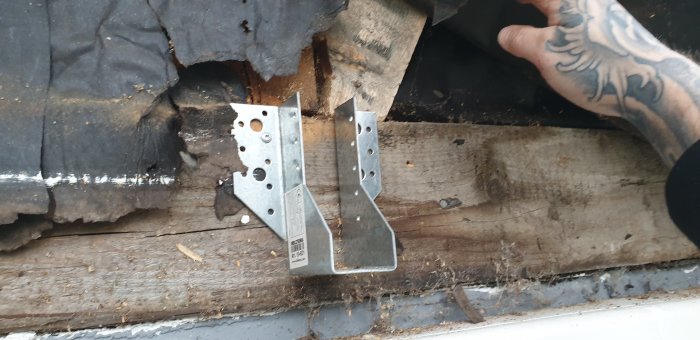
The plan is to install joist hangers in the existing frame of the house. Or should a 195x45 be screwed into the house foundation and then joist hangers?
For the joists, I was thinking 145x45?
Free length on them would be about 1.7m?
And then a 225x45 at the front on 3 posts?
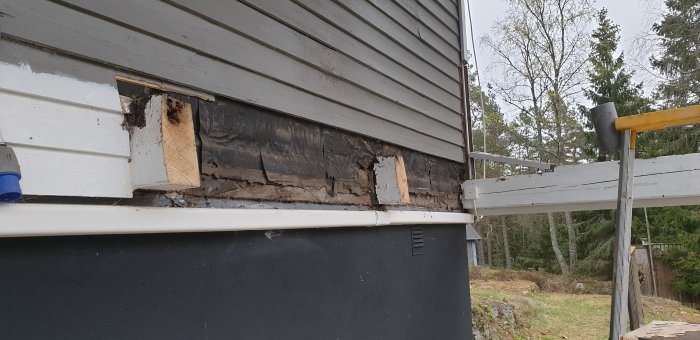
Nail new panel on the house where it's missing, paint the panel, then attach at least a 145X45 on the house side where you attach the joist hangers.
Why?
Much less risk of moisture damage to the house wall, as it looks now the water can creep into the house structure.
Furthermore, it's easier to build and a stronger construction
Ah, I thought it would be stronger if I attach directly to the "house". But then I'll put on new panel first and then screw a support beam to the panel?
It will be good
It gets stronger because you can attach the board in a better way where it fits with what's in the house's construction. I assume there's a wood sill where the board will be, so it will be good with sturdy French screws on about cc60. The board evens out the load so you don't have a weak point, the same bearing everywhere
And as I said, no risk of water... in my summer house, there was a previous owner (= relative who in the 60s built a balcony on the upper floor with beams straight into the house. When I went to fix it and broke open the panel, the entire sill over a stretch of 2 meters was completely rotten... 2 weeks of hard work to replace that sill... not fun
Personally, I hold the opposite opinion that one should not rely on the cladding for structural support as it is a consumable item that will need to be replaced from time to time. No load-bearing ropes in facade cladding, no posts on decking, etc.
The issue of ensuring that water cannot seep into the structure still persists, of course. This is typically solved with spacers, metal sheets, etc. There are some examples on Träguiden's website.
Note that a balcony must be designed to withstand almost double the so-called live load compared to a patio. If you want 45x220 C 24 at the front, at least four posts are required. I would consider using glulam instead. With 90x225, 3 posts are sufficient, and with 90x450, 2 posts are enough. 90x450 can be replaced by 190x360, for example. Keep in mind that the balcony needs to be stabilized laterally. The simplest way to do this is with a diagonal on the underside of the balcony.
Myself, I have the opposite view that you don't hang the load-bearing structure on the siding since it is a consumable item you should expect to replace now and then. No bearing lines in the facade cladding, no posts on decking, etc.
The load-bearing structure doesn't hang on the siding, it should hang in the sill, but the French goes through the house panel.
Consumable item???
If it's a good quality panel that in this case is well above the ground, it is definitely not a consumable item. My house is 40 years old, the veranda attached outside the siding in the sill. I have never replaced either the panel or the bearing line against the panel. I can guarantee TS who is now putting up new paneling that if he buys good quality and paints it properly (even edges), he will have a lifetime guarantee on that panel
The only proper solution if you want free play is to set blocks for the innermost bearing line and take a certain overhang on the nail brackets there. The worst solution is to risk getting water into the house's construction...
Remember that the balcony needs to be stabilized laterally. The simplest way is with a diagonal on the underside of the balcony.
Shouldn't be necessary if it's properly attached to the house as I described. The wooden deck then becomes rigid against the house, and the house along with ALL those thousands of screws (2 on every board/nailing rule) absorb all the diagonal forces in this case. But sure, if you want to use both belt and suspenders, go ahead and add some diagonals on the underside
When you cannot use sheet material or tongue-and-groove boards, but only decking with gaps, you get a construction that is not stable laterally. There can be quite large forces from the wind a bit up in the air.
45x145 C 24 functions as screw beams if they are placed at c/c 600 mm.
The load-bearing structure is not supported by the cladding; it should be supported by the sill, but the French goes through the house panel.
Consumable???
If it's a high-quality panel that in this case is well above the ground, it's definitely not a consumable. My house is 40 years old, the veranda is attached outside the cladding to the sill. I've never had to replace either the panel or the load-bearing beam against the panel. I can guarantee the original poster who is now installing new paneling that if he buys good quality and paints it properly (including the edges), he will have a lifetime guarantee on that panel
The only proper solution if you want free playroom is to set footings for the innermost load-bearing beam and take a certain overhang on the nail battens there. The worst solution is to risk getting water into the house's construction...
If you guarantee a lifetime warranty on wood paneling, then there's no problem. You should definitely sell that to more people.
I agree that it's a poor solution to allow water into the house's construction, which is why I pointed out that one needs to build so that it doesn't happen, even without relying on the paneling.
Anyone have any tips for cutting the old studs flush with the sill? Handsaw?
I would try a reciprocating saw with a long blade if you have one. Press against the sill and you can bend the blade slightly so that you cut flush. If not, a handsaw works well too!
Vi vill skicka notiser för ämnen du bevakar och händelser som berör dig.





Bernieberg said: