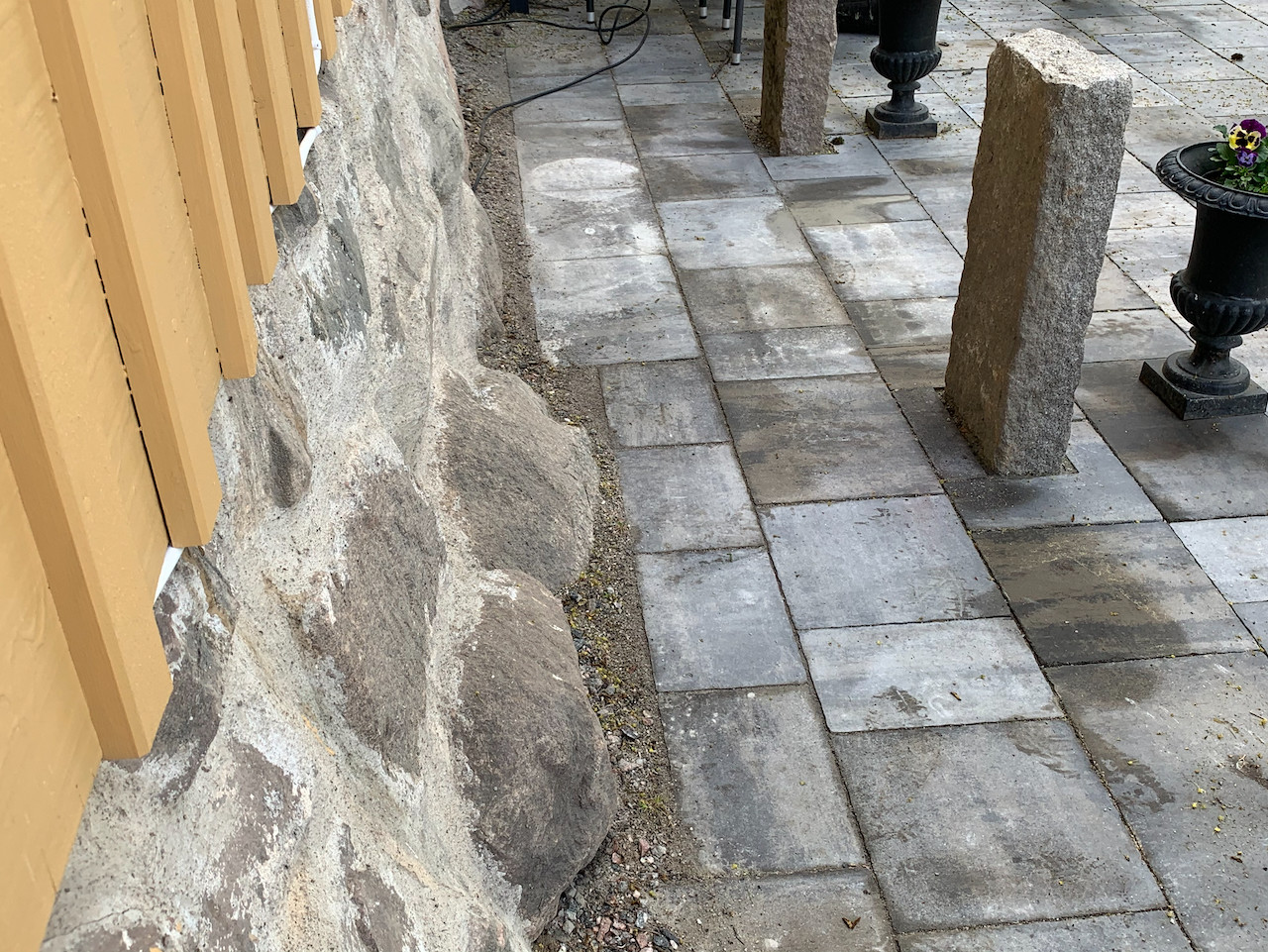
A porch is going to be built and the two rear posts that will support both the roof and the floor will need to hang on the wall. They cannot rest on the ground because the stone foundation protrudes awkwardly and unevenly outside the facade. It's possible to brace them in some way, but if it is possible to hang the rear posts on the wall while the front ones rest on two hewn granite posts protruding from the stone paving, it would probably look quite nice.
So to my question. The posts are 10*15 cm with the long side out from the wall. If no one comes up with a smarter idea, I thought I would simply drive screws through the 15 cm post, a few cm of wood paneling, air gap, fiberboard, and some other materials to then securely attach to the timber frame. To avoid the post "sagging" and staying put, I guess the screws need to go deep into the timber, requiring solid screws around 30 cm long.
A porch is going to be built, and the two rear posts that will support both the roof and the floor should be attached to the wall. It is not possible to let them rest on the ground because the stone foundation protrudes awkwardly and unevenly outside the facade. There might be a way to brace them somehow, but if it's possible to hang the rear posts on the wall while the front ones rest on two hewn granite posts protruding from the stone paving, it will probably look quite nice.
So to my question. The posts are 10*15 cm with the long side out from the wall. If no one comes up with a smarter idea, I simply intend to drive screws through the 15 cm post, a few cm of wood paneling, air gap, fiberboard, and some other layers to then attach securely into the timber frame. To prevent the post from "sagging" and to keep it in place, I guess the screws need to be deep in the timber, and then sturdy screws around 30 cm are needed.
Am I thinking correctly, and which screws in that case? The first try at googling gave me these [link] Could they work? They were expensive anyway.
You can drill into the post you are going to fasten, if you leave two inches, the post will sit very well and you can be satisfied with Biltema's 6x200mm art 87-6291 50pcs for 159kr
Good thinking. I had planned to drill to fill the holes with plugs, as screw heads don't look good on the house, but it's possible to make those holes quite deep.
But do you think it will hold to drive in a bunch of screws, despite a fairly large gap without support between the post and the timber?
As seen in the picture, the stone foundation is not shaped exactly as one might hope. It's from the 18th century, so I can no longer blame the builders. I considered shaping the post to match the stones, but I think it would look ugly and it would need to protrude over 20 cm from the wall to reach the ground. Setting the post a bit away from the wall would have been a solution, but this house has two wings with porches we are partly copying the appearance of, and their inner posts are attached to the wall. Under the floor, they look different, so the bottom parts of the posts are not visible there.
I would prefer to keep it as clean as possible. That means two back posts in the wall and two front ones on the stones (which come from an old house on the property and are given a place of honor) and empty underneath with an open staircase in front.
There isn't any real framework inside the panel, just somewhat thicker battens. I know the gap is poor, but if the post lies along its entire length flat against the panel board and is fastened through it and then into at least 10 cm of timber, in my layman's mind, it should work. If nothing else, I can use a lot of screws to distribute the force. The roof over the entrance will be three square meters of wood and tiles and will be supported by four posts. The weight per post (and screw) should be fairly moderate.
You have lockläkt panel. You should be able to remove the panel where you need the posts and then split a batten to the same dimension as the slats in the air gap and then put the panel back and after that install your post. Then you'll have wood all the way and can take the screws out of hell so you'll only have shear force like witten wrote. I would probably countersink like fribygg wrote and then go with essve waf 10mm or equivalent from another manufacturer. Such a screw can handle about 200kg in shear direction so you don't need to use so many. However, they do cost a bit, but they are usually sold individually by hardware stores, so it might not be so expensive if you need 6-8?
Certainly wise, but if I come with two facts. One is that it's a six-meter-high damn panel and I'm ridiculously afraid of heights. Two is that I can afford quite a few screws.
The question is, what do you say if I triple your amount of screws and don't touch the panel - will it hold, or will I get hit on the head when the first snow comes?
I had done the carpentry kirre written.
Then you probably don't need to go up 6 m but rather saw off the panel where you are going to attach the posts.
However you screw, it's better to recess the joists.
I had removed the lid and the bottom 10cm of a panel board to screw in an angle directly into the timber to place the post on. Quite convenient to have for assembly too. Lowering the screw in pretty deep is smart. However, I would have chosen something like:
Haha okay, then it might be a bit problematic to tear off the panel. Hmm, yes, it might hold, but I'm not sure. The problem is exactly that there's an air gap behind it, so all the weight is hanging on the screws. But you can take a multi-tool (like a Fein) and saw off the panel about 2m up or however high the posts will be. Then remove the panel, insert something into the air gap, and then put the panel back. Or, if you take a 70mm hole saw and measure exactly where the center of the posts will be, you drill 3 holes, one at the bottom, middle, and top. Then measure from the timber frame to the outside of the panel. Then split a beam to that measurement, use the hole saw through it, so you get 3 finished spacers. Then take your post, countersink the holes so the screws go through a bit, place the spacers' holes over the screws that stick out a bit, lift the whole thing in place and screw it in. This got a bit long, maybe, but I hope you understood what I mean.
@Snickarkirre I think I understand. Well thought out, but I think maybe 70mm spacers won't be enough if you want it stable towards the inside, as the timber is quite uneven. But if I carve out a rectangle instead of the spacer and do it the same way, it should work.
I want to avoid recessing the entire post. Partly because it's difficult to get the fit really tight and partly to avoid all ways of letting water into the construction. A narrower opening than the post behind it shouldn't let in any significant amounts of rain.
@JKrister Now that I've finally accepted that French wood screws are something old-fashioned to avoid, you're suggesting just that. What am I missing? Is it just the price, or are they still better sometimes?
@Snickarkirre I think I understand. Good thinking, but I think 70mm pucks might not be enough if you want it stable inward, as the timber is quite uneven. But if I carve out a rectangle instead of the puck and do it the same way, it should work.
I want to avoid embedding the entire post. Partly because it’s difficult to get the fit really tight and partly to avoid all ways of letting water into the construction. A narrower opening than the post behind it should not let in any significant amount of rain.
@JKrister Now that I have finally accepted that French wood screws are somewhat outdated and should be avoided, you come with just that. What have I missed? Is it just the price or are they still better sometimes?
More than I know, so I guess I'd say the price. I also think the cross-section of the screw plays quite a big role when it comes to pull and shear strength. But probably cheaper and lower quality steel, so go with what you've learned.
Okay, then you can cut rectangles instead, they actually work even better. It probably doesn't matter if you use franskskruv or some type of wafers, both hold incredibly well. Personally, I prefer waf screws because the head is larger on them, so you can tighten much harder without the head being pulled too deep, and if you don't have a brutal machine to tighten with, you almost have to pre-drill so it's not too hard on the machine. But then which one holds best, I have no idea.
Click here to reply
Vi vill skicka notiser för ämnen du bevakar och händelser som berör dig.

Hep said:
A porch is going to be built, and the two rear posts that will support both the roof and the floor should be attached to the wall. It is not possible to let them rest on the ground because the stone foundation protrudes awkwardly and unevenly outside the facade. There might be a way to brace them somehow, but if it's possible to hang the rear posts on the wall while the front ones rest on two hewn granite posts protruding from the stone paving, it will probably look quite nice.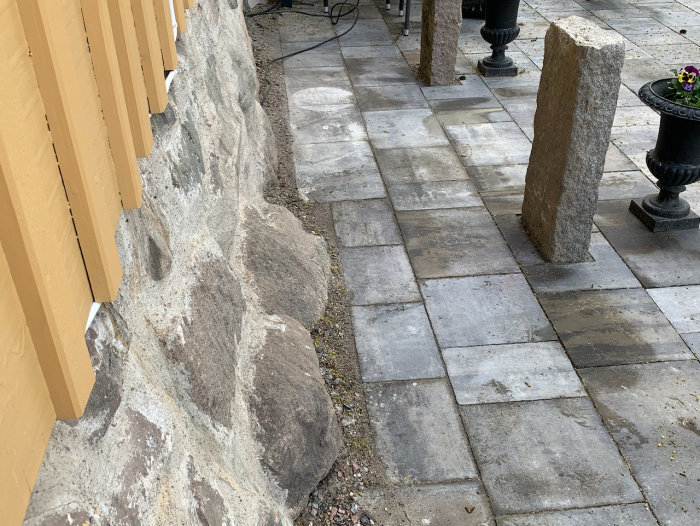
 It probably doesn't matter if you use franskskruv or some type of wafers, both hold incredibly well. Personally, I prefer waf screws because the head is larger on them, so you can tighten much harder without the head being pulled too deep, and if you don't have a brutal machine to tighten with, you almost have to pre-drill so it's not too hard on the machine. But then which one holds best, I have no idea.