
8,171 views ·
8 replies
8k views
8 replies
Attaching a Bearer to a Brick Facade?
Construction rookie
· 18 posts
I am in the process of rebuilding the roof on my attached garage.
The garage currently has a flat roof with felt covering. The roof beams rest against a supporting beam/bracing that is screwed horizontally into the brickwork on the house side.
I'm planning to convert it to a gable roof with glulam beams as the main supports and leave it open at the ridge. I will have 3 glulam beams 315×115 for the roof rafters to rest on, and 115×115 glulam posts for the main supports.
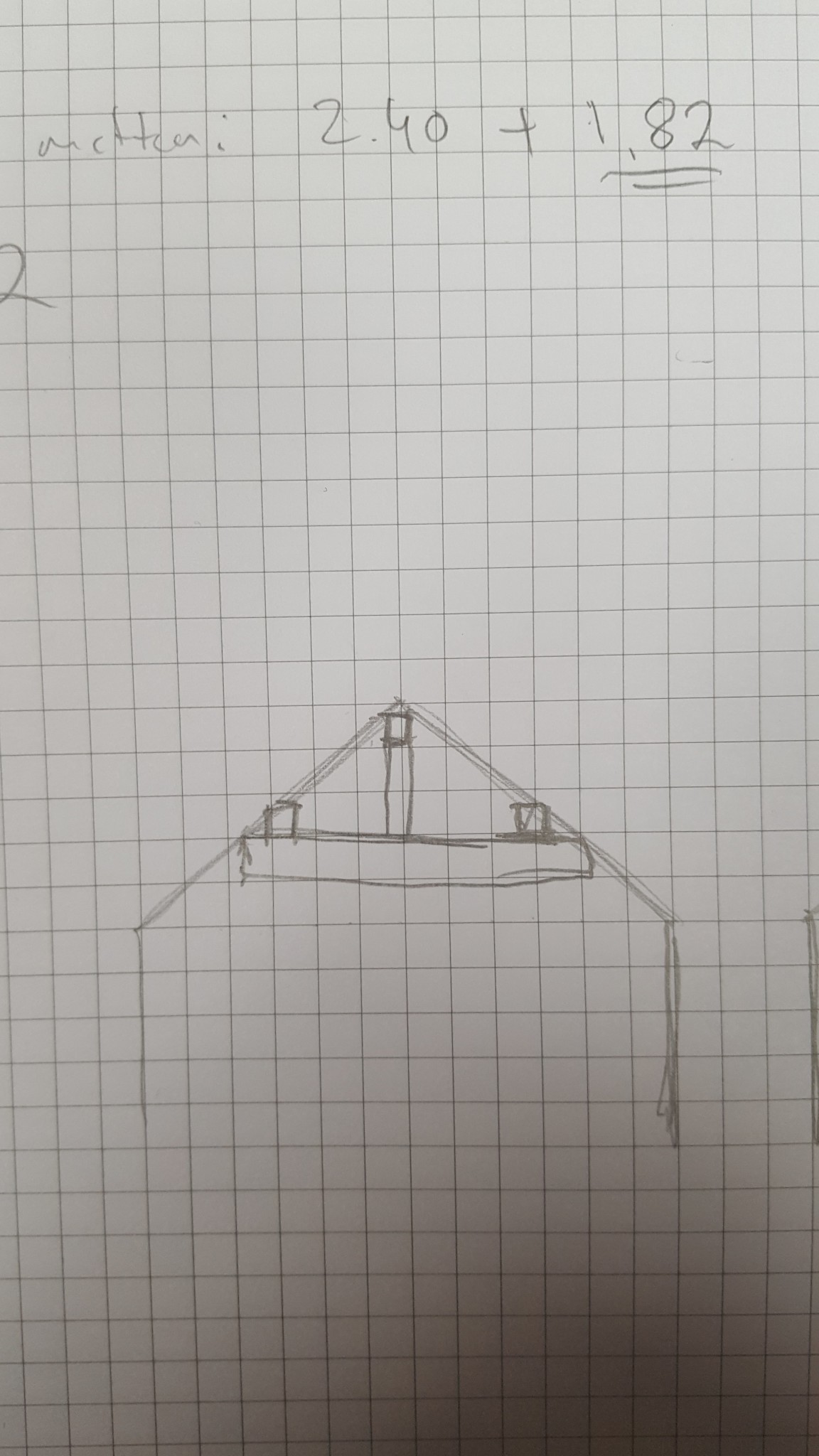
However, there's a problem on the house side where one of the posts ends up right by the basement door, which is in the garage. So the question is whether it would work to relieve the load with a horizontal glulam beam that I attach to the brick and place the post on?
Alternatively, a supporting beam that I attach to the brick, with both outer glulam beams resting directly against it, then just a short post from this support up to the ridge beam.
The question is whether the brick facade can handle this load? The roof will be quite heavy with concrete tiles and insulation inside.
Attached are two really messy drawings as I'm not at my computer
The garage currently has a flat roof with felt covering. The roof beams rest against a supporting beam/bracing that is screwed horizontally into the brickwork on the house side.
I'm planning to convert it to a gable roof with glulam beams as the main supports and leave it open at the ridge. I will have 3 glulam beams 315×115 for the roof rafters to rest on, and 115×115 glulam posts for the main supports.
However, there's a problem on the house side where one of the posts ends up right by the basement door, which is in the garage. So the question is whether it would work to relieve the load with a horizontal glulam beam that I attach to the brick and place the post on?
Alternatively, a supporting beam that I attach to the brick, with both outer glulam beams resting directly against it, then just a short post from this support up to the ridge beam.
The question is whether the brick facade can handle this load? The roof will be quite heavy with concrete tiles and insulation inside.
Attached are two really messy drawings as I'm not at my computer

Construction rookie
· 18 posts
I would prefer to just attach a ledger rule to the wall and avoid posts going down to the slab, but the question is how much load a brick facade can withstand. I am thinking that the roof I have today is attached in this way, although the current one weighs less, of course.

Your post raises some questions. What kind of brick wall do you have, facade brick or solid brick wall? A facade brick wall doesn't hold up much. There's also a difference between a 45 mm stud and a glulam beam that is 115 mm thick. How did you calculate the dimensions of the glulam beams? They seem quite large. If the gable roof is to lie parallel to the brick facade, you'll have a snow pocket. How were you planning to solve that problem? A post that ends up in a slightly awkward position can always be moved sideways if you compensate for it.
The question is whether you should take a step back and question the main principles.
The question is whether you should take a step back and question the main principles.
Construction rookie
· 18 posts
I understand. It goes a bit fast sometimes
According to the house plans, it's 1/2 stone facade brick anyway.
To clarify, the garage's long side is built against the house's short side/gable. 70s house.
As for the gabled roof, the roof pitch will naturally be an extension of the house's, so to speak, but a bit lower down.
That is, the glulam beams will be parallel to the garage's short side or out from the brick wall if you prefer.
So there shouldn't be any talk of a snow pocket if I interpret it correctly.
The calculation with the bearing beams hasn't been done since these questions have come up now that I'm double-checking everything.
But there is no strength calculation of the brick facade.
The roof's dimensioning calculation has been done via byggbeskrivningar.se so I don't see any problem there.
The garage is 4.5m with a span of 8m.
Sure, I can have the columns as I originally planned, but it will be a little awkward just by the basement door as mentioned. That's why these considerations about bearing beams came up, so to speak.
I can get glulam beams cheaply, so if there is a possibility with load-bearing, it would be preferable to have some kind of support, so to speak.
Am I making myself understood?
According to the house plans, it's 1/2 stone facade brick anyway.
To clarify, the garage's long side is built against the house's short side/gable. 70s house.
As for the gabled roof, the roof pitch will naturally be an extension of the house's, so to speak, but a bit lower down.
That is, the glulam beams will be parallel to the garage's short side or out from the brick wall if you prefer.
So there shouldn't be any talk of a snow pocket if I interpret it correctly.
The calculation with the bearing beams hasn't been done since these questions have come up now that I'm double-checking everything.
But there is no strength calculation of the brick facade.
The roof's dimensioning calculation has been done via byggbeskrivningar.se so I don't see any problem there.
The garage is 4.5m with a span of 8m.
Sure, I can have the columns as I originally planned, but it will be a little awkward just by the basement door as mentioned. That's why these considerations about bearing beams came up, so to speak.
I can get glulam beams cheaply, so if there is a possibility with load-bearing, it would be preferable to have some kind of support, so to speak.
Am I making myself understood?
Construction rookie
· 18 posts

Construction rookie
· 18 posts

I have checked the calculation regarding the glulam beams, and it seems to be correct. It's the large span of 8 meters that's causing the issue.
If you want to install a transverse glulam beam to replace one or both of the inner pillars, that's certainly possible. Each longitudinal beam then represents a point load of about 15 kN.
Facade brick should preferably not be loaded except very minimally. Exclude it from the solution.
If you want to install a transverse glulam beam to replace one or both of the inner pillars, that's certainly possible. Each longitudinal beam then represents a point load of about 15 kN.
Facade brick should preferably not be loaded except very minimally. Exclude it from the solution.
Construction rookie
· 18 posts
Yes, it will be a bit of a stretch
But as long as I gain some ceiling height compared to the current one, I'll be satisfied.
The plan is to drive up and cast down a scissor lift in the floor once the ceiling and everything is finished
Thanks for the response anyway. I'll be looking for a sustainable, aesthetically pleasing solution if possible. Otherwise, it will have to be as originally planned.
/jocke
But as long as I gain some ceiling height compared to the current one, I'll be satisfied.
The plan is to drive up and cast down a scissor lift in the floor once the ceiling and everything is finished
Thanks for the response anyway. I'll be looking for a sustainable, aesthetically pleasing solution if possible. Otherwise, it will have to be as originally planned.
/jocke
Construction rookie
· 18 posts
Without attachment to the tiles, of course...J Joakim Jokko Pettersson said:Yes, there will be a bit of range
But as long as I gain some ceiling height compared to the current situation, I will be satisfied.
The plan is to dig up and install a scissor lift in the floor once the roof and everything is finished
Thanks for the response anyway. I’ll look into finding a durable, aesthetically appealing solution if possible. Otherwise, I'll stick with the original plan.
/jocke
Click here to reply