
Having read a lot of good stuff, it's time to ask the first question.
I'm going to build a fence around the property and have an idea regarding the attachment of posts that I want to discuss with you.
Today, I have a fence around the property that sits on good old steel posts that are cast in concrete foundation blocks. They have been there for a long time, we moved in 12 years ago and they weren't exactly new even then.
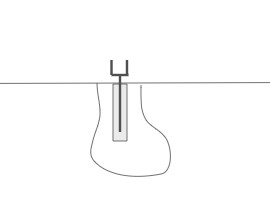
What I'm considering is if I can saw off the posts along the concrete and then insert a post shoe and fill it with concrete. I stopped a measuring stick into the post, and there is about a 15-20 cm cavity to pour into, and the diameter is about 4 cm.
The foundation blocks are very solid, and if I can avoid having to dig them up just to cast new ones, it would be quite nice.
Am I making it too easy for myself and the fence will collapse with the first gust of wind, or do you think it could work?
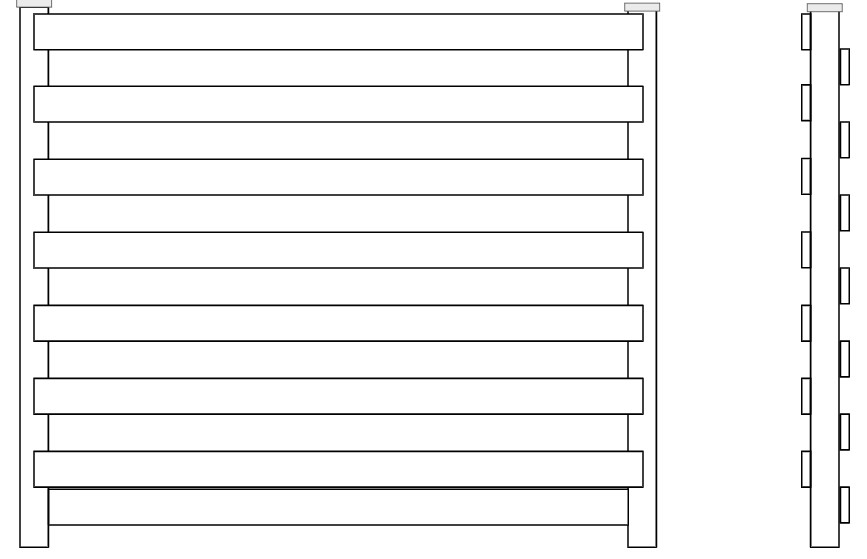
The fence will be 180 cm high, I'm attaching a drawing of the fence and a quick sketch of my idea.
I'm going to build a fence around the property and have an idea regarding the attachment of posts that I want to discuss with you.
Today, I have a fence around the property that sits on good old steel posts that are cast in concrete foundation blocks. They have been there for a long time, we moved in 12 years ago and they weren't exactly new even then.
What I'm considering is if I can saw off the posts along the concrete and then insert a post shoe and fill it with concrete. I stopped a measuring stick into the post, and there is about a 15-20 cm cavity to pour into, and the diameter is about 4 cm.
The foundation blocks are very solid, and if I can avoid having to dig them up just to cast new ones, it would be quite nice.
Am I making it too easy for myself and the fence will collapse with the first gust of wind, or do you think it could work?
The fence will be 180 cm high, I'm attaching a drawing of the fence and a quick sketch of my idea.

It depends a bit on how deep the existing plinths go, but the idea is sensible, and I would probably try to do that just because the method is incredibly simple. If it goes wrong, you can just dig around them and cast around so they stay there, but if you say they are rock solid, it should hold up well from the start, I think.RikDem said:
After reading a bunch of good stuff, it's time to ask the first question.
I'm going to build a fence around the property and have an idea regarding the mounting of posts that I want to discuss with you.
Today I have a fence around the property that sits on old-fashioned steel posts set in concrete plinths. They've been there a long time; we moved in 12 years ago and they weren't exactly new then either.
What I'm considering is if I can saw off the posts along the concrete and then insert a post shoe and fill up with concrete. I inserted a ruler into the post and there is about 15-20 cm of cavity to cast in and the diameter is about 4 cm.
The plinths are rock solid and if I can avoid having to dig them up just to cast new ones it would be pretty nice.
Am I making it too easy on myself and the fence will topple at the first gust of wind, or do you think it might work?
The fence will be 180 tall, attaching a drawing of the fence and a quick sketch of my thoughts.
I don't think you have anything to lose by doing it the way you describe.
Cut the posts off as far as you can, insert the post holders as far as they go, fix them in the correct position so they are plumb and level, and pour in expanding concrete. You practically have to use expanding concrete for this to work well.
It's a good idea to cover it with some plastic and water it for the next 2-3 days to make sure the casting is really solid.
I think this could turn out great. The only thing that might happen is that the metal from the cut-off posts starts to rust around the casting, but that's a future problem if so. For the same reason, I think you should pour enough concrete to cover the metal thoroughly so it's not exposed to too much moisture. Keep in mind that expanding concrete flows very easily, so make a small dam of soil or something similar around it, so the concrete stays there and covers the metal.
Hope this becomes your best answer! Good luck with the project!


Homeowner
· Västerviks kommun
· 465 posts
You need to have at least two fastenings for the post, otherwise, you will never achieve stability. Use this type and it will become significantly more stable. https://www.byggmax.se/plintjärn-p729168
You can use the concrete plinths if they are as stable as you describe.
You can use the concrete plinths if they are as stable as you describe.
But he can't possibly fit 2 of those with a 95 mm gap (the thickness of the post) in the existing foundations. He can only fit post holders with a centered rod.
What he can do is what I wrote, and if so, complement with diagonal braces anchored to new foundations about 30-40 cm inside the fence. These can then be attached to each post, every other post, or every third post, depending a bit on how stable it is from the start. If it's very stable, maybe every 3rd post is enough. If it's very wobbly, then every post is suitable, and so on.


Building with post shoes for a 180cm high fence is just out of the question. It will sway extremely and buckle with a slight breeze....
Sure, you can stabilize it with diagonal braces, but how nice does that look?
Sure, you can stabilize it with diagonal braces, but how nice does that look?
Click here to reply