
18,998 views ·
15 replies
19k views
15 replies
Attach glulam beam + pillar
Hello!
We are planning to tear down a load-bearing wall and have therefore had an engineer calculate the beam and the columns that will replace it.
Now I'm thinking about the "best" way to attach these to each other? I have checked around on the forum and concluded that angled screwing or some form of joint (like splice plates?) is the way to go.
Does anyone have other tips or ideas about this?
And should one also attach the beam to the rafters with, for example, angle brackets?
And the columns to the floor with the same solution?
We are planning to tear down a load-bearing wall and have therefore had an engineer calculate the beam and the columns that will replace it.
Now I'm thinking about the "best" way to attach these to each other? I have checked around on the forum and concluded that angled screwing or some form of joint (like splice plates?) is the way to go.
Does anyone have other tips or ideas about this?
And should one also attach the beam to the rafters with, for example, angle brackets?
And the columns to the floor with the same solution?

Screwing the beams is a bit tricky. Screws are not just screws. The solution that people have most often seen, and that works, is with special WT-T double-threaded screws from sfs. These work excellently but cannot be used just any way; they require correct installation to provide support. Just putting in a couple of leftover decking screws or similar does not have much effect, you might as well not bother. (If the frame only supports vertically, then you actually don't need any fastening anywayspock said:Hi! We are planning to demolish a load-bearing wall and have therefore hired a structural engineer to calculate the beam and columns that will replace it. Now I'm sitting and thinking about the "best" way to attach these to each other. I have looked around the forum and concluded that angled screwing or some form of joint (like splice plate?) is the way to go. Does anyone have other tips or ideas about this?
And should you also attach the beam to the rafters with, for example, angle irons? And the columns to the floor with the same solution?
 )
)The easiest, if the joint is not visible, is as mats_o says, to nail on plates.
I had planned to plaster in all of it anyway, so it leans towards using plates. There will be a pole at each end of the beam, where one stands against an outer wall. Should I angle these against the floor chipboard? I'm mostly thinking about the pole that ends up out in the room so it stays in place after any collisions with small children .
And should you/should you angle the beam against the rafters?
And 'yes', the beam and poles are of the same dimension.
. And should you/should you angle the beam against the rafters?
And 'yes', the beam and poles are of the same dimension.
Last edited:
Depending on how large the load is on your pillar, it might be an idea to let the pillar pass down through the floor to the lecan directly. Wood takes significantly less load across the fibers.
Angle iron is a good solution otherwise. Same goes for the roof trusses.
Angle iron is a good solution otherwise. Same goes for the roof trusses.
Ask the constructor.
However, placing a glulam post on a horizontal 40 (45?) beam feels questionable. If the support for this then consists of wedges, the bearing surface there is very small. The risk is that the short beam deforms, resulting in the floor chipboard cracking.
However, placing a glulam post on a horizontal 40 (45?) beam feels questionable. If the support for this then consists of wedges, the bearing surface there is very small. The risk is that the short beam deforms, resulting in the floor chipboard cracking.
I can only agree with Krawk.
Since you need a glulam beam, we're probably talking about quite a bit of weight. That weight will be transferred to the pillars and what is below the pillars should be stronger than the pillars and beam, otherwise you risk having a problem there.
Since you need a glulam beam, we're probably talking about quite a bit of weight. That weight will be transferred to the pillars and what is below the pillars should be stronger than the pillars and beam, otherwise you risk having a problem there.
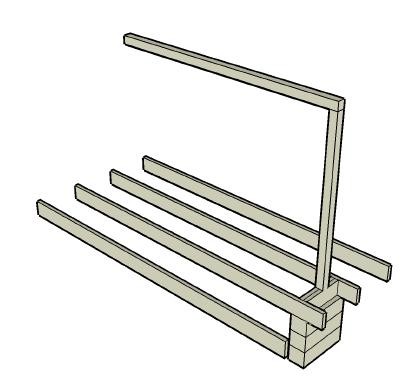
I had at least checked the deformations in the noggings.
Even with respect to creep with increased moisture content since the underside of the nogging is cold (?).
It's nothing that will cause the house to collapse, but there's a risk of sagging around the column that would be difficult to repair.
I see no reason not to extend the column through the floor structure. Then you can also secure it to the floor joists with a nogging on each side.
Even with respect to creep with increased moisture content since the underside of the nogging is cold (?).
It's nothing that will cause the house to collapse, but there's a risk of sagging around the column that would be difficult to repair.
I see no reason not to extend the column through the floor structure. Then you can also secure it to the floor joists with a nogging on each side.
Thank you for the feedback!
I have rethought it and am planning to take the pillars down through the flooring. But as you already mentioned, what about the cold and some moisture in the crawl space? How does the glue-laminated timber get affected by this?
I have rethought it and am planning to take the pillars down through the flooring. But as you already mentioned, what about the cold and some moisture in the crawl space? How does the glue-laminated timber get affected by this?