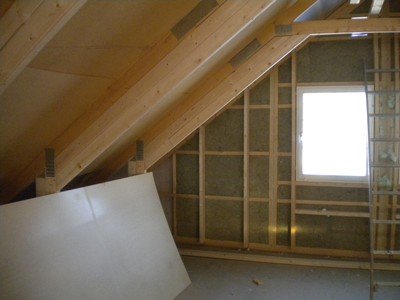
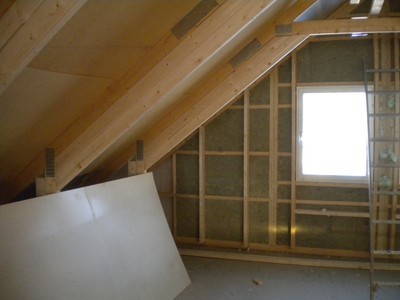
I currently have a sloped ceiling (which I've torn open to the sheath) with 4 visible rafters at CC ~960 mm. I plan to add lying 45x45 mm battens to make room for a bit more insulation. The 45x45 battens are intended to be set at CC 600 mm. Each 45x45 batten will have 4 attachment points. A vapor barrier will then be attached to these battens, and after that, vertical 28x70 mm battens with CC 300 measurements for plasterboard. My question is how best to attach the 45x45 battens that will "carry" the vertical battens and plasterboard. Is it sufficient with 1 screw per rafter, i.e. 4 screws per batten, or are more recommended? What screw dimensions? I'm considering 6x80 C4 (mainly because I have some left over). Is that sufficient, or should thicker screws be preferred with such few attachment points?
6x80 works fine. Preferably not fully threaded. They pull the timber together a bit worse. It's probably enough with 4 screws per beam. Alternatively, you can place two screws slightly at an angle in each rafter. In that case, preferably with a slightly longer screw.
If you're still a bit worried, you can indulge in an angle bracket on the inside. They probably cost about 6-7 SEK each plus some small screws.
I have probably misunderstood what you are supposed to do, but you usually add onto the actual roof truss to make room for more insulation, then you can screw in as many screws as you want.
The cross battens are then attached perpendicular to the roof trusses.
I may have misunderstood what you are doing, but you usually increase the size of the roof truss itself to make room for more insulation, then you can screw as many screws as you want. You then attach the battens perpendicularly to the roof trusses.
[image]
The room is not that large, so I don't want to add too much. Another reason is that I will place 120mm insulation between the roof trusses and 45mm insulation perpendicular to this (in the new studs) to reduce the thermal bridge a bit.
Is it masonite you used for the construction of the air gap? I myself plan to use wind barrier fabric for the outer layer and paper for the inner layer. I will use linisolering.
The image is borrowed, just wanted to show what I mean.
If you want to screw them in with your 6*80, you have to pre-drill, as I said. 5*100 feels better if you don't want to bother drilling.
Get 80 mm screws with a 45 mm neck length. I had pre-drilled and used double screws or bought 6.0x120 mm. Don't you think the air gap gets compressed when you insulate against the fabric?
Get 80 mm screws with a 45 mm neck length. I would have pre-drilled and used double screws or bought 6.0x120 mm. You don't think the air gap will be compressed when you insulate against the fabric?
The thought has crossed my mind, but I'm screwing 25x35 battens on each side between the rafters and 1 batten in the middle of the compartment to prevent the insulation from pushing the windbreak fabric against the roof sheathing. I hope this will be enough to at least have a minimum of 20 mm gap where the insulation might push a little extra.
I usually do the same, but I use oil-hardened fiberboard to create the air gap...
I was recommended fabric instead of fiberboard in connection with flax insulation, the argument was that fiberboard is too dense. What is right I do not know, but in this case (about 11 m2 of sloped ceiling) I thought I would go according to the recommendation from isolina.
Click here to reply
Vi vill skicka notiser för ämnen du bevakar och händelser som berör dig.