
1,143 views ·
11 replies
1k views
11 replies
Asbestos-treated wood wool panels?
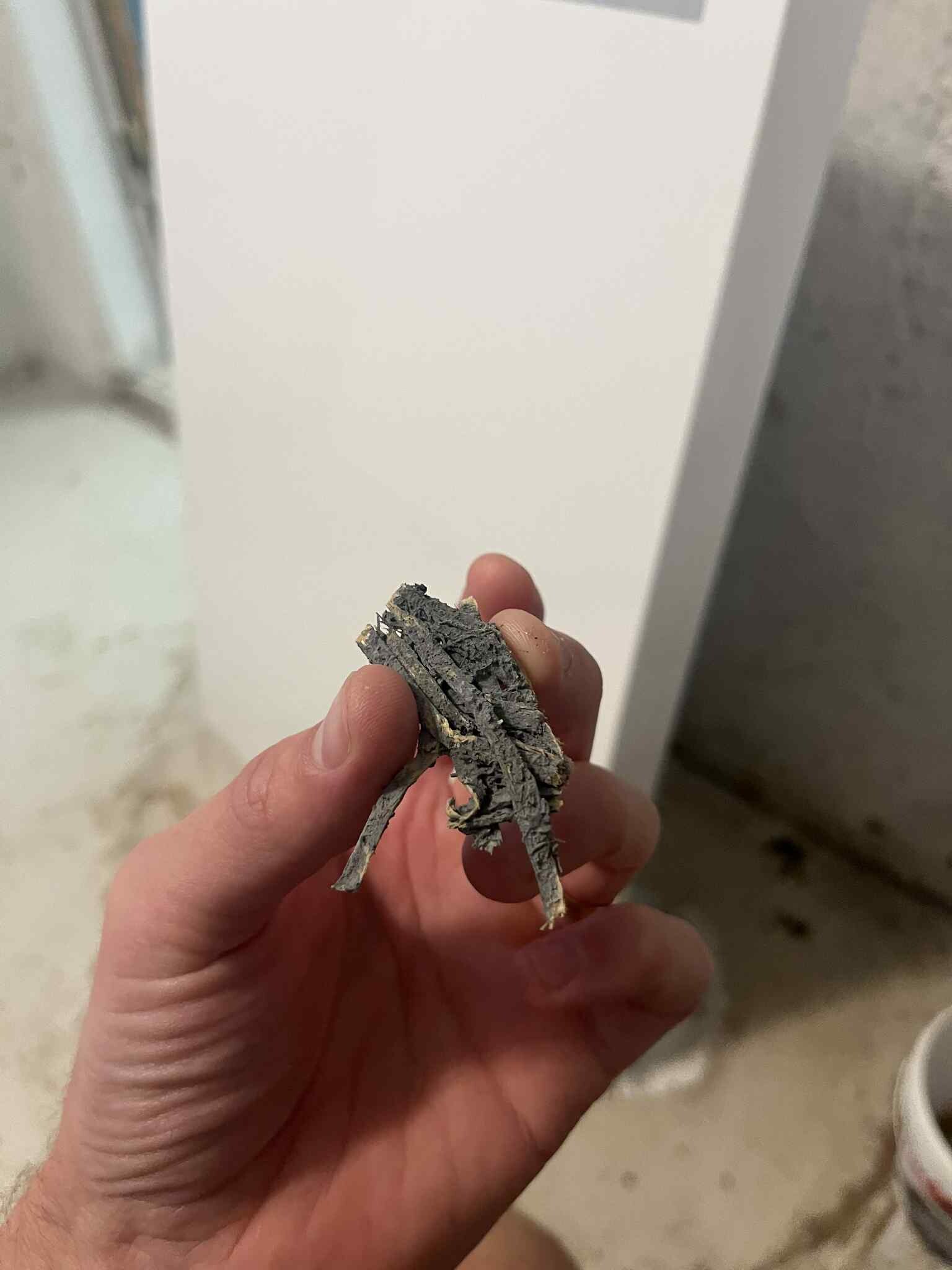
Could this be asbestos/asbestos-treated?
This is from the ceiling in a boiler room in the basement of a house built in 1934. When I made a hole in the joists between the floors, a bunch of these bluish-gray compressed rods/fibers fell onto the floor.
The ceiling seems to be some kind of boards with compressed fibers of the bluish-gray material in the pictures, and then a thin layer of plaster on top.
The first picture is of a lump of fibers and the second picture is of the hole in the ceiling where you can see a bit of the context.
This is from the ceiling in a boiler room in the basement of a house built in 1934. When I made a hole in the joists between the floors, a bunch of these bluish-gray compressed rods/fibers fell onto the floor.
The ceiling seems to be some kind of boards with compressed fibers of the bluish-gray material in the pictures, and then a thin layer of plaster on top.
The first picture is of a lump of fibers and the second picture is of the hole in the ceiling where you can see a bit of the context.


Smart alek
· östergötland
· 2 818 posts
From here, we can only guess..
If you're worried, send for testing
If you're worried, send for testing

Self-builder
· Stockholm
· 8 646 posts
Never heard of asbestos in such boards.
But the question is what you should do with the information?
Are you going to drill more holes?
Otherwise, it's probably best just to leave it, regardless of asbestos or not.
But the question is what you should do with the information?
Are you going to drill more holes?
Otherwise, it's probably best just to leave it, regardless of asbestos or not.
Thanks for the reply. No, but the entire boiler room is sprinkled with this after renovation, and it has probably spread around half the basement. It hasn't been cleaned up since the kitchen renovation, so I just need to know how "urgent" it is and how it should be cleaned before I just grab a broom and a regular shop vacuum.

As mentioned, it looks like "ordinary" träullit. Whether such material has ever been mixed with asbestos, I have no idea. But it's unlikely.
I carry out renovations more according to: If it's not proven or obvious, or materials that are likely to contain asbestos (e.g., tile adhesive/grout from the 1960s), I assume it's not asbestos. But treat all construction dust as hazardous to health. Use a protective mask; the dust is harmful regardless of whether it contains asbestos.
If you renovate an entire house, or several over your lifetime, without respiratory protection, the risk is greater that you'll suffer from lung problems, like COPD, from it than you will from a few instances of asbestos exposure. If, for example, you tear down a bathroom and later discover that there was probably asbestos behind the tiles, it's not a big deal, as long as you don't do it every week. However, if over a long period you renovate a house and daily expose yourself to demolition dust, cement dust when pouring mortar or concrete bags into the mixer, etc., then you have a real risk of developing lung problems.
Use a proper half-mask, not just disposable masks that half the dust passes through.
If you have a good mask on and "accidentally" expose yourself to asbestos, you have reduced an essentially zero risk by an additional 95%.
I carry out renovations more according to: If it's not proven or obvious, or materials that are likely to contain asbestos (e.g., tile adhesive/grout from the 1960s), I assume it's not asbestos. But treat all construction dust as hazardous to health. Use a protective mask; the dust is harmful regardless of whether it contains asbestos.
If you renovate an entire house, or several over your lifetime, without respiratory protection, the risk is greater that you'll suffer from lung problems, like COPD, from it than you will from a few instances of asbestos exposure. If, for example, you tear down a bathroom and later discover that there was probably asbestos behind the tiles, it's not a big deal, as long as you don't do it every week. However, if over a long period you renovate a house and daily expose yourself to demolition dust, cement dust when pouring mortar or concrete bags into the mixer, etc., then you have a real risk of developing lung problems.
Use a proper half-mask, not just disposable masks that half the dust passes through.
If you have a good mask on and "accidentally" expose yourself to asbestos, you have reduced an essentially zero risk by an additional 95%.
Thanks for the good answer! I've understood that a lot depends on exposure time, but it has been there for several months, and even though the basement is not furnished, we go down daily to do laundry, etc. So I was mostly wondering if anyone has heard of asbestos in such panels, if it should be sent for testing, how thoroughly I should clean, or if professional cleaning is needed.H hempularen said:As I said, it looks like "ordinary" wood wool panels. But if such has ever been mixed with asbestos, I have no idea. But not likely.
I do renovations more according to: If it’s not proven or obvious, or materials likely to contain asbestos (e.g., tile adhesive/grout from the 60s), I assume it's not asbestos. But I handle all construction dust as hazardous to health. Use a protective mask; the dust is harmful to health regardless of whether it contains asbestos.
If you renovate an entire house, or several during your lifetime, without respiratory protection, the risk is greater that you will suffer from lung problems, like COPD. More so than getting sick from a few instances of asbestos exposure. If, for example, you tear down a bathroom and later discover there was probably asbestos behind the tiles, it's not a problem, as long as you don't do it every week. But if you renovate a house over a long time, and daily expose yourself to demolition dust, cement dust when pouring mortar or concrete bags into the mixer, etc., then you have a real risk of developing lung problems.
Use a proper half-mask, not just disposable masks that let half the dust through.
If you have a good mask on and "accidentally" expose yourself to asbestos, you have reduced an already negligible risk by an additional 95%.
Last edited:

Thank you, do you know if asbestos has ever been used (due to fire protection in e.g. boiler rooms) in träulllit (or similar boards), perhaps there were several manufacturers, etc.? The house was built in '34 but I don't know if the ceiling is from the construction year or not.F fribygg said:
Last edited:
As far as I know, there is only wood and cement in träullit, but contact Träullit AB and ask if you are concerned.M MARTINOV said:
Click here to reply