
Living in a one-story house with a basement from the 60s.
Divided into 2 sections (an angled house), one section is the living room on the upper floor and the recreation room in the basement. The other section is the rest of the house.
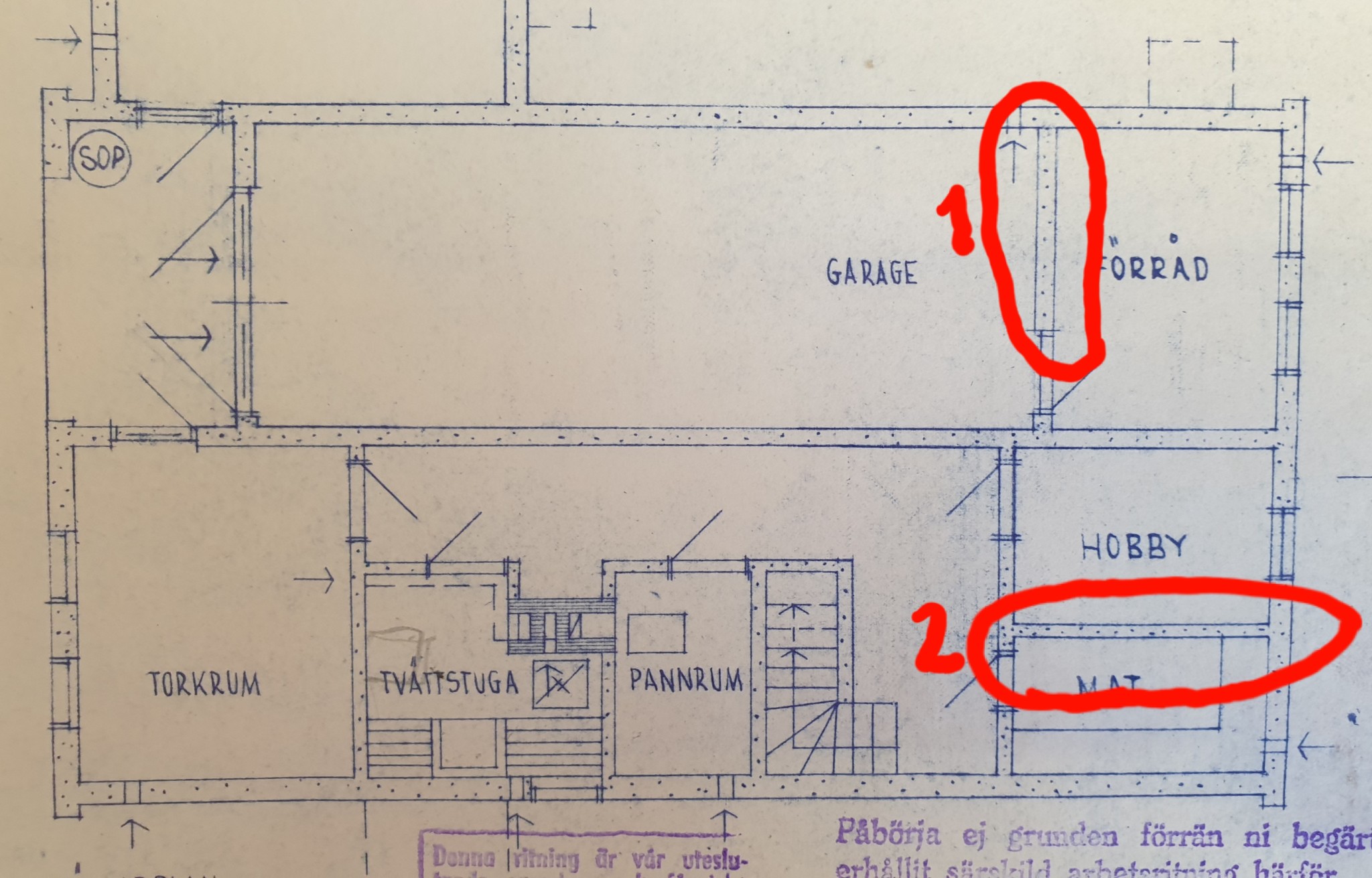
We are going to renovate the basement now and are considering tearing down walls 1 and 2 shown in the picture (which belong to the other section, i.e., the rest of the house).
Both walls are made of brick and not concrete blocks as the dots on the drawing indicate, which makes me question if I'm interpreting the drawing correctly
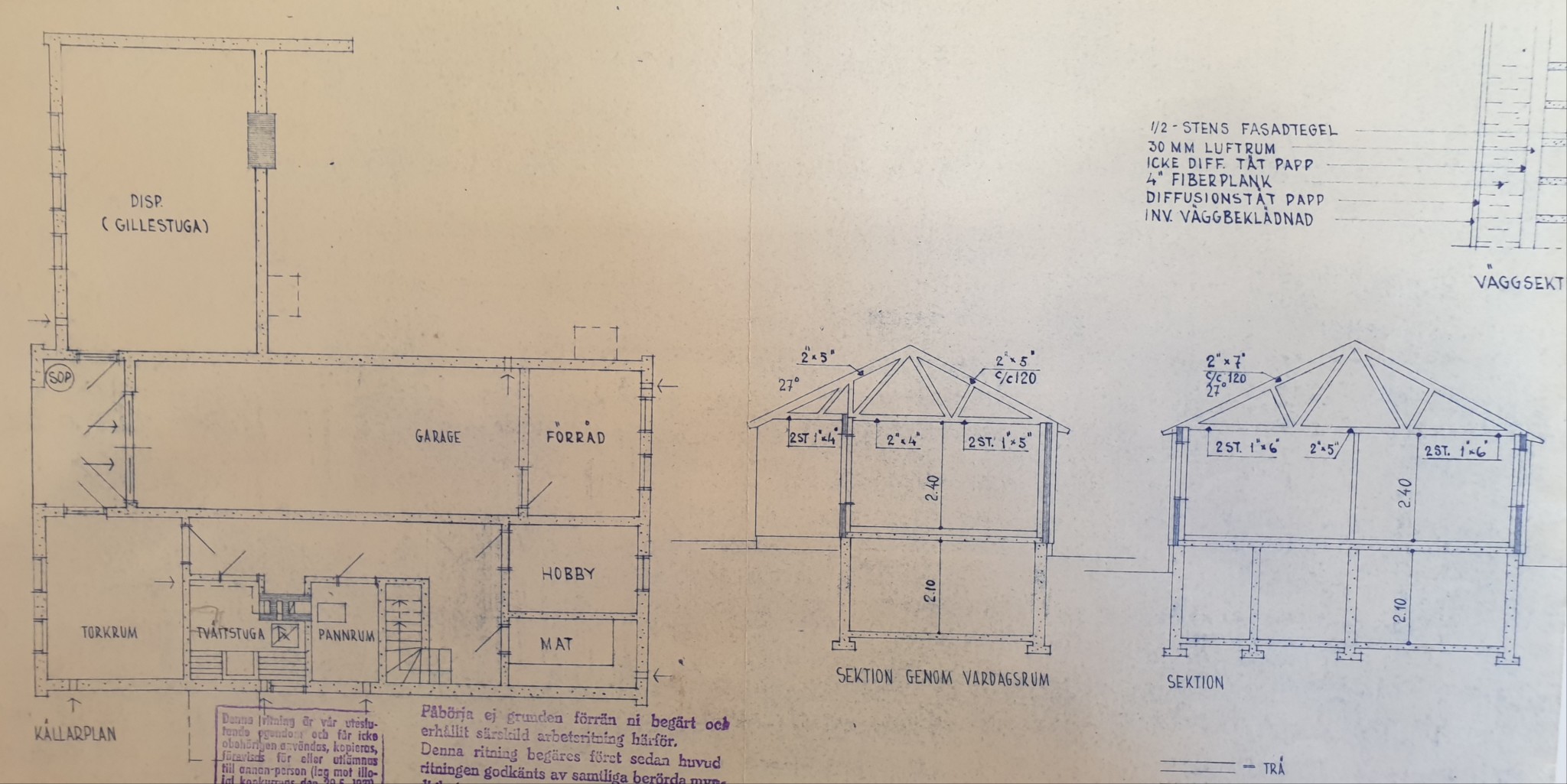
I am quite sure that wall 1 is not load-bearing, partly due to its direction and partly if I interpret the drawing for the section correctly.
Wall 2 seems to be load-bearing according to the drawing, but doesn't it feel like it's too small to be load-bearing? I mean, it's not particularly long?
Maybe I'm interpreting the drawing wrong? I'm looking at the 4 walls visible in the section part and thinking they must be load-bearing?
Can I at least assume that wall 1 is not load-bearing?
Divided into 2 sections (an angled house), one section is the living room on the upper floor and the recreation room in the basement. The other section is the rest of the house.
We are going to renovate the basement now and are considering tearing down walls 1 and 2 shown in the picture (which belong to the other section, i.e., the rest of the house).
Both walls are made of brick and not concrete blocks as the dots on the drawing indicate, which makes me question if I'm interpreting the drawing correctly
I am quite sure that wall 1 is not load-bearing, partly due to its direction and partly if I interpret the drawing for the section correctly.
Wall 2 seems to be load-bearing according to the drawing, but doesn't it feel like it's too small to be load-bearing? I mean, it's not particularly long?
Maybe I'm interpreting the drawing wrong? I'm looking at the 4 walls visible in the section part and thinking they must be load-bearing?
Can I at least assume that wall 1 is not load-bearing?
You are probably right in your speculations,
1 not load-bearing.
2 possibly load-bearing but probably not.
When you are going to demolish no. 2, place a prop on the side and then feel if there is pressure on them when the wall is demolished. If so, you will need to place a small beam there.
1 not load-bearing.
2 possibly load-bearing but probably not.
When you are going to demolish no. 2, place a prop on the side and then feel if there is pressure on them when the wall is demolished. If so, you will need to place a small beam there.

It doesn't need to be. Here in the apartment, there is an inner wall where only 1 m in the middle is load-bearing. It could also be that a load-bearing wall first follows a line and then shifts sideways to another line.R ravve007 said:
It's likely that the basement walls on the sectional drawing are load-bearing.R ravve007 said:
When it comes to basement walls, you also need to consider that those underground are subjected to significant pressure from the soil and may require interior walls (parts of interior walls) to withstand it.
That's not reliable. There might not be noticeable pressure when you demolish it, but there could be significant pressure when there's a lot of snow on the roof.larsbj said:
Last edited:
But there is no load-bearing wall above that could transfer snow load down.BirgitS said:
Moreover, the roof trusses are self-supporting.
Okay, placing something heavy on top there in the future (aquarium, kitchen island, etc.).
Yes, so probably no walls on the ground floor are load-bearing, but the basement walls should support the floor structure. You can see from the section drawing that there are reinforcements under the base plate under the drawn walls.
It can of course be load-bearing for the floor structure, but if so, they must have made it weaker there than in other places, which seems unlikely. And it would be noticeable, and a beam would be needed.Okay, place something heavy on top there in the future (aquarium, kitchen island, etc.).
Yes, so likely no walls on the entrance floor are load-bearing, but the basement walls should support the floor structure. You can see on the sectional drawing that there are reinforcements under the foundation slab beneath the drawn walls

Wall 1 is stabilizing in relation to the garage's rather long exterior wall. Should not be demolished without another measure with the same effect. I find it hard to believe that wall 2 would be load-bearing. The section is misleading as not only load-bearing walls are drawn. However, I would like to see a technical description before I say anything for sure. The house is some form of prefabricated house, which the fiber planks in the ground floor's exterior walls reveal. Prefabricated houses can have a slightly odd construction.
Thank you for all the answers! What I'm concluding is that I don't dare to take down wall 2, it feels too risky without being sure if it's actually load-bearing. It struck me that the chimney, which is at the same distance from the exterior wall as wall 2, might be the one shown on the sectional drawing as load-bearing, and not wall 2. On the other hand, the chimney goes all the way up to the roof, which leads me back to thinking that it must be wall 2 shown on the drawing.
Regarding wall 1: it seems reasonable that it would support the long exterior wall. Please explain more about what should be done if we want to demolish it. We were thinking of building a new wall about 1.5 meters behind wall 1, so this new wall could support the exterior wall instead - but I'd appreciate tips on how the wall should be built (beams, brick?). Is it the long exterior wall that needs support, or is it the roof?
Regarding wall 1: it seems reasonable that it would support the long exterior wall. Please explain more about what should be done if we want to demolish it. We were thinking of building a new wall about 1.5 meters behind wall 1, so this new wall could support the exterior wall instead - but I'd appreciate tips on how the wall should be built (beams, brick?). Is it the long exterior wall that needs support, or is it the roof?
My comment on wall 1 is of a more general nature. Masonry walls cannot be of unlimited length and height. How long and how high they can be depends on the type of material, presence of ground pressure, etc. If the new wall is placed so that the storage becomes larger and is made of masonry, I don't see any problems.
Click here to reply