The short version is to try to keep your wood dry, then it won't rot. Rot spores occur naturally, and a rotting deck doesn't make a difference one way or another. If the right conditions for rot are present in the house, it will rot regardless of a rotting deck or not.
Rot fungi are a group of microorganisms capable of breaking down wood structures. Rot fungi can break down cellulose, hemicellulose, and, in some cases, lignin in the wood. The decomposition products are absorbed into the hyphae for use in metabolism. The breakdown of the wood quickly deteriorates the strength of the timber. For rot fungi to establish and grow in timber, the fungus requires access to moisture. The required moisture content varies between different fungal species, but it must be above 20% for any fungus to cause rot damage.
Rot fungi are divided into three different groups: brown rot, white rot, and soft rot. Brown rot is the most common type of rot attack in buildings. A heavy attack by a brown rot fungus results in wood that turns brown and develops cracks, dividing the wood into cube-like pieces. The strength of the timber is already compromised early in an attack.
White-rot fungi mainly attack wood from deciduous trees, and white rot is therefore not as commonly found in buildings. In an attack, the wood turns white and does not crack into cubes but becomes fibrous.
Soft rot can occur on the surface of construction elements exposed to high moisture loads over a long period, such as window frames. The wood eventually develops small surface cracks. The fungi that cause soft rot can tolerate the low oxygen content of a water-saturated material. Wood affected by soft rot loses much of its strength. Examples of mold genera that can develop into soft rot include Chaetomimium, Humicola, and Petriella.
Rot fungi spread via spores carried by the air. Spores germinate and develop hyphae if they come into contact with wood with suitable moisture content and temperature. Timber can be affected by rot fungi without any fruiting body having formed. Various factors determine if and when fruiting bodies form, such as moisture, temperature, fungal species, season, etc.
Common species
Common wood-decaying fungi found in buildings are the cellar fungus (Coniphora puteana), house fungus (Serpula lacrymans), and rot fungi from the genus Antrodia sp. House fungus and cellar fungus are commonly found in moisture-damaged crawl spaces and basements, in bottom floors, sill plates, blind floors, and hollow spaces, as well as alongside wet areas and kitchens. The house fungus can quickly cause significant rot damage, often requiring extensive renovation measures.
Rot damage caused by the genus Antrodia is commonly found on the building's upper floors and in attics.
Conditions for establishment and growth
For rot fungi to establish and grow, the following conditions are required:
the temperature must be between +0°C and +40°C, with an optimum between +15°C and +30°C
the moisture content must be between 20% and 120%, with an optimum between 40% and 80%, depending on the fungal species
there must be access to oxygen
the pH must be between 2 and 7, with an optimum at pH 5.
Some rot fungi can attack wood even under other conditions.
However, there is one rot fungus that can establish and grow even at very high moisture levels. It is the pile fungus, Rigidiporus vitreus, which attacks piled wood structures—primarily in the zone between air and groundwater.
To avoid rot in wood, building structures should primarily be designed so that the timber's moisture content only briefly exceeds 20%, that is, given a constructive wood protection. For wood used above ground in protected structures, constructive wood protection combined with the right selection of wood is generally sufficient for construction durability. Timber in exposed locations, and where the moisture content exceeds 20% for extended periods, must be given chemical treatment through pressure impregnation or similar. This applies, for example, to decking or wood in contact with the ground.
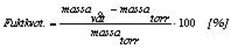
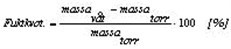
The definition of moisture content allows for the moisture content in wood to be over 100%, which is common in the sapwood of light wood species such as spruce, pine, and alder. In these cases, it means that the water in the wood's cell cavities and cell walls weighs more than the cell walls themselves.
The definition of moisture content allows for the moisture content in wood to be over 100%...
OK, but that's a strange definition! Why not (Wet wood - dry wood) / wet wood? The fact that there could be over 100% water in a board just sounds crazy
OT
======================================================================
Applied to Whisky, Old Turkey 101 proof: (100 grams - 49 grams) / 49 grams = 104%, if we disregard the different density of water/alcohol.
In fact, it is 50.5% alcohol.
======================================================================
OT2
Bartender, what's the recipe for this drink? Well, it’s 50% Gin, 50% Vodka, 25% Martini, 25% ice, and 7% Port wine. But that's more than a hundred percent! Yes, but they're big drinks, too
When the neighbor tore down parts of their weather-beaten dock, I took over some planks and built a small table - even the wife liked the vintage style!
I think you should take a knife and stab the beam..
As it looks in the picture, it's only at the bottom?
Then it will last for ages!
It's not dry rot.
Looks like a natural aging of an outdoor beam.
As long as you don't fall through the deck, it's fine😎
Regards, Henrik
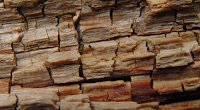
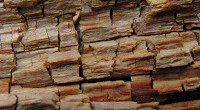
Took some pictures of a wooden part on my deck. Old "wooden beams".
What do you think about this?
Is the wood affected by mold/fungus?
I notice it looks so dark brown and also a bit patterned.
When wood is dry and old otherwise, I think it becomes more gray.
Thinking of dry rot.
Or is it simply "just" rotten old wood?
Should it be replaced/examined immediately?
It has been painted blue, which it still is in some parts.
OK, but that was a strange definition! Why not (Wet wood - dry wood) / wet wood? It sounds crazy for a plank to contain over 100% water
You said it yourself earlier. Ratio, not content. Ratio is the relationship between A and B (division). Content, on the other hand, is the proportion of a substance in a mixture, for example.
Other types of decay fungi also form grid patterns. What you see are heavily dried-out boards partially affected by decay. The brown color suggests it was painted with some stain or tar paint.
If you want to know how urgent it is to replace it, insert a Morakniv into the rotten area to see how deep it's soft. There might be a hard core even if it looks like that...
Yes and no....... This is a natural process because the sun dries out the wood and the rain pushes into gaps, causing discolorations that eventually require the wood to be replaced due to appearance.
All outdoor wood has "mold," becomes discolored, and develops microbial growth. If you call it mold, okay, but it's not really fair to call this mold as I see in the pictures. LEnnart
Is it just me who thinks that wood looks good?
Except for the piece that is a "threshold" to the deck. Nothing to worry about, they will last a long time. If you want to help the wood a bit and maybe stop the process, you could go over it with some oil or tar.
I can somewhat agree with Ronekma and Martenw, as long as the shoe doesn't break through or pose a danger to children, it's just patina in my eyes. If the construction starts to fall apart, you have to act. Otherwise, I would just enjoy and relax in the spring sun.
Vi vill skicka notiser för ämnen du bevakar och händelser som berör dig.