
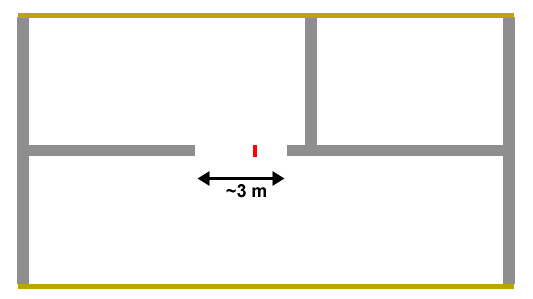
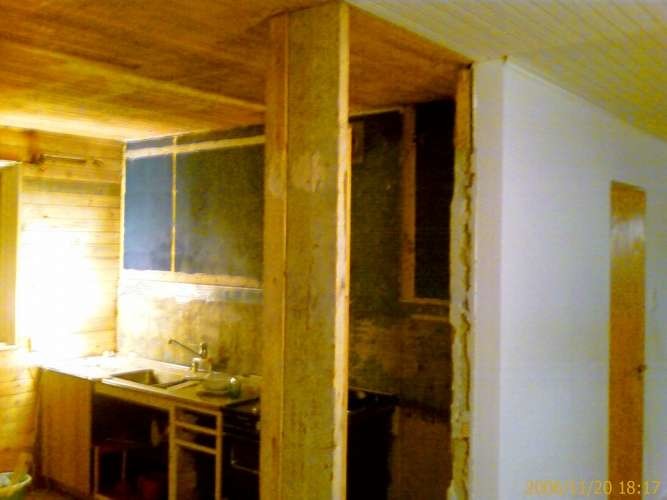
I have a fairly substantial wooden beam (plank measuring 25 cm wide and 6 cm thick) or whatever you want to call it, in the opening of the load-bearing wall in our house (floor-to-ceiling). (the house is a 1.5 story from '57)
The question is whether it is meant to be load-bearing or if it is only there as support for the door frame and hanging wall cabinets that have been attached to the sides between this and the load-bearing wall.
Now, my neighbor has an identical house and he has removed this. However, I am pretty anxious because I don't want the upper floor to come crashing down.
The question is, can a plank measuring 6x25cm be intended as load-bearing?
In the picture here, it is marked in red. Gray is lightweight concrete walls, and the rest is wood.
I will provide a picture tonight as well.
The question is whether it is meant to be load-bearing or if it is only there as support for the door frame and hanging wall cabinets that have been attached to the sides between this and the load-bearing wall.
Now, my neighbor has an identical house and he has removed this. However, I am pretty anxious because I don't want the upper floor to come crashing down.
The question is, can a plank measuring 6x25cm be intended as load-bearing?
In the picture here, it is marked in red. Gray is lightweight concrete walls, and the rest is wood.
I will provide a picture tonight as well.

Not a constructor, but do you have a truss located just above?
My thought is that the aerated concrete is load-bearing, and you have an opening of 3 meters, so a truss should be somewhere in that span, and instead of bridging the door opening, a column has been placed there to avoid issues with sagging. I would think you can remove it without the roof collapsing, but you might get a slight dip in the ceiling.
You could also check if there is a load-bearing element under the plank. I would probably have placed a small steel beam over the opening, just in case, especially if you have a furnished floor above.
My thought is that the aerated concrete is load-bearing, and you have an opening of 3 meters, so a truss should be somewhere in that span, and instead of bridging the door opening, a column has been placed there to avoid issues with sagging. I would think you can remove it without the roof collapsing, but you might get a slight dip in the ceiling.
You could also check if there is a load-bearing element under the plank. I would probably have placed a small steel beam over the opening, just in case, especially if you have a furnished floor above.
Hello,
You were absolutely right! I went up to the attic space, and there are roof trusses (if that's what they're called. In any case, boards that go across the entire house between the ceiling of the lower floor and the floor of the upper floor. The same dimension as this "beam") with CC60.
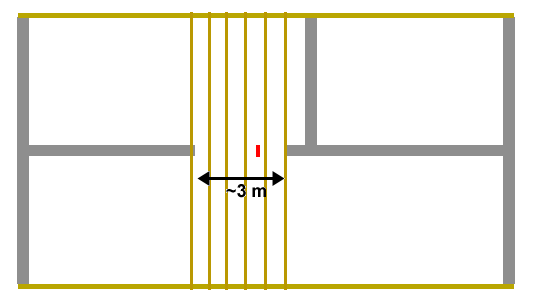
However, there is no truss directly next to this wooden beam; instead, 20cm to the right and 30 cm to the left of it. Then there are several trusses that are not supported. A total of 5 in the entire opening, with the wooden beam sitting between the 3rd and 4th truss. Shown in the drawing below.
Right now, we have unarranged the upper floor, so there is no significant weight on any of these "trusses" (sorry for being bad with terminology). :-/
I am attaching a drawing with the "trusses" drawn in.
More tips and pointers are welcome. There usually are many skilled people here, right?
You were absolutely right! I went up to the attic space, and there are roof trusses (if that's what they're called. In any case, boards that go across the entire house between the ceiling of the lower floor and the floor of the upper floor. The same dimension as this "beam") with CC60.
However, there is no truss directly next to this wooden beam; instead, 20cm to the right and 30 cm to the left of it. Then there are several trusses that are not supported. A total of 5 in the entire opening, with the wooden beam sitting between the 3rd and 4th truss. Shown in the drawing below.
Right now, we have unarranged the upper floor, so there is no significant weight on any of these "trusses" (sorry for being bad with terminology). :-/
I am attaching a drawing with the "trusses" drawn in.
More tips and pointers are welcome. There usually are many skilled people here, right?
Well, now I don't know what it's for anyway. Maybe it was a larger opening once upon a time that has been filled in. I see no problem with removing it in that case. It doesn't bear anything anyway, does it? Maybe someone from the forum knows?
Hey, it's a bit tricky. Either it rests against the shiplap roof board seen in the photo above. It's nailed to the rafters.
Another option is that inside the roof board there is a sturdy board, but I find that hard to believe since the beams there would have to be narrower. Maybe I should go at it with a reciprocating saw and be ready to run.. :-/
Another option is that inside the roof board there is a sturdy board, but I find that hard to believe since the beams there would have to be narrower. Maybe I should go at it with a reciprocating saw and be ready to run.. :-/
One option is to take it easy Take a handsaw and start cutting the beam fairly high up, around 30 cm from the ceiling, so you don't have too much self-weight from the beam. If the saw gets stuck, there's a load on it. That doesn't necessarily mean it's load-bearing, but if it doesn't get stuck, you can relax.
Take a handsaw and start cutting the beam fairly high up, around 30 cm from the ceiling, so you don't have too much self-weight from the beam. If the saw gets stuck, there's a load on it. That doesn't necessarily mean it's load-bearing, but if it doesn't get stuck, you can relax.Yes, that's indeed good..
It should probably work to set a "rule," say 95x95(
95X95 PE FAS FURU SRA) about 3 dm further out along a rafter as a load bearer? It should probably withstand quite a bit of pressure without breaking.
It should probably work to set a "rule," say 95x95(
95X95 PE FAS FURU SRA) about 3 dm further out along a rafter as a load bearer? It should probably withstand quite a bit of pressure without breaking.
Hmm yes, it's probably not impossible... I guess I need to open the ceiling and take a look. hmm... it can't get worse than getting 50 liters of sawdust in my face... I could also drill into the ceiling plank a bit away from the beam (sideways) and see if there's anything there or if I hit the sawdust.
hello and welcome builder.
Still sitting at work, so I will briefly go over a few things.
The load-bearing wall is not in the center of the house. The rooms on each side are 310cm VS 360cm wide. The post is located approximately at 290/370 physically speaking (it's quite wide but not centered).
Tomorrow morning, I will drill a hole in the ceiling plank to see if the post supports more than just the ceiling plank, i.e., if it aligns with the load-bearing wall.
I can already say that underneath there is a concrete slab. That is what the post stands on as it goes past/through the parquet floor that exists. Under the parquet is a lot of sand/gravel, but I assume the post goes all the way down.
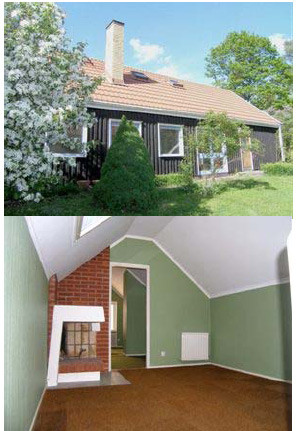
I will check how it looks and get back to you regarding the appearance of the roof trusses. Here is a picture of the house and the upstairs layout.
Still sitting at work, so I will briefly go over a few things.
The load-bearing wall is not in the center of the house. The rooms on each side are 310cm VS 360cm wide. The post is located approximately at 290/370 physically speaking (it's quite wide but not centered).
Tomorrow morning, I will drill a hole in the ceiling plank to see if the post supports more than just the ceiling plank, i.e., if it aligns with the load-bearing wall.
I can already say that underneath there is a concrete slab. That is what the post stands on as it goes past/through the parquet floor that exists. Under the parquet is a lot of sand/gravel, but I assume the post goes all the way down.
I will check how it looks and get back to you regarding the appearance of the roof trusses. Here is a picture of the house and the upstairs layout.
here I am, a bit tipsy just back from poker night.
"The Builder" was absolutely right. I've been poking in a crack in the direction of the load-bearing wall... about 2-4 mm wide in the ceiling plank. First comes a bit of tar paper, but above that, there's something red/orange that's very hard. I poked at it with a narrow chisel and it's much harder/more reflective than concrete or wood. So it seems there might be some sort of steel beam that either spans the entire top of the load-bearing wall or just over the opening +- the load to the load-bearing wall.
I can't bring out the drill since it'll wake up the wife. The easiest might be to cut a small hole in the floor on the upper level and peek just where the beam should be. Right now there's no nice flooring upstairs, just the floorboard that's everywhere in the house. On top of that, there used to be an ugly carpet.
It might be appropriate to make an inspection hole.
In any case, it seems like this post is taking some load off that beam. But shouldn't a 6x20 cm plank be a bit small to offload a steel beam that replaces a load-bearing wall?
PS. What would we do without the people on this forum..
"The Builder" was absolutely right. I've been poking in a crack in the direction of the load-bearing wall... about 2-4 mm wide in the ceiling plank. First comes a bit of tar paper, but above that, there's something red/orange that's very hard. I poked at it with a narrow chisel and it's much harder/more reflective than concrete or wood. So it seems there might be some sort of steel beam that either spans the entire top of the load-bearing wall or just over the opening +- the load to the load-bearing wall.
I can't bring out the drill since it'll wake up the wife. The easiest might be to cut a small hole in the floor on the upper level and peek just where the beam should be. Right now there's no nice flooring upstairs, just the floorboard that's everywhere in the house. On top of that, there used to be an ugly carpet.
It might be appropriate to make an inspection hole.
In any case, it seems like this post is taking some load off that beam. But shouldn't a 6x20 cm plank be a bit small to offload a steel beam that replaces a load-bearing wall?
PS. What would we do without the people on this forum..
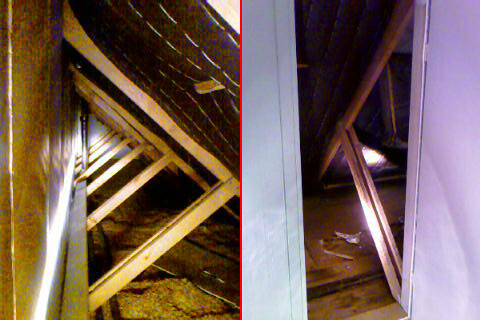
Hello,
I'm neither a mathematician nor do I have a protractor, but I can say that the angle is less than 45. I'll guess it's barely 40. I only have a set square and a level, and it wasn't exactly close to 45.
This has become quite complicated. The house, on the other hand, is "architect-designed," as the seller called it. Not standardized is another fitting term.
It's getting close to cutting time. :-/
What's important to me is really: If I cut it, can the house collapse or take damage? If the floor becomes a bit wobbly or something, that can be fixed if needed. I just don't want to wreck the whole place hehe.
Thanks
I'm neither a mathematician nor do I have a protractor, but I can say that the angle is less than 45. I'll guess it's barely 40. I only have a set square and a level, and it wasn't exactly close to 45.
This has become quite complicated. The house, on the other hand, is "architect-designed," as the seller called it. Not standardized is another fitting term.
It's getting close to cutting time. :-/
What's important to me is really: If I cut it, can the house collapse or take damage? If the floor becomes a bit wobbly or something, that can be fixed if needed. I just don't want to wreck the whole place hehe.
Thanks
