We have installed 4 new interior doors in our hallway, and since this was our first time mounting doors, we unfortunately made a rather awkward mistake. We didn't account for the parquet flooring going under the frames, instead aiming to put small transition strips between the parquet and threshold (as has been done previously in the house). This turned out to be an ugly solution and something to avoid as much as possible, which we now agree with in hindsight.
Another mistake we made during the flooring process was leaving too much clearance around the doors, making it cumbersome to cover gaps with sealant and trim.
This is how it looks today:
#1 Opening to the kitchen, no door here:
You can see there's a gap that can't be covered with a sealant strip (due to the renovation gypsum (6 mm)).
Besides that, our plan is to use a small metal strip to cover the gap just as we had with the previous floor.
#2 Opening to the living room
It may be hard to see, but the floor in the living room (older parquet) doesn't extend under the threshold, which led us to choose the same solution on the other side. In the future, the frame and threshold will be removed here.
Once again, you can glimpse gaps that make it difficult to cover with the sealant strip.
#3 Door to bedroom 1
This is 1/4 doors we installed, and we set it just like the previous door without considering that the parquet should go under the frame. We can also see here that we have been too generous with space around the frames, making it difficult to avoid gaps.
#4 Door to bedroom 2
Similar issues as with #3
#5 Door to bedroom 3
Again similar issues as #3
#6 Door to the toilet
Here we have similar issues even though the door opens outward. Likely, there will also be gap problems here.
The floor is laid with 6-10 mm spacing on all sides, based on the floor manufacturer's advice via phone.
As I see it, there are the following solutions:
1. Take down all new frames, widen the door openings, lay the floor, and finally mount the doors again. This is likely the "correct" solution but also involves quite a bit of extra work, especially considering we have already wallpapered with quite expensive wallpaper. The bathroom is tiled, so I had to saw with an angle grinder which was not well-received
2. Cut the frames about 1 cm from the floor in place with a multi-tool, saw the doors 1 cm with a circular saw. There will still be difficulty getting the floor under without removing the frames. You could perhaps jigsaw the floor after the frames, but it feels doomed to fail.
3. Trim the doors and make extra-wide flat thresholds. This means you must jigsaw the thresholds to fit the seal and door trim. I have already tried cutting a template in plywood for this, which took about 20 minutes.
4. Skip the threshold and let the hallway floor meet the floors in adjoining rooms and then place a thin metal strip over the joint. Since the floor previously ended at the threshold, the metal strip will end up quite far into the rooms instead of right under the frame. This can however be corrected when the other rooms’ floors are redone. This entails some other things; if the floor should go under the frame to avoid gaps, the frame must be cut or raised. If it’s cut, this can probably be done in place, but to get the parquet underneath, the frame must still come down.
Regardless of the solution, I will have to redo the floor panels around the doors since we were too generous with clearances. I have an unopened packet of parquet left that I hope will be enough to make these changes. In the worst case, I'll have to order another packet.
Is the plaster sticking out beyond the width of the side frames? Haven’t you used door casings?
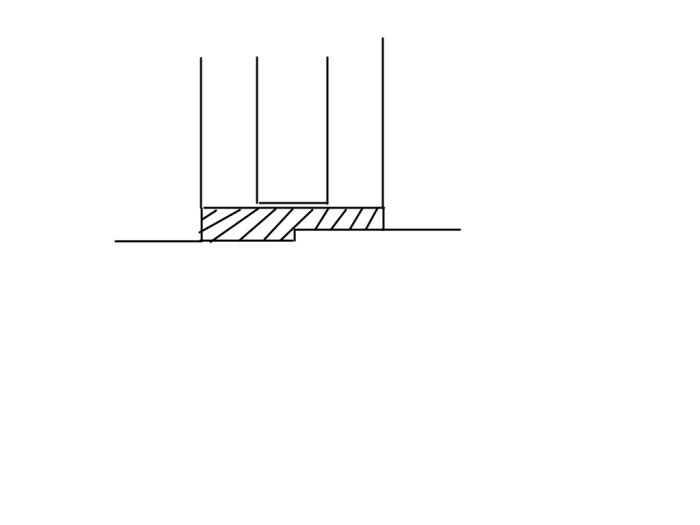
If there are no specific reasons, thresholds under interior doors are not necessary. The simplest solution is to order oak pieces from a custom joinery that fit under the doors and accommodate any level differences. These pieces should be as wide as the frame with any applied extensions. See attached sketch.
It is correct that the plaster sticks out 6 mm outside the frame, and it's really not unusual. When you install double plaster, you often use salningslister to compensate. In this case, it is only 6 mm, so an 8 mm sealing strip should work well. On top of this will, of course, come the moldings, which will be more or less at the same level as the plaster.
Having custom-made thresholds solves the problem of different levels on the floor, but unfortunately, we still have the troublesome problems, namely 1. the door leaf is already only 3-5 mm above the floor, 2. there will still be gaps between the floor and the front/back of the frames, i.e., where the sealing strips and moldings are intended to be placed.
borrowing an image from another thread on the forum with a picture of "skurkloss".... (justus's picture wasn't so easy to understand if you haven't seen this in reality)
I don't know if it fits with the rest of the style of the house, but in older houses, this is definitely the most attractive (and most classic) solution.
Those who go entirely without a frame, or with minimal trim, as mentioned, will encounter problems if something isn't 100% - presumably that's why they installed trim, to cover the gaps and skews that arise...
If the bottom of the door hits the floor, there isn't much choice between raising the frame or cutting the door at the bottom, but if it's not a solid door, it won't work - many new doors are made of something like painted pressed cardboard or something similar...
Perhaps you can loosen the frame, but to avoid messing up the wall, you could cut a few millimeters at the top of the frame and reinstall it a bit higher...
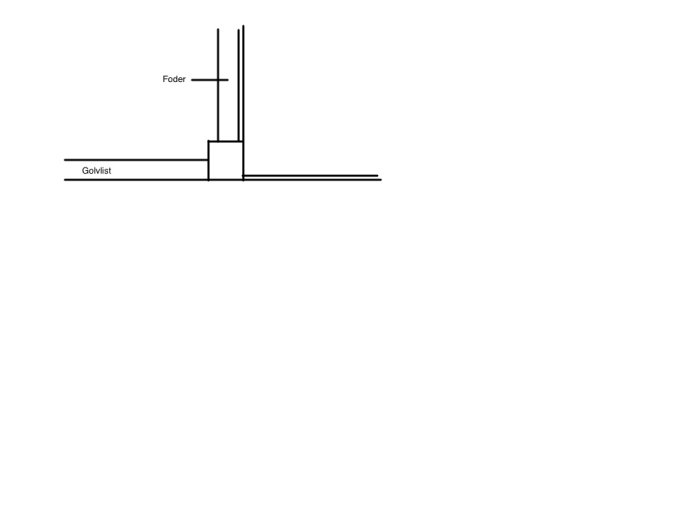
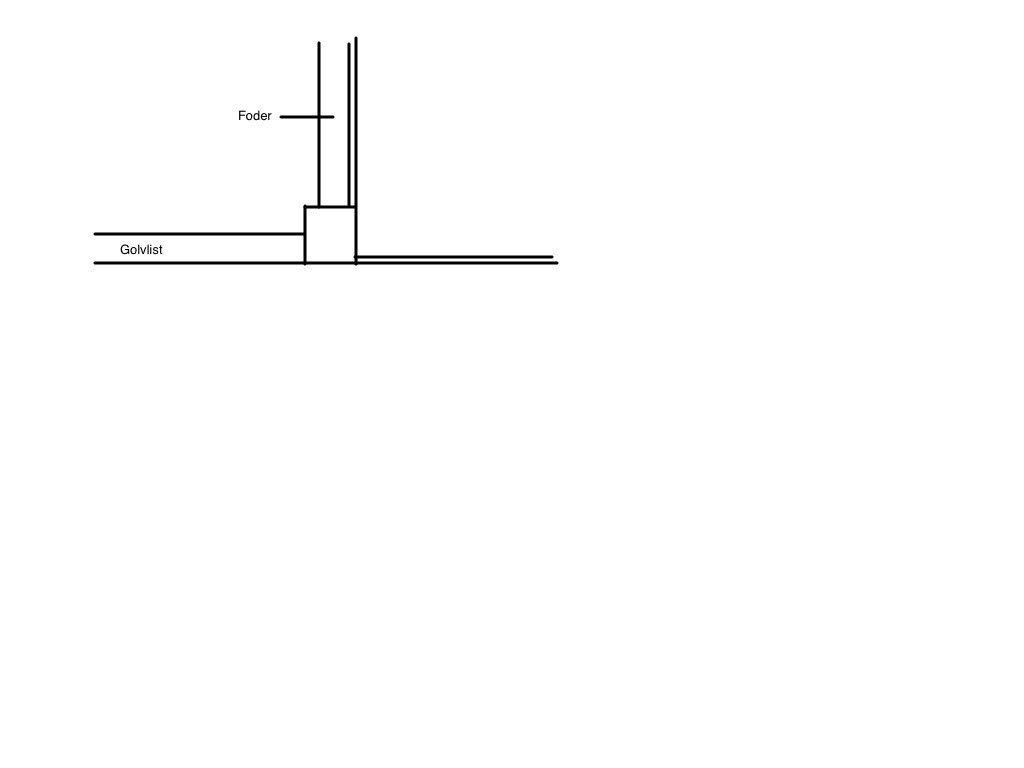
It's a plinth block I've drawn in my illustration. I don't remember what that detail is called, but without it, there will be no neat joints between the trim and the baseboard. The plinth block should be a little thicker than the other moldings, but it doesn't need to be decorated as was common in the past.
The threshold should cover both floors, along with trim/base blocks that solve the problem... but if you only have a few mm clearance door to floor, a sensible threshold won't fit. The downside with floating floors is they need to move, otherwise, you could have made another solution...
Will consider if it can help in this case. However, it doesn't really match the style.
Here is another picture that shows a bit better what the problem is:
Imagine putting a molding on the frame here and it is about 3-5 mm in, then on top of that there is a door trim. The problem will be large holes in the floor down to the white carpet.
The threshold shown in this picture is a standard threshold for the frame, but as you can see, it cannot be used without creating a large seam.
Can't a triangular strip in oak attached to the threshold cover the hole in front of the threshold, or if there is no level difference, a thin metal transition strip with oak foil?
Can't a triangular strip in oak attached to the threshold cover the hole in front of the threshold, or if there's no level difference, a thin metal transition strip with oak foil?
That's how we initially thought to solve it and also how it was solved previously in the house. But I was quickly informed by the Byggahus forum that it's a makeshift solution that you only do if you must. And now in hindsight, I have to agree that it's not really that nice.
If you were to take on all the work of raising the frames by 1 cm, how do you deal with the holes, it feels like a big risk that the frame screws go into the old holes?
That's how we initially thought of solving it and also how it had been solved previously in the house. But I was quickly informed by the byggahus forum that it's a stopgap solution you only use if you have to. And in hindsight, I have to agree that it's not particularly nice really.
Sure, it's an emergency solution and you have to decide for yourself if you want to take on a big job to make it really nice or just go for an emergency solution.
In our case, the base in each room is thick particle board, where any thresholds are to be placed, it is solid. So the floor goes from particle board, to solid, back to particle board again. I have noticed here that they can be at quite different angles, which means that if you squeeze a parquet floor under the frame, there is a risk that there will be a bump in the floor just inside and if you walk, it flexes. How do you handle this?
I don't quite understand what you mean, but the floor is not supposed to go all the way to the wall under the frame; there should be a gap or maybe it's too tight under the frame so the floor gets stuck in the frame and doesn't fit at all.
Click here to reply
Vi vill skicka notiser för ämnen du bevakar och händelser som berör dig.







BirgitS said: