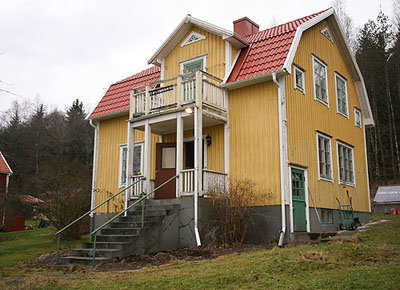
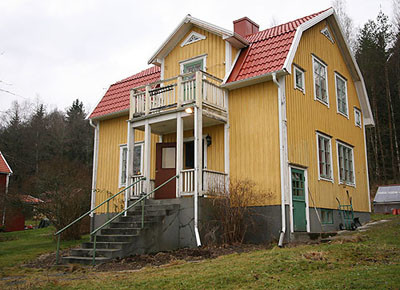
We are about to cast a new concrete foundation for our veranda. I am now considering the attachment/anchoring of the wooden posts. Previously, they just stood directly on the concrete. I've attached a picture of the previous veranda. The new one will have windows and panels behind the "fence."
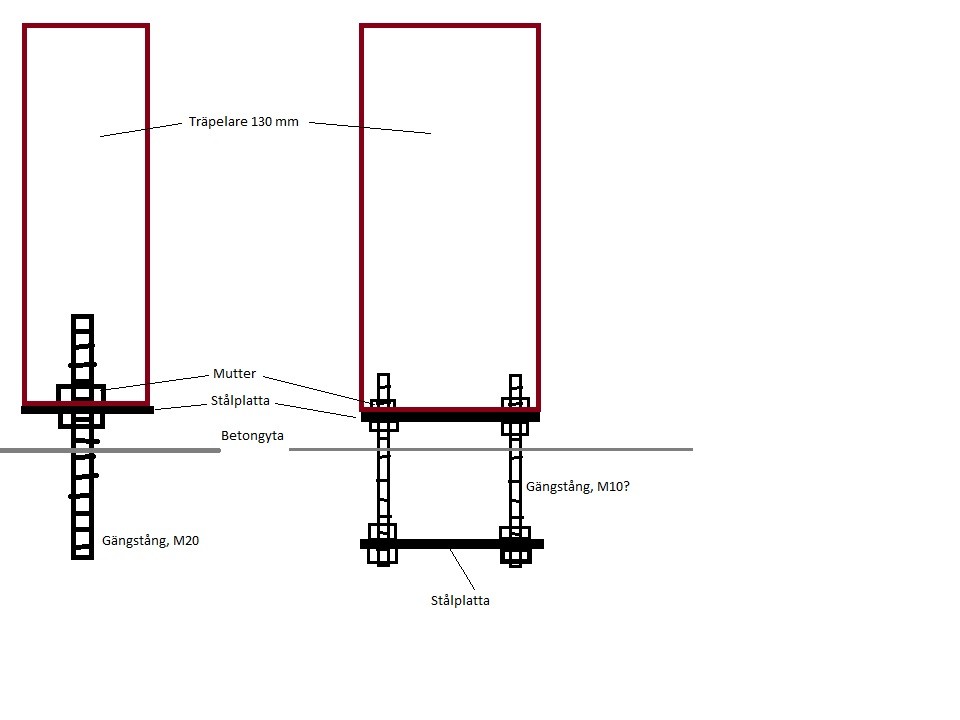
The posts are 130 mm solid wood, so post shoes in that size are rarely available, right? I'm thinking of casting in a threaded rod (20 mm) for each post and then placing a nut, steel plate, and nut. This way, I have the possibility to adjust the height. You make a recess in the post for the projecting part of the threaded rod + nut.
Is this a reasonable solution? Or should I rather have 4 narrower threaded rods per post? Still with a steel plate that it stands on.
Attaching a professional sketch of what I mean
Should we maybe have a steel plate under the concrete surface as well, like a kind of "anchor"? Perhaps easier to fix the threaded rods before casting then?
I can also add that I would like to cast the solution to avoid drilling near the edge of the new foundation later on. If possible. Alternatively, if one can leave a hole for later casting with something?
No, I don't really think so. It was just something that came over me plus the father-in-law had some kind of adjustable feet on some construction at home and he thought it was good. I was thinking more that it might be a plus when you have to cut the 4-meter long posts to get it level when laying the floor on the balcony. If one of them happens to be a few mm off then...
However, I am also happy to receive non-adjustable suggestions!
Would you recommend 1 piece of 20mm threaded rod per pillar or 4 thinner ones to support the plate? If I opt for 4 thinner ones, they might be 10cm from the edge but will have a lower load per piece.
Got my inspiration from "Stolpsko FZV" at www.wurth.se. There is also a plate underneath, probably for bolting down. Would it be better to have an underside plate too, which you cast in with nuts and everything?
What do you mean by moment? Lateral load? When the construction is finished, the load should mostly consist of downward pressure and potential wind impact. Before we renovated the veranda, the wooden pillars stood directly on a concrete block with a pipe in the center. I'm thinking of avoiding wood against concrete this time.
I believe the moment that arises in a construction like in the picture is negligible in this case.
A joint connection is therefore preferable. Post bases are available in these sizes, both fixed and adjustable, both in lateral and vertical directions.
For example, Hilti has many suggestions for post bases.
If the connection is to be designed to handle moments, the column must be fixed which requires some calculations and it's a more advanced node.
The balcony itself should be made "torsionally stable" (so it can't be compressed into a rhombus shape) and then securely attached to the house. This way, the posts shouldn't need to take moments at the attachments, and they can be seen as hinged attachments.
That's how I see it anyway. As the non-constructor I am.
Vi vill skicka notiser för ämnen du bevakar och händelser som berör dig.