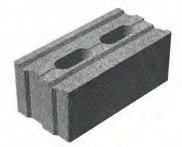
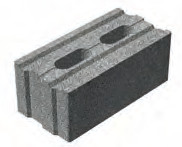
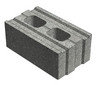
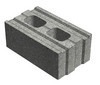
Hi, I'm going to build a retaining wall of Lecablock in the garden (=my first masonry project). I’ve poured a concrete footing that I will lay the blocks on, and now I'm considering how best to anchor the wall into the footing. I will be using the new type of Lecablock with "lightening holes" in it. So I'm thinking of drilling rebar into the footing that can extend into the holes in the blocks. Then I will fill the holes with mortar (or something else suitable).
The mortar recommended with the Lecablocks is Flexoheft M5, but it can handle a maximum joint thickness of 8mm. Therefore, it doesn’t seem suitable to use. Does anyone have any other tips on what to use for casting the reinforcement into the drilled holes in the footing and in the Leca holes? Concrete? Expanding concrete? And is it suitable to use Flexoheft between the blocks and the footing, or should a strip of mortar with another type be used?
Chemical anchors to the foundation, and regular cement/concrete for the holes in the blocks.
Is it going to be a high retaining wall? It can result in large forces in the ground.
You can cast in 12mm reinforcement bars that are bent into large arches on the inside in the back as you backfill.
As anchors
Thank you for the answers!
I had never heard of kemankare before but it appears to be the right product.
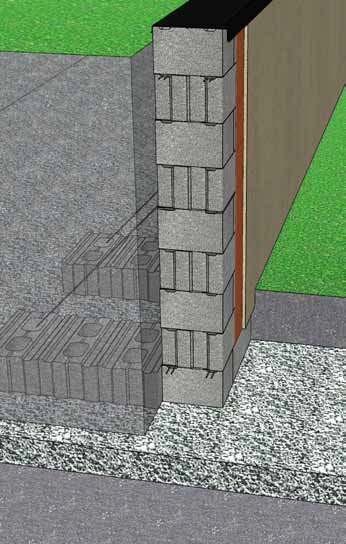
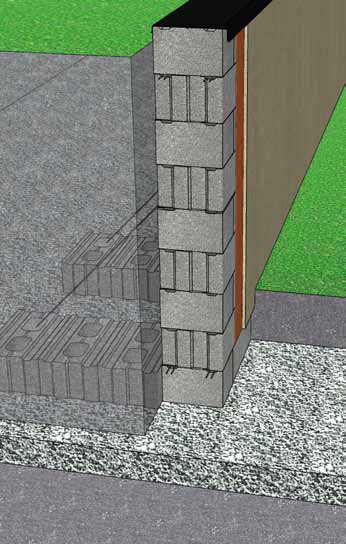
The wall will be about 1.2m high. I plan to follow Weber's instructions with inward "angled supports" of stainless steel reinforcement. See image.
In this instruction, the wall is built directly on well-compacted macadam, but as I mentioned, I have cast a footing to achieve maximum stability.
Chemical anchor is too expensive.
Take pieces of 10mm rebar. Drill 20-30 mm holes and cast them with masonry and plaster mortar, B
Build with masonry and plaster mortar B.
That's how I would do it, but as you know, I'm no pro at this. :blushing:
Chemical anchors are a waste of money. Drill holes and attach the rebar with a slurry made of mortar and water. A retaining wall should ideally lean inward about 12 degrees. In the inner angle between the footing and the wall, fill up with mortar to a height of about 1.5 stones.
80kr for 150ml and 129kr for 280ml at biltema. Not too expensive I think.
Chemical anchor is a fantastic tool, and not particularly expensive when justified.
But here we're talking about a type of 20 meter long retaining wall, which means it will need a larger number of bolts, so it's not that cheap anymore.
I would use short pieces of reinforcement, with large holes and cast them in with a bit of mortar.
If you want to secure, for example, 8mm or 10mm reinforcement, what diameter hole needs to be drilled?
I once drilled 10 or 12mm holes, filled with some quick-setting compound, but then it was impossible to get a 6mm threaded rod in! So I've figured that the hole must be considerably larger than what you want to cast in it.
I'm not a mason, but to me, using chemical anchors sounds like overkill! We're talking about the joint between the concrete foundation and the first layer of lecablocks, essentially all the pressure from the ground is likely to affect the wall sideways. In that case, I would be more worried about the joints between the other courses of the wall, which are just held together with mortar.
If I were building the same wall, I would do roughly what Stickan56 suggests; cast anchors for the first course, tilt the wall 10-12 degrees inward, and preferably complement with struts according to Weber's image.
qvist has the new lecablocks from weber
(I have been there and had a look)
We debated a bit on how best to dub them, and we thought that perhaps it's best to place the dub in the foundation so it comes up into one of the cavities in the Leca block.
And then pour a scoop of mortar/concrete into the cavity which would form a cake that surrounds the reinforcement dub and the cake in turn is surrounded by the cavity in the block.
That should work, right?
Then there is the question of whether the dub even needs to be cast in place, if he drills an 8mm hole and knocks down an 8mm iron, that should be enough, right?
Vi vill skicka notiser för ämnen du bevakar och händelser som berör dig.