I live in a Götenehus from 2010 and have a problem that is larger than others. The house is heated by an exhaust air heat pump with air supply in vents above the windows, underfloor heating on the ground floor, and radiators on the upper floor.
The problem is that I have large air leaks in wall corners and against the floor and ceiling. When I take photos with a thermal camera, it's even below zero in some places when it was about -10 outside.
The suggestion from Götenehus is to remove floor and ceiling moldings and seal on the inside, but I think that sounds completely wrong.
When I refer to cheating with the sealing plastic and that it's a construction error, they refer to meeting the National Board of Housing, Building and Planning's regulations for energy and environmental requirements indoors. They say the walls can be as leaky as possible as long as they meet this.
I think this sounds very strange, it's an inspection remark, but I'm not really sure how to proceed, not entirely keen on putting silicone strips all around the house on the inside...
Anyone with experience of similar problems or who can give me a tip?
Apparently, the construction plastic is not sealed as it should be. Partly for heating economy, but also to prevent warm, humid indoor air from penetrating and condensing in the wall, resulting in mold and rot.
To my ears, this SCREAMS CONSTRUCTION FRAUD. Even in my old, drafty Skånelänga from the previous century, it's not this drafty and cold. It sounds like a clear case for a lawyer. Sue them into bankruptcy. They'll flatly deny it out of old habit, as they know very few homeowners/private individuals have the energy, time, desire, perseverance, and money to pursue a case in court.
If you don't do anything, you'll be left holding the Black Peter when you try to sell the house.
It is a terraced house with a vertical wooden facade. From what I understand, it's assumed that the plastic isn't properly installed. A corner has been opened from the outside, and it's been observed that the paper is in place there. Between the respective houses, there is an air gap of about 10 cm.
I've talked to some carpenters, and some say it's not uncommon to miss fixing the plastic around the corners during construction.
Götenehus also suggests that it's the plastic, or it must be, as that's essentially the wind barrier. But they solely refer to the building regulations regarding indoor climate, and in that regard, the house is fine!
SP has been here for measurements, and it's SP who photographed with a thermal camera and detected sub-zero temperatures. However, SP concludes that the indoor climate is okay.
I discovered the problem for the first time when a large crack appeared in one of the exterior corners, where cold air was blowing straight in. They then sealed it and installed a corner strip, which naturally moved the cold air down to the floor and up towards the ceiling.
For your information, we have a loose-fill attic, about 1 meter with wool on a plastic layer.
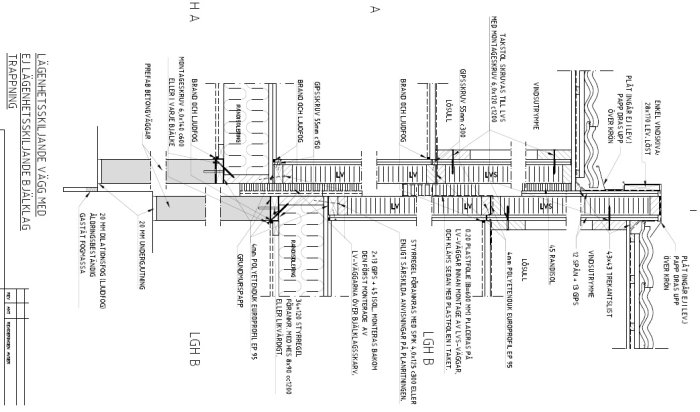
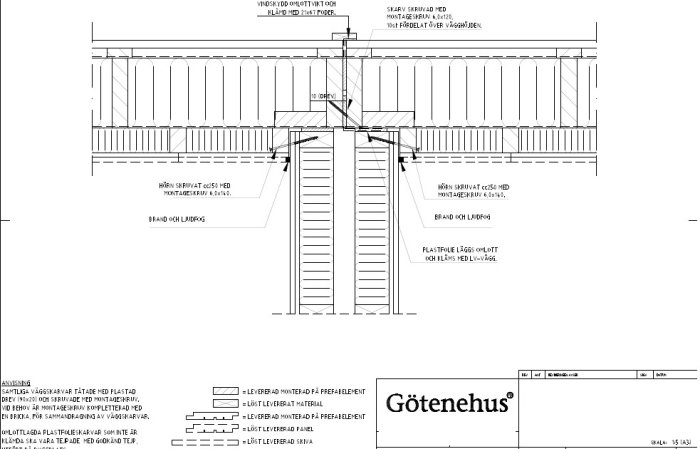
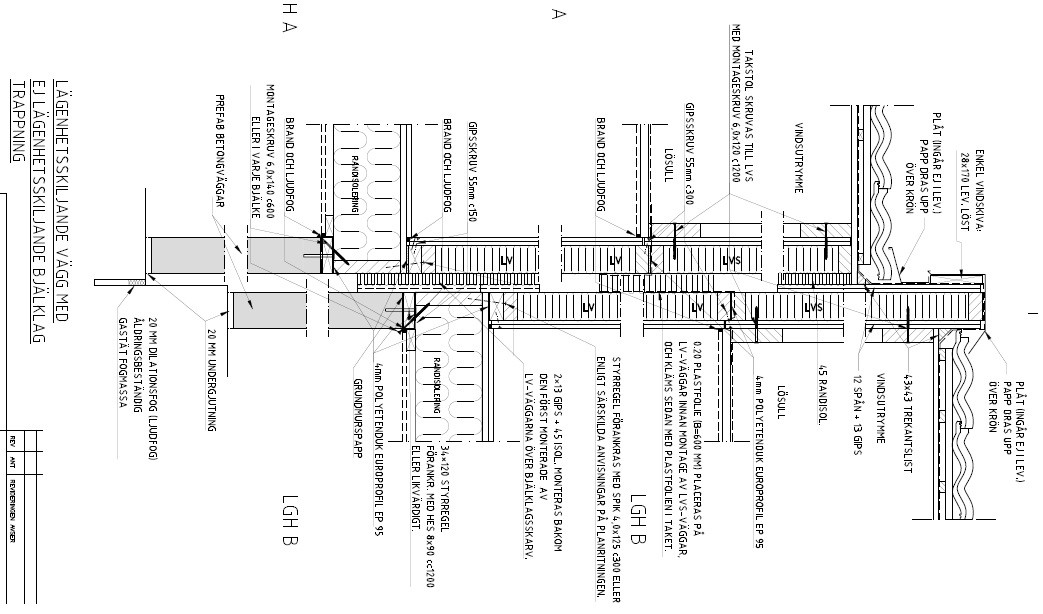
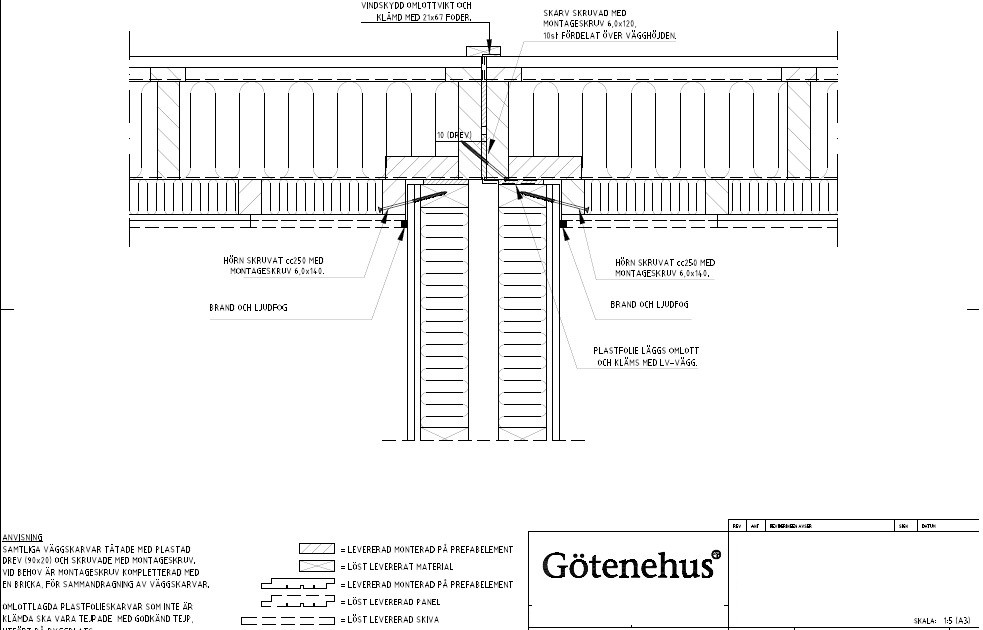
Regarding what the wall construction looks like, I'm attaching two pictures, and I hope they're readable!!!
I'm looking for advice on how to proceed here. It feels like I have to demonstrate one or more places where the plastic isn't okay to prove that the construction wasn't performed professionally. It doesn't seem sufficient that SP measured sub-zero temperatures in roof angles, as they fully refer to the building regulations for the indoor environment.
Unfortunately, the wind barrier does little to counteract the negative pressure inside the house. A small gap in the plastic is enough for air to be sucked in there.
Since it is probably the diffplastic that is not airtight, I actually think their solution with soft sealant would work somewhat. The alternative involves quite extensive interventions!
Yes, exactly, that's what I'm asserting too, I naturally want to fix the problem itself and not just the consequence.
But what I'm mainly looking for with my question here on the forum is how I should proceed. Who should I ideally contact to get support and help to address this with the house supplier? What do you think my chances are?
Sour. I would stand my ground. My feeling is that the construction industry, or perhaps the developers of low-energy/passive houses, in the past ten years have recognized that the air-tightness of the vapor barrier is much more important for both energy performance and moisture safety than previously thought. However, it doesn't seem like this knowledge has reached the craftsmen 100% yet. Stand your ground; now's your chance to get it fixed.
Construction defect insurance, does it cover this?
Assume that an energy calculation was made before construction and that it was assumed the house would have a certain tightness, around 0.5 liters/second. Based on your description, it sounds like the leakage is probably quite large. If that's really the case, the house will not meet the assumed energy calculation and likely does not meet the requirements in PBL (as most manufacturers for economic reasons tend to be on the edge). Provided the house has not already been pressure tested (should be mandatory), I suggest the following action:
Pressure test the house (about 10,000 SEK) and if the value is higher than what the house manufacturer calculated, then you have proof that they did not do what they should have, i.e., they delivered a house that does not meet what you ordered. Then it's up to them to fix the house to make it sufficiently tight and, of course, they should cover the pressure testing cost if the result is unsatisfactory.
Thank you for a good answer! Götenehus actually conducted a pressure test during the construction period, but I have not been given the results. I was there when it was done and the person who conducted it didn't seem entirely satisfied with the outcome, to put it that way. Where can I find the tightness figure you mentioned, is it in the contract or where might it be?
We had to submit the energy calculation when the building permit was submitted. The calculation should therefore be with the municipality and it should, among other things, indicate the density they calculated on. By the way, it's interesting that they conducted a pressure test but you have not been informed of the results.
Vi vill skicka notiser för ämnen du bevakar och händelser som berör dig.