
5,952 views ·
16 replies
6k views
16 replies
Advice on Tretex walls, demolish or not?
Ah, then the wall was more even than it first sounded in your description.P Pär Nordqvist said:Then I'll show it instead. Here is a picture of these paper or wooden strips that probably helped to create a gap between the timber and the tretex boards, and perhaps made them straighter. I also attach a picture of the tension paper and how it looks after the joint has come loose in part of the room, a couple of meters.
(It is probably masonite and not paper, by the way)
If you want insulation in place again, I would frame, insulate, and put up drywall.
If it is an interior wall and you do not want additional insulation, you can put up some drywall strips in a similar way with CC 60 to get a small spacing between the drywall and the wall for a straighter surface, then screw the drywall onto them. The disadvantage is that you get a rather poor gap between the wood and drywall, which will make it tricky to attach things to the wall without it bending in or out depending on the type of mounting chosen. If you frame as usual, you avoid that problem but "lose" a few centimeters of floor space.
Thanks for the answer! Yeah, I don't know how it will be. Have to get a carpenter here in any case. The ceiling is very high, 2.88 m. The Tretex boards seem to be of that size, there are no seams. But nowadays there probably aren't such tall boards, regardless of material, I think 2.30 is the max, as ceiling heights are not nearly as big today.Dowser4711 said:
Ah, then the wall was flatter than it first sounded from your description.
(It's probably masonite and not paper)
If you want insulation in place again, I would frame it, insulate and set gypsum.
If it's an interior wall and you don't want any more insulation, you could put some gypsum strips in a similar way with CC 60 to get a small distance between the gypsum and the wall and a straighter base, then screw the gypsum on them. The downside is that you get a rather poor gap between the wood and gypsum that will make it tricky to attach things to the wall without it bulging in or out depending on the type of fastening chosen. If you frame as usual, you avoid that problem, but "lose" a few centimeters of floor space.
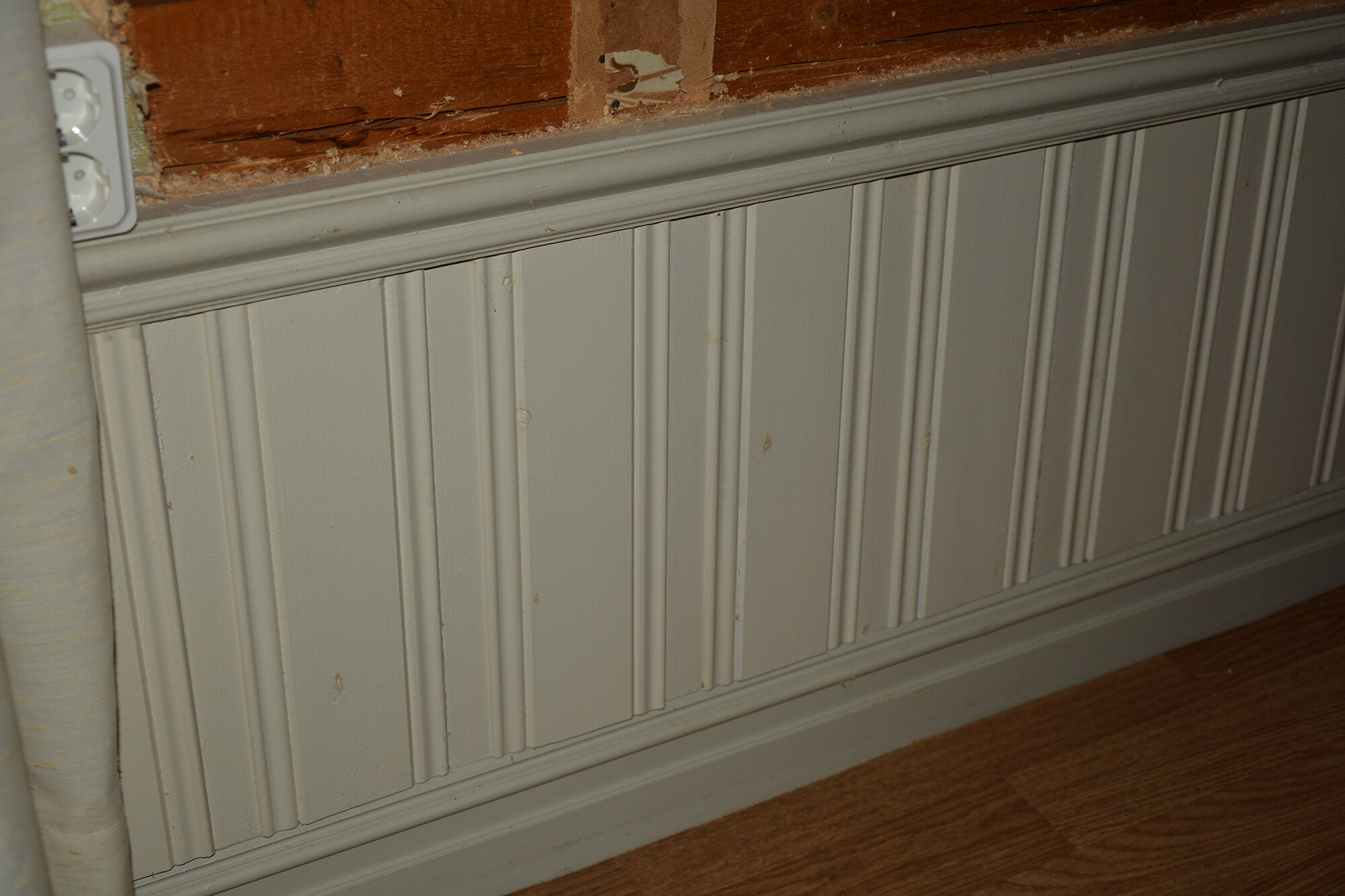
Then there's a wood panel that's 49 cm high from the floor, and the Tretex goes behind it plus it goes under a wide, curved ceiling molding. Then it must also be loosened to get a new board behind it. If it's taken down, the stretched paper risks following. Oh no, what a mess! I thought I was clever when I started with this, but I wasn't, I was foolish.

Last edited:
Click here to reply