
5,497 views ·
27 replies
5k views
27 replies
A strange moisture measurement...
Hello. I have a single-story house built in 1969 in an L-shape. I'm meticulous and go up to the attic several times a year to check if everything looks okay; the entire residence has leveling floors with different coverings. Oil-heated until 2007, then district heating until 2012, and now geothermal heating. Additional insulation was added in 2011 by previous owners, and there haven't been any direct mold problems in the attic. There's some, but to a low extent.
This week, I went up and did some moisture measurements, and got some very strange values. In some boards, which otherwise seem very healthy. No smell, nothing special at all.
In the board with rust on the metal strap over 30%, and it's nearly across the entire width of the board.
In the nearest boards, it's at 14-16%.
What could cause this? The roof was replaced in 2016, and what I can think of is if air is escaping around the attic hatch, which is located just beneath, but then more boards should have high moisture content.
Could it be treated or something that interferes with my cheap meters??
This week, I went up and did some moisture measurements, and got some very strange values. In some boards, which otherwise seem very healthy. No smell, nothing special at all.
In the board with rust on the metal strap over 30%, and it's nearly across the entire width of the board.
In the nearest boards, it's at 14-16%.
What could cause this? The roof was replaced in 2016, and what I can think of is if air is escaping around the attic hatch, which is located just beneath, but then more boards should have high moisture content.
Could it be treated or something that interferes with my cheap meters??

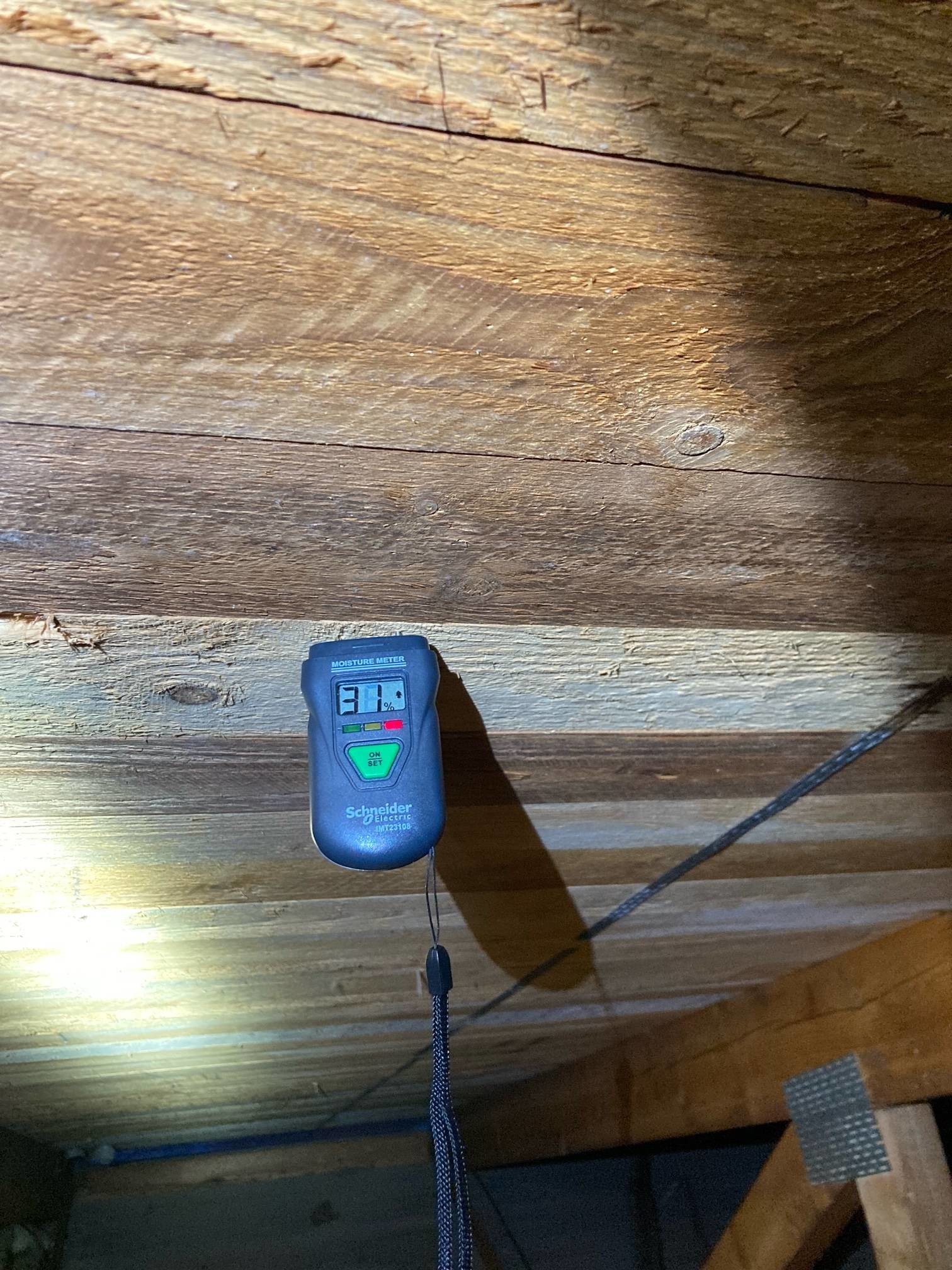
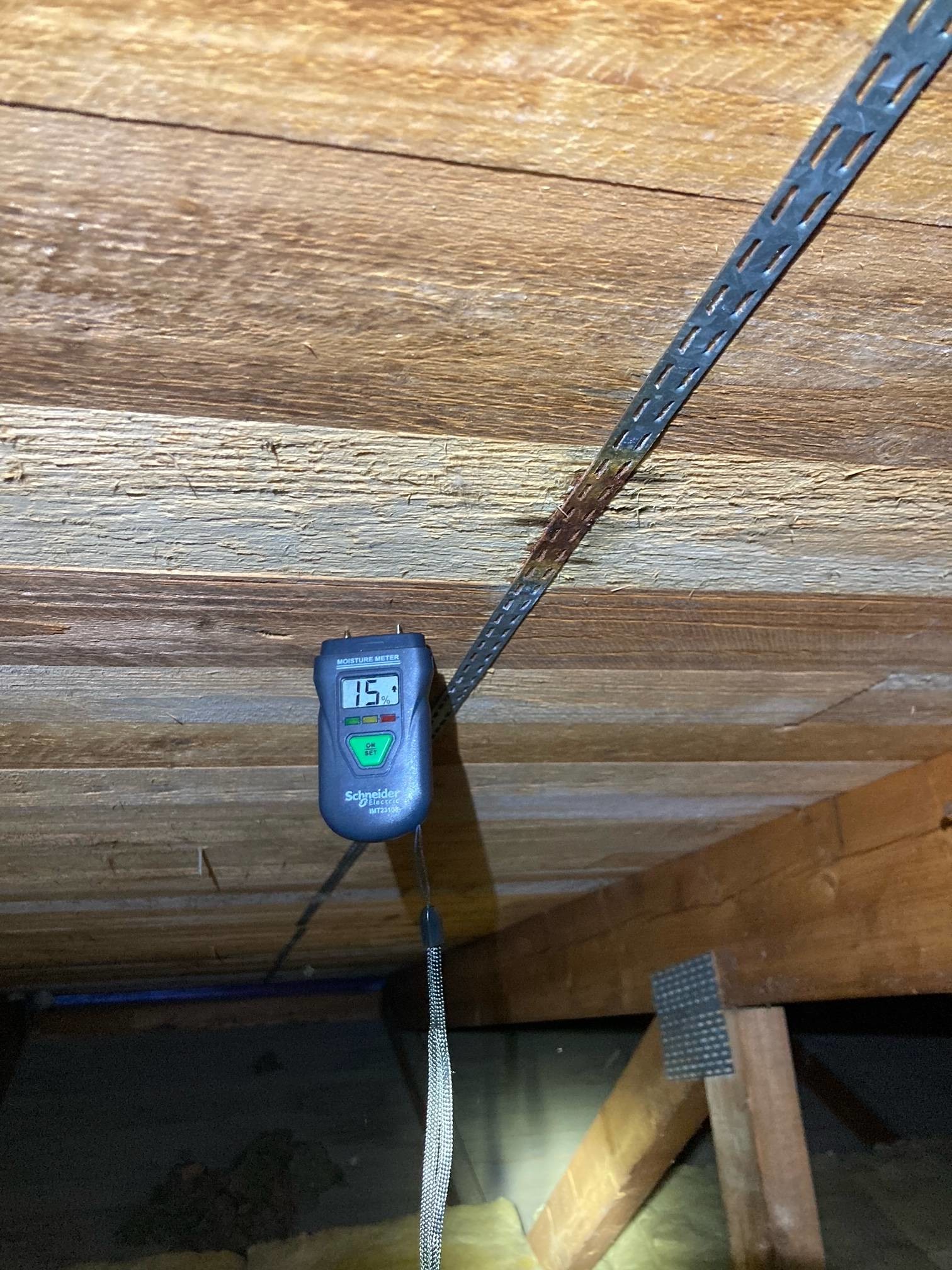
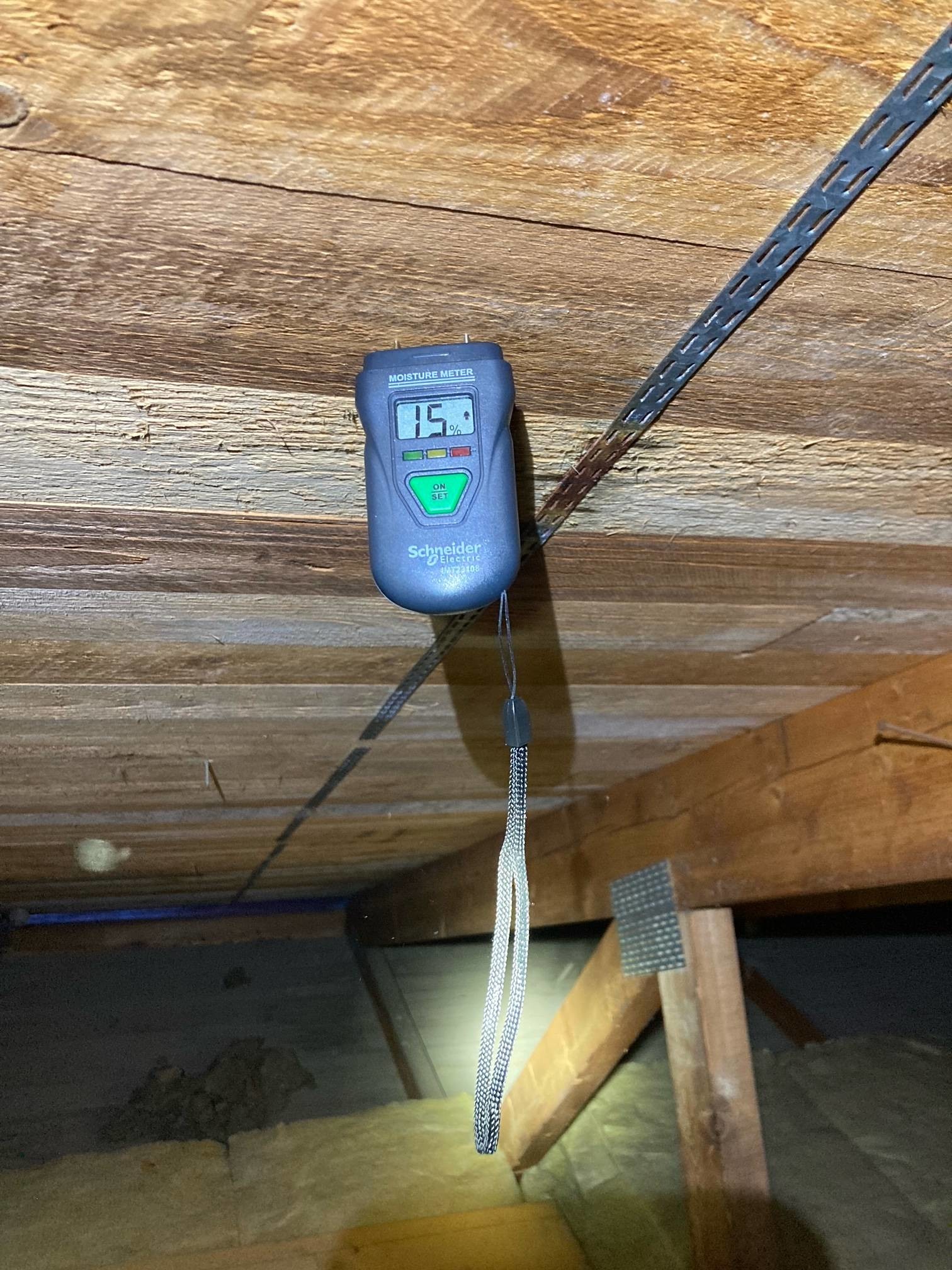
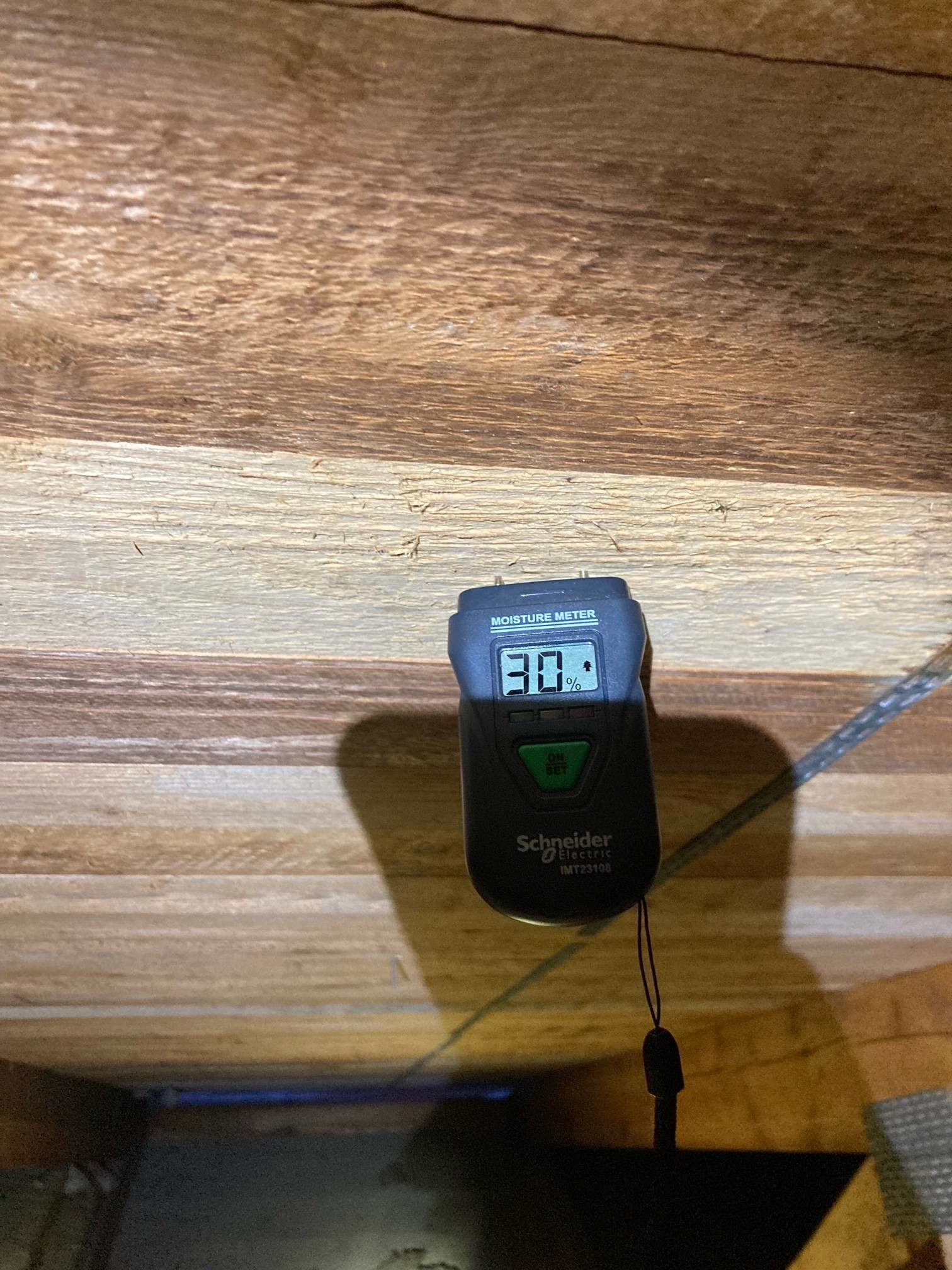
It is quite similar, varying between 23-35%. I carved off a piece from it yesterday and brought it into the warmth. After about an hour, it was down to 16-17%.
I think it feels strange, I doubt there is leakage. Since both the old tjärpappen and new t-duk as well as the tiles are in place. The roof is facing directly north.
I think it feels strange, I doubt there is leakage. Since both the old tjärpappen and new t-duk as well as the tiles are in place. The roof is facing directly north.
Okay, so is the rust from before the roof replacement?C Coaster said:
I seem to recall that the rust was there before as well. It might have been like this for years, but it feels a bit unsettling.Ulltand said:
What I can imagine is that the cold outside air meets the warmer air right there, you can see there's no insulation and a large air gap against the outer roof. And that's where the condensation occurs.
The boards that have high humidity are not planed and have a very rough surface, maybe they absorb better than the planed ones.
It's a bit of a strange coincidence that the rust coincides with the damp board. Even if it's local condensation.C Coaster said:I remember the rust being there before too. It may have been like this for years, but it feels a bit uneasy.
What I can think of is that the cold outside air meets the warmer air right there, you can see that there's no insulation and a large air gap against the outer roof. And the condensation forms there.
The boards that have high moisture are unplaned and very rough on the surface, maybe they absorb better than the planed ones.
There's no reason to panic. You are keeping an eye on it and can measure what's happening during rain and dry periods, heat, etc.
As mentioned, no panic. As you say, it generally looks quite healthy, so even if there is some form of leakage or something else, you have plenty of time to analyze what it might be and how it should be addressed before it becomes a major issue.
Even if you don't believe in leakage, I would still recommend that you take a look at the corresponding place in spring, when the snow is gone and most of it has dried up. Lift the roof tiles there and up over the next seam in the membrane on top of the paper.
Feel it and see if everything feels "as it should."
If there is a small leakage in the membrane, it could lead to it running on the paper until there is some damage to it.
Even if you don't believe in leakage, I would still recommend that you take a look at the corresponding place in spring, when the snow is gone and most of it has dried up. Lift the roof tiles there and up over the next seam in the membrane on top of the paper.
Feel it and see if everything feels "as it should."
If there is a small leakage in the membrane, it could lead to it running on the paper until there is some damage to it.
I was up last week, when it shifted from -19 to +2 and snow melting, of course, then I had 40% moisture in the board.Dowser4711 said:
As mentioned, no panic. As you say, it generally looks quite healthy, so even if there were some form of leakage or other issue, you have ample time to analyze what it could be and how to address it before it becomes a significant problem.
Even if you don't think there's a leakage, I would still recommend you take a look at the corresponding spot in the spring when the snow is gone and everything has dried up. Lift the roof tiles there and up over the next seam on the felt above the paper.
Feel it and see if everything feels "as it should".
If there is a small leakage in the felt, it could lead to water running on the paper until there’s some damage to it.
What I find strange is that there are no direct traces of free water, meaning if it were a leakage, there should be more, I think. And not that the board would absorb so that it became so moist throughout its entire length, i.e., about 2.5-3m.
I've been up and measured a bit more now. It is primarily the boards with very coarse sapwood that have high moisture content, that is in the same area as in the pictures, not in the rest of the roof where I can measure without crawling through the insulation. 18-35%
The planed boards never exceed 18%, very strange.
What is the humidity in your attic?
Yes, if I measure in the damp boards at a knot, it's 16-17% moisture there….?
So be it, there's no vapor barrier, only a brake in the form of a paper. The problem area is above the garage, right above a garage door that is anything but tight, although I maintain 16-18°C in the garage year-round. Perhaps it's warm air leaking out from the door that travels up to the attic and condenses? I see no frost or signs of it in the area, which I think should be the case if the boards hold 30% moisture, which corresponds to over 100% RH—shouldn't there be free water on the underside of the roof, then?
Is the garage in the same attic as the rest of the house? If so, it is probably the coldest part of the room and the moisture condenses there first.C Coaster said:Yes, if I measure in the damp boards in any knot, it's 16-17% moisture there...?
That may be the case, it is not a vapor barrier but just a brake in the form of a paper. Where the problem has arisen is above the garage, right above a garage door which is anything but airtight, however, I maintain 16-18°C in the garage year-round. Maybe it's warm air leaking out from the door that draws up into the attic and condenses? I have no frost or signs of it in the area, which I think there should be if the boards hold 30% moisture, that corresponds to over 100% RH, then there should be free water on the underside of the roof, right?
You probably don't have any significant moisture load in the garage, so I consider the door theory unlikely.
Yes, it's in the same building. The strange thing is that I only have the problem facing north, not on the other end which faces south. However, the eaves ventilation is blocked there, not by me but by the previous owner.