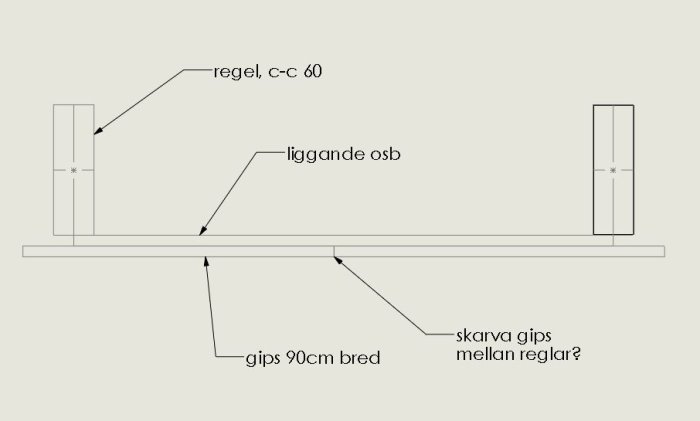
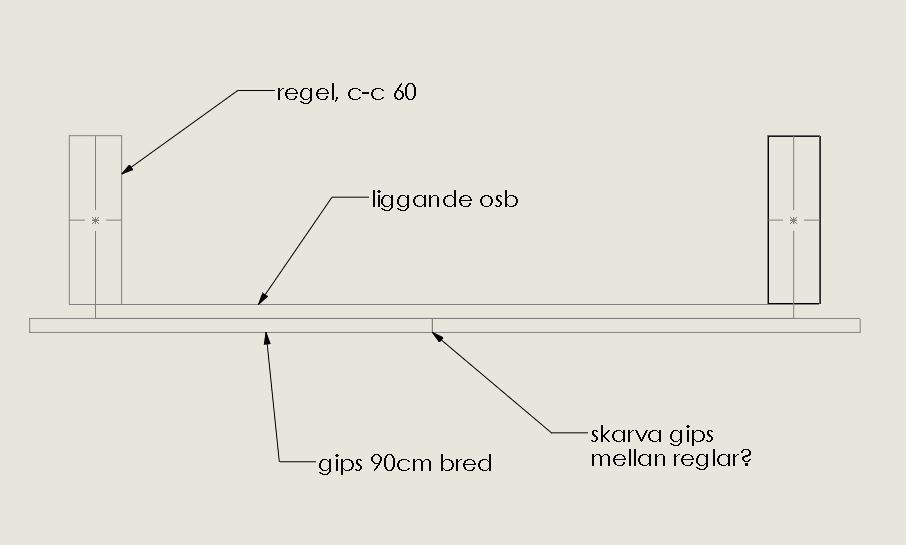
I'm pondering what the "norm" is for installing 90Gips with c-c60 between the studs. I will have horizontal OSB behind it; is this "stiff" enough to splice the gypsum against with regard to whether the filler will crack? Conversely, the vertical joints between the OSB, can these be considered jointed when I screw the gypsum on both sides of the OSB joint?
In the houses I've built, I've screwed the gypsum board into the underlying wooden board and completely ignored where the studs were located. However, I made sure to always offset the gypsum joint at least a few dm from the underlying wooden board joint.
Your plan will work well, but make sure to use some extra screws as OSB has slightly lower strength than studs. I usually screw in two rows in the middle of the board when I screw into OSB...
Yo, then it seems to be the "norm" to do so it seems, and this works even after filling and painting, i.e., the joints/seams do not crack due to softer substrate?
As mentioned, it's perfectly fine to screw into OSB. You also don't need to screw more than usual. Both the gypsum and the screw have much lower strength than the strength of the OSB.
I haven't quite decided on 90 or 120 yet, but the ceiling height is 330cm, so I haven't really decided on the setup yet. 120 boards are pretty tricky to handle, so I'm pondering the options for the moment.
90 panels can otherwise also be installed horizontally. I believe some of these panels are also offered with all edges beveled. The advantage is that there is minimal waste, you also don't have to consider the height when choosing panel length, easier installation due to lower weight, and you can rest the panels on each other's seams. I believe they are also referred to as Ergo-panels for this very reason. Just make sure to stagger the seams. Good luck
It is okay to mount drywall on OSB without having a stud behind it. I screwed horizontal drywall sheets onto vertical studs and OSB in the attic, it has worked so far.
If the ceiling height is 330 and the original poster wants 90 panels horizontally, the last panel must be lifted 2.7 meters. It must also be ripped lengthwise.
One way could be to have a row of horizontal ceiling gypsum (60 cm) at the bottom, and then 270 standing above. It won't be such a high lift.
that was a smart idea! as you say, it avoids high lifts, better a heavy lift a short distance than a high lift with less weight.