4,574 views ·
18 replies
5k views
18 replies
260 HEA beam on 115x155 glulam post?
Hello!
We are renovating our house from 1975, a 1.5-story villa. The villa is built on a concrete slab where double 45x70 studs are embedded into the concrete for the load-bearing wall. We have now torn down the load-bearing wall between the kitchen and living room, which was 5m long and only constructed with 45x70 studs and plasterboard on both sides.
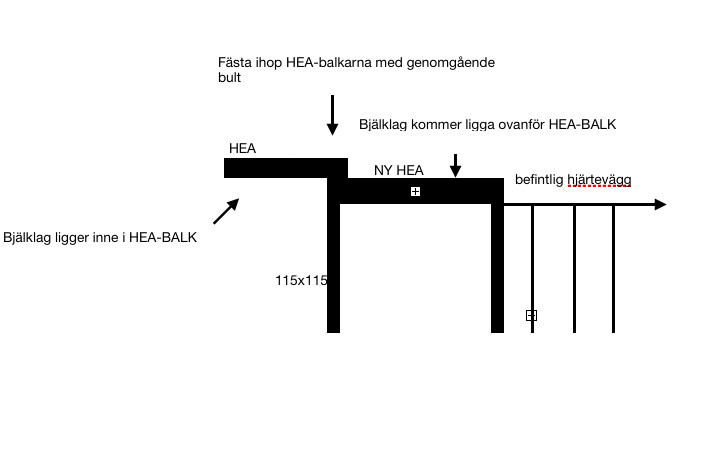
I have been in contact with a structural engineer who claims that we should replace the load-bearing wall with a 260 HEA beam. The beam will rest on two 115x115 glulam columns on each side. One of the columns will have a point load of about 8 tons (80kN).
Now to my question. Is it sufficient to have 115x115 columns for this? We have also removed about 1x1M of flooring and reinforced with about 10cm of concrete and 12mm reinforcement where the column will stand.
We are renovating our house from 1975, a 1.5-story villa. The villa is built on a concrete slab where double 45x70 studs are embedded into the concrete for the load-bearing wall. We have now torn down the load-bearing wall between the kitchen and living room, which was 5m long and only constructed with 45x70 studs and plasterboard on both sides.
I have been in contact with a structural engineer who claims that we should replace the load-bearing wall with a 260 HEA beam. The beam will rest on two 115x115 glulam columns on each side. One of the columns will have a point load of about 8 tons (80kN).
Now to my question. Is it sufficient to have 115x115 columns for this? We have also removed about 1x1M of flooring and reinforced with about 10cm of concrete and 12mm reinforcement where the column will stand.


It depends on how long it is. If it is 2.5 m long, it can handle about 140 kN. The capacity decreases quadratically with the length. There is a term called buckling length, which is calculated using one of Euler's buckling cases. Leonard Euler was a Swiss mathematician who lived in the 1700s. A fairly well-tested theory, in other words...
Unfortunately, I don't have many calculations for columns, but for someone to be able to check, you need to know the length of the column. I assume the column will not be braced in one direction, i.e., "outward" in the wall?
The length of it will be about 2150mm. So in other words, it should handle the pressure then!J justusandersson said:It depends on how long it is. If it's 2.5 m long, it handles about 140 kN. The capacity decreases quadratically with the length. There is a concept called buckling length, which is calculated using one of Euler's buckling cases. Leonard Euler was a Swiss mathematician who lived in the 1700s. Quite a proven theory in other words...
Thanks for the answer!

The length will be approximately 2150mm and it will stand in the middle of the room, so not braced. I was planning to drill down and use heat-adhesive to fix a 10mm rebar into the concrete and into the post. I want to have a hidden fastening since the pillar will be visible. Maybe there are better options for fastening it downwards?P patrikd84 said:
Spontaneously, this solution doesn't sound completely solid. An HEA260 on 115x115 unbraced columns in the middle of the room... Did you get any details from the designer regarding the implementation?
Last edited:
I agree with you! It's only one pillar that will be unbraced, but it's also the pillar that will take the most load. The unbraced pillar will take 8 tons, and the other pillar that connects to another wall will take 4 tons. No more details than that it was HEA260 that was applicable and that it should be able to rest on 115x115. Also, I was supposed to reinforce under the pillar that would take 8 tons. I'm not quite sure how to proceed now...B bossespecial said:
You don't have the possibility to attach a simple sketch of how you envision the placement of the beam on the column?
An HEA260 in a villa is not small potatoes, so here it might be good to describe what "sufficient" means.