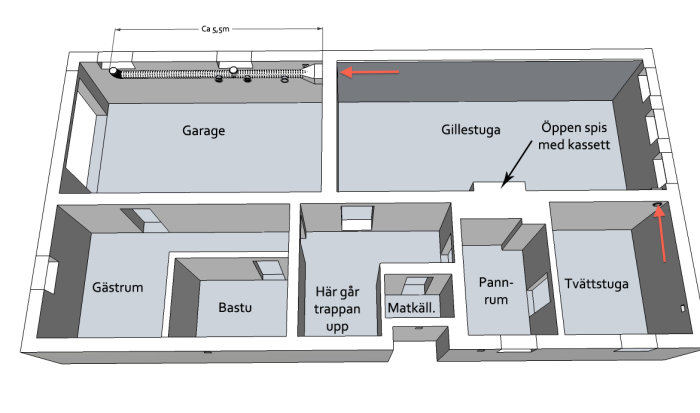
Now that the insert has been installed in the recreation room's fireplace, I need to make openings in a couple of the walls for heat transfer. One of the walls is certainly load-bearing (running the entire length of the house with the concrete floor slab across it), while I'm not sure if the other is load-bearing (running along with the concrete floor slab).
I am not a structural engineer and do not have much experience when it comes to strength, so I am turning to the forum's combined expertise for advice.
Are there any "no-no's" and rules that I need to be aware of? I'm thinking about the distance to the joint between wall and ceiling, as well as wall to wall, positioning in relation to the concrete floor slab joints, etc. Of course, I realize that I need to watch out for pipes and electrical wiring, so I am aware of that. It's more the structural aspects I need help with.
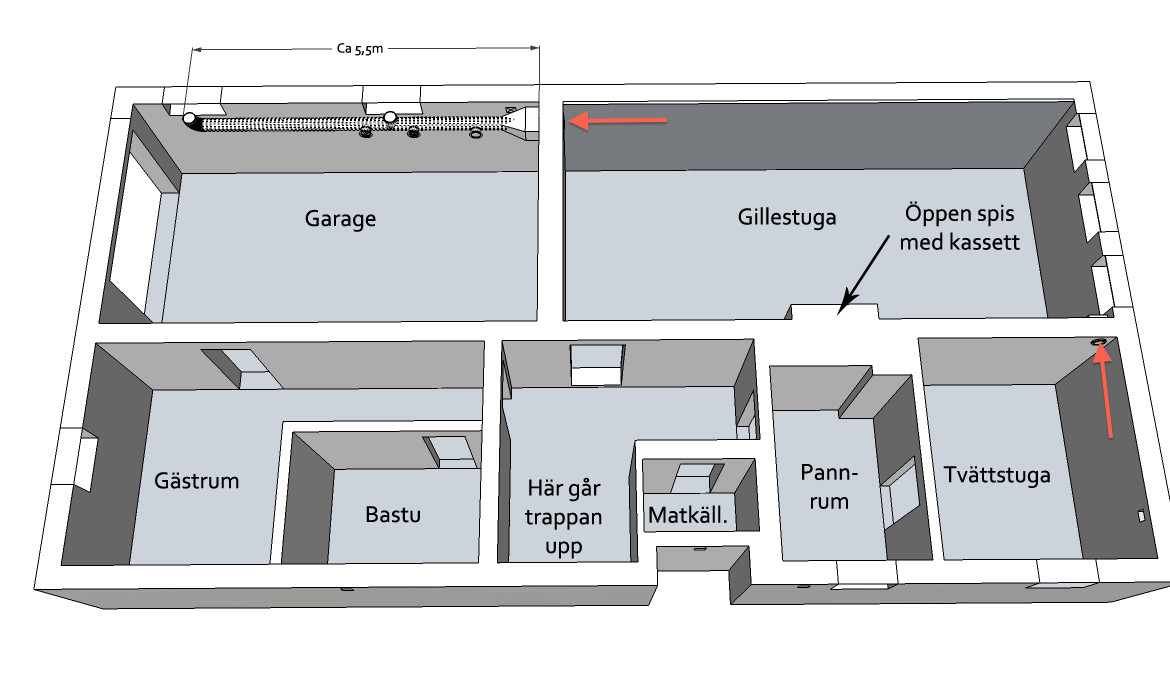
Attached is a small drawing I made for the ventilation system. The red arrows indicate where I want to make the openings. The system will be built on 125 mm spiral ducts.
Can't see any problems at all, even in a load-bearing wall you usually have doors, so a hole of one or a few dm should have no significance for the load-bearing capacity.
The only thing is to place the hole at least one stone below the "ceiling" (DIY)
That's how I did it and it worked fine
That's kind of what I'm thinking. Is "one stone from the ceiling (or another joint like wall/floor)" some type of rule, or is it more like "might as well do it to be sure"?
A small problem is that I don't know how big the stones are. The walls are plastered, and I haven't managed to find anywhere where the shape of the stones can be identified. Since this is a heat transfer system, I would like to have the passage as close to the ceiling as possible, as warm air rises...
Also, I don't know if only whole stones are laid, has any "standard house" ever been built with, like, half stones at the top against the floor joists?
My gut feeling tells me that there aren't any problems at all.
Especially if you drill holes as close to the outer walls as you've drawn in the picture, then there should be some support from the outer walls.
I don't think you even need to stay particularly below the ceiling. But it might be a good idea to do it anyway.
If you want to be absolutely secure, you can cast the space between the pipe and the hole in the wall afterwards.
A round shape like a pipe becomes incredibly strong and supportive in itself if it cannot expand in any direction (be compressed).
That's the way I'm thinking too. Is "a stone from the ceiling (or other seam like wall/floor)" some kind of rule or is it more of a "might as well do it to be safe"?
A small problem is that I don't know how big the stones are. The walls are plastered, and I haven't found anywhere where the shape of the stones can be identified. Since this is a heat transfer system, I would like to have the passage as close to the ceiling as possible, as warm air rises, as you know...
Then I don't know if only whole stones are laid, has any "standard house" ever been built with something like half stones at the top against the joists?
I reasoned that the upper edge of the hole should be 20cm down. The hole is round and shouldn't significantly affect the load-bearing capacity.
Tip is to buy a cheap set of hole saws at Jula. Then you drill the hole, chip out everything within the hole area and then drill again, etc.
The hole saw will have to be thrown away afterward, but it makes a nice round hole
Thank you all, now I feel quite confident to drill the holes where I want them myself. However, I don't think I'll go so far as to build around the pipes; I think I'd do more harm than good since I have no clue how to do masonry. I'll have to smear some kind of sealant there to attach the pipe and reduce the risk of any possible vibrations, but I'll try to figure that out when the time comes.
I checked Jula, they have a really cheap set for wood, chipboard, and plaster with 127 mm but since it costs 129 SEK, it doesn't feel like it's of any quality. The question is whether it can even get through the first concrete block before it's finished... and then that's 129 SEK down the drain... otherwise it would be really nice to get a perfectly round hole. I think my partner would appreciate that more than if I go wild with the hammer drill and regular concrete drill!
Checked Jula, they have a really cheap set for wood, chipboard, and plaster with 127 mm but since it costs 129 kr it doesn't feel like it's of any decent quality. The question is whether it even manages to get through the first concrete hollow block before it's done...and then it's 129 kr down the drain...otherwise, it would be really nice to get a perfectly round hole.
I strongly doubt you'll even get through your first hole with that one before the teeth are completely gone.
If you’re going to cut holes in concrete/leca/concrete hollow block etc. then it should probably be something like this instead. http://www.jula.se/halsagsats-for-betong-189210
Otherwise, you can buy a longer (through the wall) concrete drill, draw a circle and drill the hole tightly around, then knock out the piece in the middle.
Not as nice of a hole but it works.
Fix the pipe and fill with foam sealant.
Cut off the remnants a little bit inside and throw on mortar on the outside so it looks nice
Vi vill skicka notiser för ämnen du bevakar och händelser som berör dig.