
2,796 views ·
20 replies
3k views
20 replies
Level tongue and groove in subfloor for gypsum board
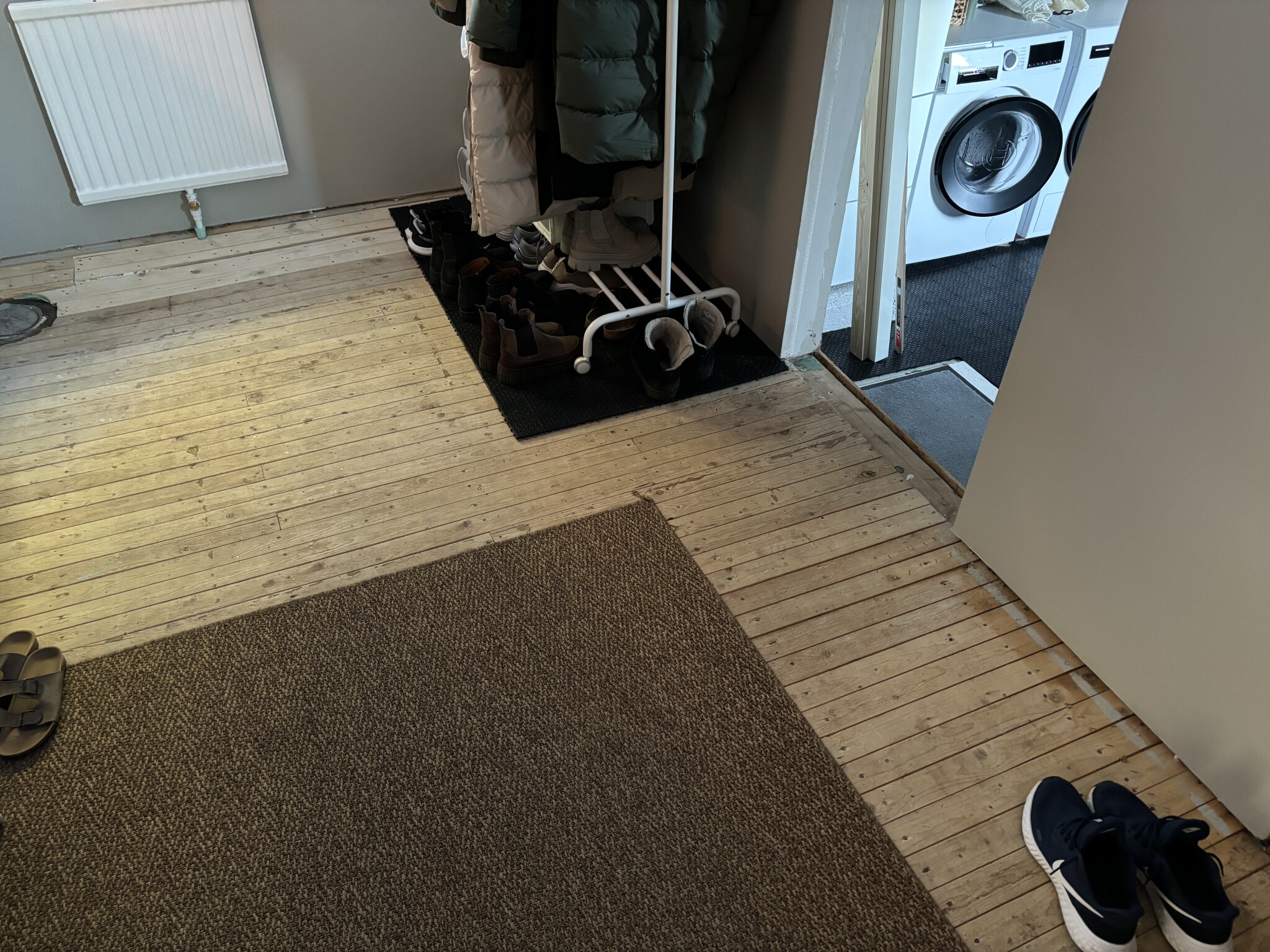
How can I level out different boards at various spots in the tongue and groove so that I can glue floor gypsum on top? It could be about 1-2 mm where it deviates. I want as much support under the gypsum as possible.
Is the glue you use for gluing filling enough that you can apply extra glue to fill it out, or do you lay down felt paper or something similar to level it out?
60x60 tiles will be laid on the gypsum.
What to do?
Is the glue you use for gluing filling enough that you can apply extra glue to fill it out, or do you lay down felt paper or something similar to level it out?
60x60 tiles will be laid on the gypsum.
What to do?
Better to use self-leveling compound with a mesh in it...Dr Benz said:
How can I level out different boards at various spots in the tongue and groove so that I can glue gypsum board on top? It might be about 1-2 mm where it deviates. I want as much support under the gypsum as possible.
Is the glue used for gluing sufficiently filling that you can apply extra glue to fill out, or do you use paper felt or something similar to level out?
60x60 tiles will be laid on the gypsum.
What to do?
Yes, it will likely be stiffer. We usually do 12-15mm.
Reinforcement and fiber filler, and it will be good.
It's often needed to do this as the surfaces are so uneven...
Great! That's the thickness of the gypsum so it doesn't change anything. Is it difficult to get it even, or does it flow well enough to solve itself? Suggestions for self-leveling compound and mesh suitable for this? I'm going to rebuild a small toilet. That is, two interior walls in the corner where the clothes hang. Would you recommend leveling the entire surface first and then building the framework on it, or framework first?Rejäl said:
Best answer
The thickness will be the same as with plasterboard, with plasterboard you will get hollow underneath because the floor is uneven.Top!
It's the thickness of the plaster, so it doesn't change anything.
Isn't it hard to get it even, or does it flow so well that it resolves itself?
Suggestions for self-leveling compound and mesh suitable for this?
I am going to rebuild a small toilet. That is, two interior walls in the corner where the clothes are hanging.
Would you recommend plastering the entire surface first and then framing on it, or frame first?
We have worked a lot with Bostik and rotnät..
https://www.bygghemma.se/hus-och-by...ytspackel-bostik-sl-c400-fiber-20kg/p-1817206
https://www.k-rauta.se/produkt/rotnatspackelnat-25x1145x745-zink/7350011340132
Perfect. I like Bostik. Prefer to buy from them.
IF you are going to have electric heating (at least in the bathroom), do you then lay a cable in the leveling compound or in the adhesive later?
Sorry for so many questions...😩
IF you are going to have electric heating (at least in the bathroom), do you then lay a cable in the leveling compound or in the adhesive later?
Sorry for so many questions...😩

Good input but yes. It's a place by an old well with a slope where the tongue and groove have come apart a bit, but I'll seal that first.BirgitS said:
Otherwise, okay.
Is it so fluid that it's completely self-leveling? Or do you still need to work with it a bit?
And then we're off. Other things were prioritized before this. I've almost floated the entire floor, but I bought too little, so a few more bags are needed.
Once this is done, it's time to start tiling. We are laying 60x60, and the question is, what adhesive is recommended? I plan to ask in the store on Monday when I buy more leveling compound, but I think it would be good to hear from you all here as well.
Preferably something that's easy to work with and doesn't set too quickly. It's my first time laying tiles (have done wall tiles) and with tiles this large.
Is priming needed between the leveling compound and adhesive?
Once this is done, it's time to start tiling. We are laying 60x60, and the question is, what adhesive is recommended? I plan to ask in the store on Monday when I buy more leveling compound, but I think it would be good to hear from you all here as well.
Preferably something that's easy to work with and doesn't set too quickly. It's my first time laying tiles (have done wall tiles) and with tiles this large.
Is priming needed between the leveling compound and adhesive?
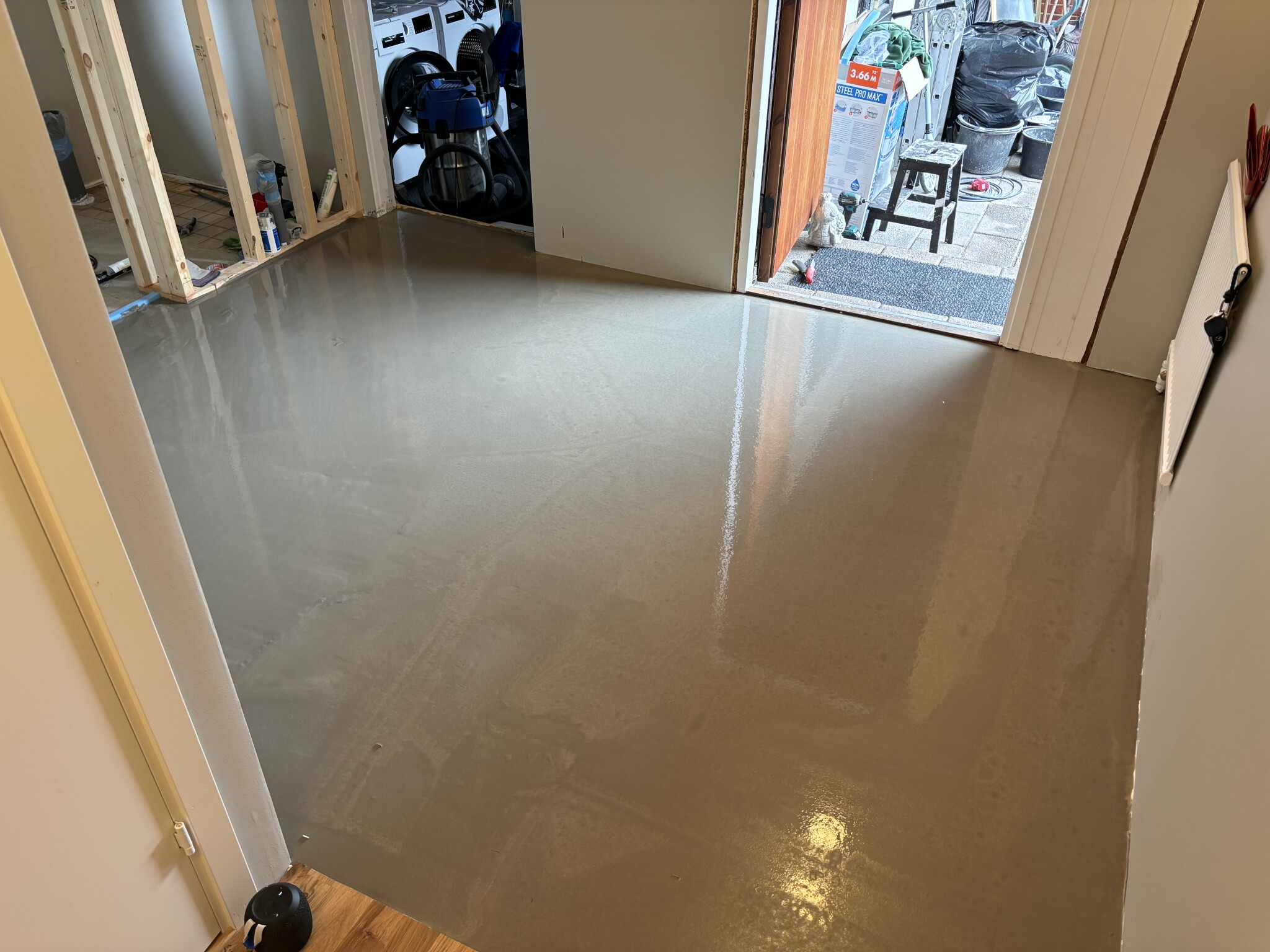
That looks really good. Is it almost just a matter of pouring out the mix and looking happy? Or how do you treat it after you pour it on the floor?And we're off. Other things were prioritized before this. I have floated almost the entire floor but I bought too little, so a few more bags are needed.
Once this is done, it's time to start tiling. We will lay 60x60, and the question is which adhesive is recommended? I plan to ask at the store on Monday when I buy more float, but I think it would be good to hear from you here as well.
Preferably something that is easy to work with and doesn't set too quickly. It's my first time laying tiles (I've done tiling) and those are pretty big tiles.
Is priming needed between float and adhesive?
It actually wasn't that hard to do the actual thing. Pour it out and then rock it with a 50mm plastic pipe about 80 cm wide on a handle.N naikon said:
What I learned was that it dries faster than you can manage to mix 13 bags, so when I wanted to correct a bit where I started, it was too late. So there were some uneven spots but still within tolerance, I would say. It would have been advantageous to have two people. One to mix and one to pour/rock when needed. Managed to cover about 8 sqm and have about 3 left for the remaining hall and where the toilet will be. It took more than estimated because the room was built with a slope for a previous drain. And it consumed more than I had hoped. Bostik is good to work with. However, nothing to compare with...
*Have a canister with the right amount of water per bag marked and ready. Just fill up and pour it in for each bag.
*Have a proper machine that can mix. I bought an Einhell with a powerful motor and 2-speed with a large whisk that mixes really well. It shows no signs of not managing.
*Preparation is key. The neighbor came by before I started, and that made me seal along all the walls one more time. And that was probably good. Otherwise, it would have disappeared into possible gaps.
Next week it’s tiles 60x60. Really nervous. But it has to work out. 🥴