
4,757 views ·
18 replies
5k views
18 replies
How do I know if the wall is load-bearing or not?
How do I know if the wall is load-bearing or not? The ceiling in the basement is concrete resting on leca walls. Those walls are undoubtedly load-bearing 
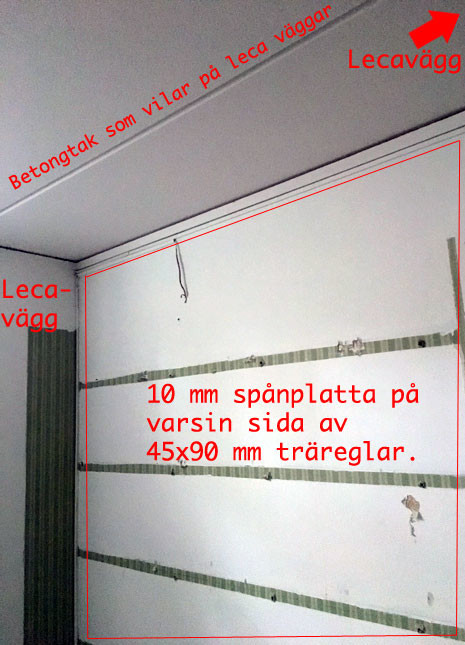
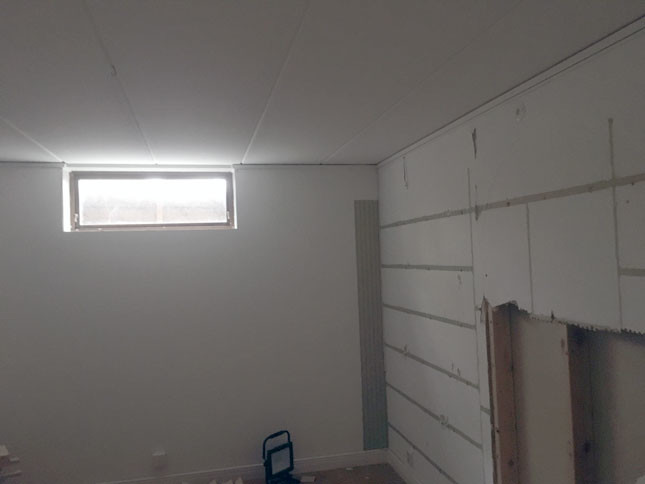
I want to remove the wall in the photo to create a larger room. At some point, someone made an opening about 150 cm wide in the middle of the wall. Then they filled it in to restore a solid wall. I want to remove the entire wall. The wall is framed with 45x90mm wooden studs with 10mm particle board on each side of the studs. Since particle board is used, it feels like the wall is not original from when the house was built in the 70s. I can add that the rest of the house is leca. Even interior walls that are made of slightly narrower leca. The second picture shows more clearly what the ceiling looks like.
I want to remove the wall in the photo to create a larger room. At some point, someone made an opening about 150 cm wide in the middle of the wall. Then they filled it in to restore a solid wall. I want to remove the entire wall. The wall is framed with 45x90mm wooden studs with 10mm particle board on each side of the studs. Since particle board is used, it feels like the wall is not original from when the house was built in the 70s. I can add that the rest of the house is leca. Even interior walls that are made of slightly narrower leca. The second picture shows more clearly what the ceiling looks like.
Last edited:
Probably not load-bearing as the floor structure spans in the other direction. However, it could be a stabilizing wall meant to handle horizontal forces. You will surely get more comprehensive answers shortly.
Thanks for the answer. I can also say, if it matters, that the room is about 5 meters long and 4 meters wide. The same size room on the other side of the wall. What I'm trying to say is that there is nothing other than the lecaväggarna supporting the roof over a span of 10 meters. So it feels strange if the wall would be needed right there.P petterovski said:
Best answer
It is not load-bearing for vertical forces. It could be stabilizing, but this is also unlikely because you have a rigid framework where the horizontal forces are transferred via this to stabilizing outer/inner walls. How far is it to the outer/inner leca wall on the left and right in the image?E Elnovis said:Thank you for the response. I can also mention if it matters that the room is about 5 meters long and 4 meters wide. The same size room on the other side of the wall. What I'm trying to say is that there's nothing other than the cinder block walls supporting the ceiling for a length of 10 meters. So it feels strange if the wall would be needed just there.
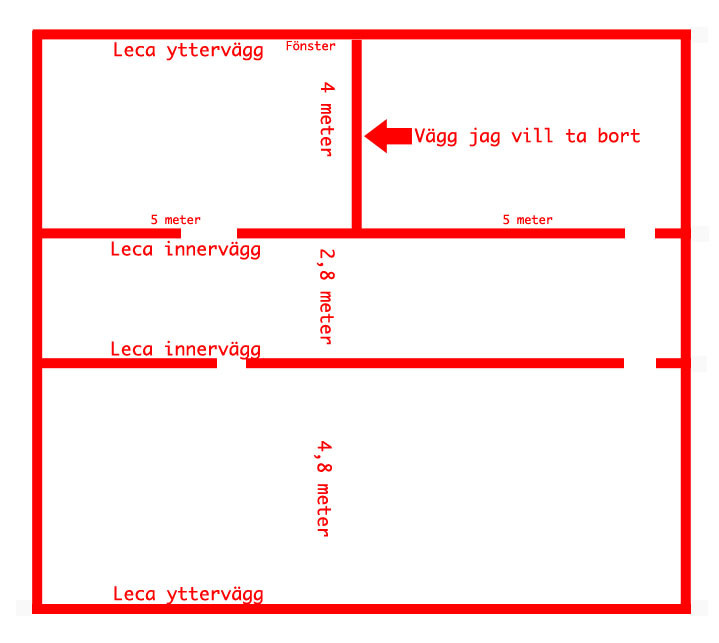
I have drawn a picture to make it a bit clearer. There I have also included measurements and the window you see in one of the images to make it easier for you to orient yourself. This is only a small part of the house as it is built in an L shape. It is a large house of 184 square meters with an equally large basement.P petterovski said:It is not load-bearing for vertical forces. It might be stabilizing, but that's unlikely since you have a rigid floor where the horizontal forces are transferred via this to the stabilizing exterior/interior wall. How far do you have to the exterior wall/interior wall made of leca to the left and to the right in the picture?
You can tear down the wall.

The floor structure is probably made of lightweight concrete elements. These are usually never laid on stud walls. So the wall is certainly not load-bearing. The production of chipboard got started in the late 60s. They contained a lot of formaldehyde at that time. They quickly became very popular due to their price and utility. Not least, they allowed one to make beds cheaply and easily.
Formaldehyde is apparently toxic. Is there something I should consider when tearing down the wall? I don't know how old these particle boards are and it's hard to find out.J justusandersson said:The floor structure probably consists of lightweight concrete elements. Such elements are usually not supported on stud walls. So the wall is likely not load-bearing. The production of particle boards started in the late 60s. They contained a lot of formaldehyde at that time. They quickly became very popular due to their price and usability. Especially for making beds cheaply and easily.
Last edited:
Most of the formalin is probably not left, so you probably don't need to worry about that. It has disappeared into the air. I would like to take this opportunity to correct myself regarding chipboard. The major production started in the late 60s, clearly linked to the "miljonprogrammet," but the material has existed longer. I suddenly remembered building a bookshelf from veneered chipboard in woodworking class in the early 60s, but back then it was mostly a furniture material.
The wall you want to remove may have a stabilizing function. (But then there should be a similar one on the other side of the house as well.) 10-meter long walls of "lecasten" usually require lateral stabilization, somewhat depending on earth pressure, etc. It could be that there were walls that are now removed. Worth checking.
The wall you want to remove may have a stabilizing function. (But then there should be a similar one on the other side of the house as well.) 10-meter long walls of "lecasten" usually require lateral stabilization, somewhat depending on earth pressure, etc. It could be that there were walls that are now removed. Worth checking.
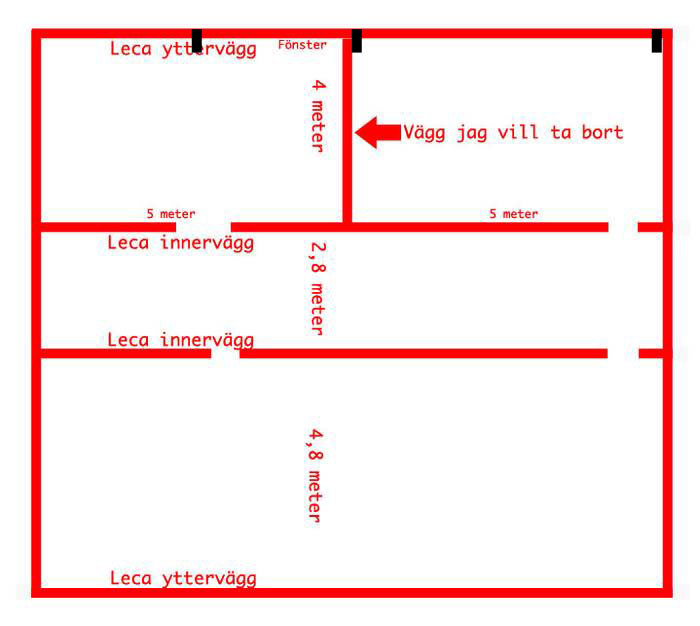
I forgot to mention that there are pillars in some places on the exterior walls. Could these have a stabilizing function?J justusandersson said:Most of the formalin is probably not left, so you probably don't need to worry about that. It has evaporated into the air. I want to take this opportunity to correct myself a bit regarding particle boards. The major production started in the late 60s, clearly linked to the million program, but the material has been around longer. I suddenly remembered building a bookshelf from veneered particle board in crafts class in the early 60s, but then it was mostly a furniture material.
The wall you want to remove may have a stabilizing function. (However, there should be a similar one on the other side of the house as well.) 10-meter long walls of lecasten usually require lateral stabilization, somewhat depending on ground pressure, etc. It's possible that there were walls that have now been removed. Worth checking.
Yes. Can't you draw them into your sketch?
Great! Then I have no objections to tearing down the wall.
They stiffen the leca wall laterally and prevent it from bulging inward. A basement wall is exposed to soil pressure. Above-ground walls for lateral loads due to wind.