
9,473 views ·
14 replies
9k views
14 replies
Spliced stud as strong as regular?
Saw that they had long finger-jointed beams at Byggmax https://www.byggmax.se/45x220-regel-fingerskarvad-c24-p662009
Suppose you need a beam on pillars longer than the longest beam they have. Is it better to splice the beam on a pillar yourself or to use a longer finger-jointed beam where the joints are between pillars?
Suppose you need a beam on pillars longer than the longest beam they have. Is it better to splice the beam on a pillar yourself or to use a longer finger-jointed beam where the joints are between pillars?
It is certainly "better" to use a longer finger-jointed stud. It is classified as C24 and this applies to the entire stud including the finger joints. A well-executed finger joint is stronger than the wood around it.M Martin Lj said:
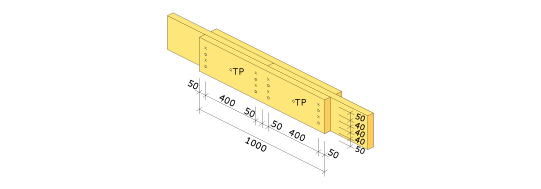

Correct. Then there is a breaking force / pulling apart. If you instead splice 1/3 in from the support, it becomes a shear that needs to be absorbed, which is also easier to counteract.V vectrex said:
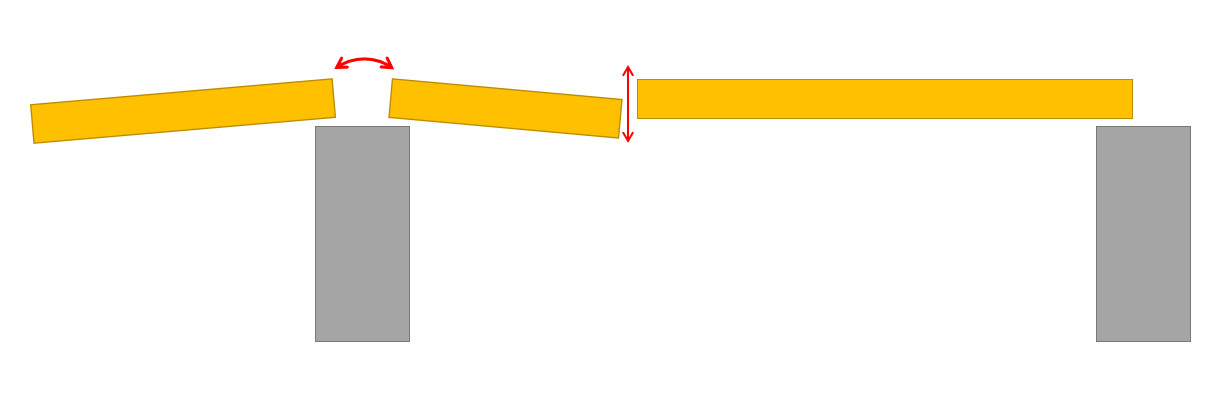
I understand. One thought might otherwise be that there is support when the joint rests directly on a pier. But now I'm starting to feel like I may have misunderstood the main question.V vectrex said:
Moreover, my feeling is that finger joints are weaker than completely knot-free timber. This is from an experiment to lift an old lamppost with a jack, blocking, and 2”5”. Finger-jointed timber gave way and snapped. Knotty timber as well. Then there was a piece of timber with tight growth rings, no knots, which was absolutely incredible. The post went up anyway!
That is absolutely true, but it’s not the finger joints that make it weak, it’s the knots. It’s difficult to find timber that is completely knot-free; you’ll have to search for a long time.T Tsdoesds said:I understand. An alternative thought might be that there is support when the joint rests directly on the plinth. But now I'm starting to feel that I might have misunderstood the main question.
Moreover, my feeling is that finger joints are weaker than completely knot-free timber. This from an experiment to jack up an old lamppost with a jack, blocking, and 2”5”. Finger-jointed wood gave way and snapped. Knotty wood likewise. Then there was a piece of timber with tight growth rings, no knots, which was absolutely amazing. The post went up anyway!
Best answer

The theory behind placing the joints on a beam about 1/3 from the supports is based on the idea that the joint should be made where the bending moment is zero. A beam that is supported on several supports (called continuous) has its largest positive bending moment midway between the supports and its largest negative bending moment (largest) over the supports. Somewhere in between, the bending moment changes direction and passes through zero.
When it comes to headers, i.e., the third supporting level after floor timber, and beams, other aspects need to be considered, especially shear forces. The timber's ability to handle these depends on the cross-sectional area, regardless of the strength class. Therefore, it is often a better strategy to use double joists, with lower height, with staggered joints for the headers. The properties of finger-jointed timber are best utilized as beams (second level) over multiple supports.
When it comes to headers, i.e., the third supporting level after floor timber, and beams, other aspects need to be considered, especially shear forces. The timber's ability to handle these depends on the cross-sectional area, regardless of the strength class. Therefore, it is often a better strategy to use double joists, with lower height, with staggered joints for the headers. The properties of finger-jointed timber are best utilized as beams (second level) over multiple supports.
Click here to reply