
Hello!
We have major problems with internal condensation in our one-year-old house (completed in December 2020).
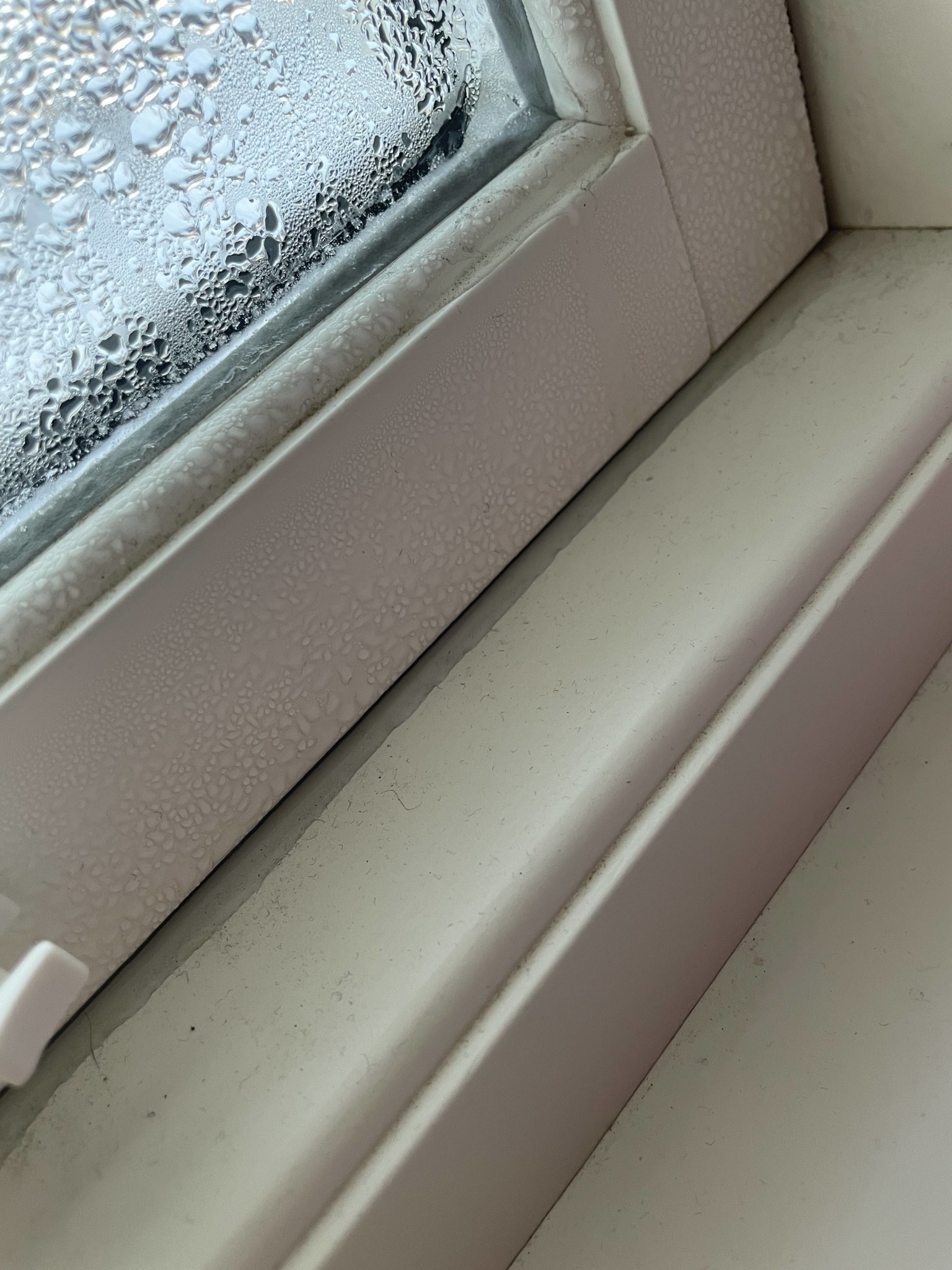
The problem arises as soon as the temperature drops below zero outside. As soon as it goes below freezing outside, condensation begins to form in the bottom corners of the windows.
We have double-checked the ventilation and had people come to check the airflows, and everything with the ventilation seems okay.
We have also been in contact with the window manufacturer, who states that the amount of condensation we have is harmful to the windows, but that it is not due to the windows themselves but possibly how they are installed.
So now to our question:
How far out is it okay to install windows?
Our windows are mounted two cm outside the insulation. The outer glass of the windows is two cm inside the wood of the windows. This means the outer glass is positioned exactly in line with where the insulation begins.
Could this be causing the issue?
The "air gap" is 45 mm. Could this affect internal condensation by allowing more cold air into a large air gap?
The windows are double-pane from SP fönster. We understand that it would also have been better for internal condensation to have radiators under the windows, but we have underfloor heating.
The problem appeared already last winter when we had just moved in, but we were told that internal condensation can occur if there is a lot of construction moisture left. Now a year has passed, and we have had a dehumidifier running (in the bathroom) for most of the year, plus we had a dehumidifier running during the construction period, so construction moisture should no longer be a factor.
The pictures show the condensation on the windows when it was about -14 degrees outside.
We have major problems with internal condensation in our one-year-old house (completed in December 2020).
The problem arises as soon as the temperature drops below zero outside. As soon as it goes below freezing outside, condensation begins to form in the bottom corners of the windows.
We have double-checked the ventilation and had people come to check the airflows, and everything with the ventilation seems okay.
We have also been in contact with the window manufacturer, who states that the amount of condensation we have is harmful to the windows, but that it is not due to the windows themselves but possibly how they are installed.
So now to our question:
How far out is it okay to install windows?
Our windows are mounted two cm outside the insulation. The outer glass of the windows is two cm inside the wood of the windows. This means the outer glass is positioned exactly in line with where the insulation begins.
Could this be causing the issue?
The "air gap" is 45 mm. Could this affect internal condensation by allowing more cold air into a large air gap?
The windows are double-pane from SP fönster. We understand that it would also have been better for internal condensation to have radiators under the windows, but we have underfloor heating.
The problem appeared already last winter when we had just moved in, but we were told that internal condensation can occur if there is a lot of construction moisture left. Now a year has passed, and we have had a dehumidifier running (in the bathroom) for most of the year, plus we had a dehumidifier running during the construction period, so construction moisture should no longer be a factor.
The pictures show the condensation on the windows when it was about -14 degrees outside.


Condensation occurs when the warm indoor air is cooled down upon meeting the inside of the window. There are several parameters that need to be considered to understand why you are experiencing condensation. The temperature on the inside of the glass, the temperature of the room air, and the room air's relative humidity. I find it far-fetched that the windows become cold due to the (sloppy?) installation of the windows. How are your sealing strips? Get a weather station so you can log the different variables. In an emergency, you can investigate the temperature around the windows with a thermal camera. It reveals thermal bridges effectively.
Construction veteran
· Norrland
· 342 posts
Are the insides of the windows flush with the outside of the insulation? It sounds like they are positioned very far out if that's the case. Could that be what's affecting it, perhaps? Is there any window in the house that's set further in, and if so, does it get condensation on that window?
In a wooden facade, the outside of the window frame is normally aligned with the facade panel, so that the gap between the frame and window opening in the facade can be covered with a trim board. The gap between the frame and window opening must be sealed, as must the contact surface between the sash and frame on the inside with sealing strips. Double-glazed insulated glass units are normally not sufficient to meet the requirements of the BBR (Swedish Building Regulations) in a newly built house unless compensated with thicker insulation than usual, for example in the walls. This can lead to deep window niches that impair air circulation. As I wrote in my previous post, many parameters are important. Without knowledge of most, it is just speculation.
No, they don’t sit that far out. The outermost window glass is exactly level with the edge of the insulation. Since it is two cm from the wood on the outside of the window to the window glass itself, the window is positioned two cm outside the edge of the insulation (but the window glass aligns with the edge of the insulation).S Snickarkirre said:
looking at the wall from the outside, it is:J justusandersson said:On a wooden facade, the outside of the window frame is normally aligned with the facade panel, so that the gap between the frame and the window opening in the facade can be covered with a trim board. The gap between the frame and the window opening must be insulated, and the contact surface between the sash and the frame on the inside must have sealing strips. Double-glazed windows are normally not sufficient to meet the requirements in BBR (Boverket's Building Regulations) in a new house, unless it is compensated with thicker insulation than normal in, among other things, the walls. This can lead to deep window niches that impair air circulation. As I wrote in my previous post, there are many parameters that matter. Without knowledge of most, it is just speculation.
22 mm (battens), 22 mm (baseboard), 45 mm (ventilation), 9 mm (GU), 195 mm (insulation), 45 mm (insulation), 25 mm (plywood+gypsum)
and looking at how the window is positioned:
22 mm (trim board), 55 mm (lining) and then the window is placed.
in other words, the window is extended about 2 cm compared to how many usually build (as we understand). Do you think this affects the condensation?
we will unscrew the lining outside one of the windows and check how it is insulated. In addition, we know someone who can borrow a thermal camera, so we will also do this next week to see if we get any wiser!
thanks for the response!
Construction veteran
· Norrland
· 342 posts
Absolutely, I completely understand. But it's not uncommon to have moldings on the outside of windows either. I thought it sounded like it was placed almost outside the insulation. But now misschico wrote that it wasn't, and it was I who misunderstood that. Sure, there are many parameters that play a role. I just thought there might be a window/door that was mounted further in and maybe didn't have the same problem with condensation, and then that might have been a clue as to what COULD be the issue.J justusandersson said:For a wood façade, the exterior of the window frame is normally aligned with the façade panel, so that the gap between the frame and the window opening in the façade can be covered with trim board. The gap between the frame and the window opening must be insulated, as must the contact surface between the sash and the frame on the inside, which must have sealing strips. Double-glazed windows are normally not sufficient to meet the requirements of BBR (Swedish National Board of Housing, Building and Planning's Building Regulations) in a new house, unless compensated with thicker insulation than normal in areas like the walls. This can lead to deep window niches that impair air circulation. As I wrote in my previous post, there are many parameters that matter. Without knowledge of most, it is just speculation.
All the windows are installed the same way and all windows have the same problem in the living area.S Snickarkirre said:Absolutely, I completely agree. But it's not uncommon to have trim on the outside of windows either. I thought it sounded like it was basically outside the insulation. But then misschico wrote that it wasn't, so I misunderstood it. Yes, of course, there are many parameters involved. I just thought that maybe there was some window/door installed further in and maybe didn't have the same condensation problem and that might have been an indication of what COULD be the problem.
We actually live on top of a garage (built an apartment above a double garage). In the garage, on the ground level, we haven't seen as much condensation, but we're not there all the time, so maybe we just haven't noticed it as much there.
With 55 mm casing, I would probably say that the window is relatively recessed for a wooden facade. The outer wall has a U-value of approximately 0.2, which I find surprisingly high (= poor) in combination with 2-glass insulated panes. But that is hardly the cause of the condensation problems.
U
Utsliten och utdömd
Building conservationist
· 2 795 posts
Utsliten och utdömd
Building conservationist
- 2,795 posts
Do you park a damp/snowy car in the garage?
The moisture has to come from somewhere.
In our previous house, we had 450mm insulation and triple-glazed windows that were installed flush with the facade. We didn't have this problem at all. Quite the opposite, we had condensation on the outside of the windows on summer mornings and frost on the outside of the windows in winter.
The moisture has to come from somewhere.
In our previous house, we had 450mm insulation and triple-glazed windows that were installed flush with the facade. We didn't have this problem at all. Quite the opposite, we had condensation on the outside of the windows on summer mornings and frost on the outside of the windows in winter.
Yes, that's how you want it to be. So that condensation forms on the outside, that is!U Utsliten och utdömd said:Do you park a damp/snowy car in the garage?
The moisture has to come from somewhere.
In our previous house, we had 450mm insulation and triple-glazed windows that were mounted flush with the facade. Didn't have this problem at all. Rather the opposite, we had condensation on the outside of the windows on summer mornings and frost on the outside in winter.
We often park the car in the garage below, but the garage has its own ventilation. In other words, the systems are not connected and are not the same type of system either.
the ventilation is also wider than normal. Is 55 mm still a relatively large packing?J justusandersson said:
What kind of heating system do you have? Is it an air source heat pump (LVP) or do you have radiators under the windows? As mentioned, the windows can get too cold in combination with high humidity. This humidity can be due to poor ventilation combined with moisture from drying wood in the construction sector. I had similar problems with floor-to-ceiling windows in a newly built house that was heated with an air source heat pump. I bought a humidity/CO2 meter and could quickly ascertain a high humidity level in combination with poor ventilation (CO2 often exceeded 1500 ppm). I resolved this by adding extra ventilation and ensuring that nothing was covering the windows.
Looking at the pictures, you can see that there is condensation on the wood as well and not just on the glass. This indicates that the entire window construction has too poor a u-value relative to the climate where you live. You probably needed better windows. The number of people in your household also has a significant impact on the humidity in the house. A person emits quite a bit of moisture through breathing and sweating. How many people are there in your household?