
8,013 views ·
23 replies
8k views
23 replies
Will three load-bearing beams be enough?
Are you completely sure? I spoke to a carpenter yesterday and he said I needed to dig a row with plitar, would have preferred to avoid it because there are so many rocks in the ground.E erikjakan said:
I used 40cc to handle the deflection according to the Swedish wood table.
Sorry, I read too quickly, 3m cc on the beams is a bit too far.
I have actually added another beam, how does the ground look? Many times garden slabs are sufficient as a foundation for decks. It's easy to adjust as needed if something settles.
I have actually added another beam, how does the ground look? Many times garden slabs are sufficient as a foundation for decks. It's easy to adjust as needed if something settles.

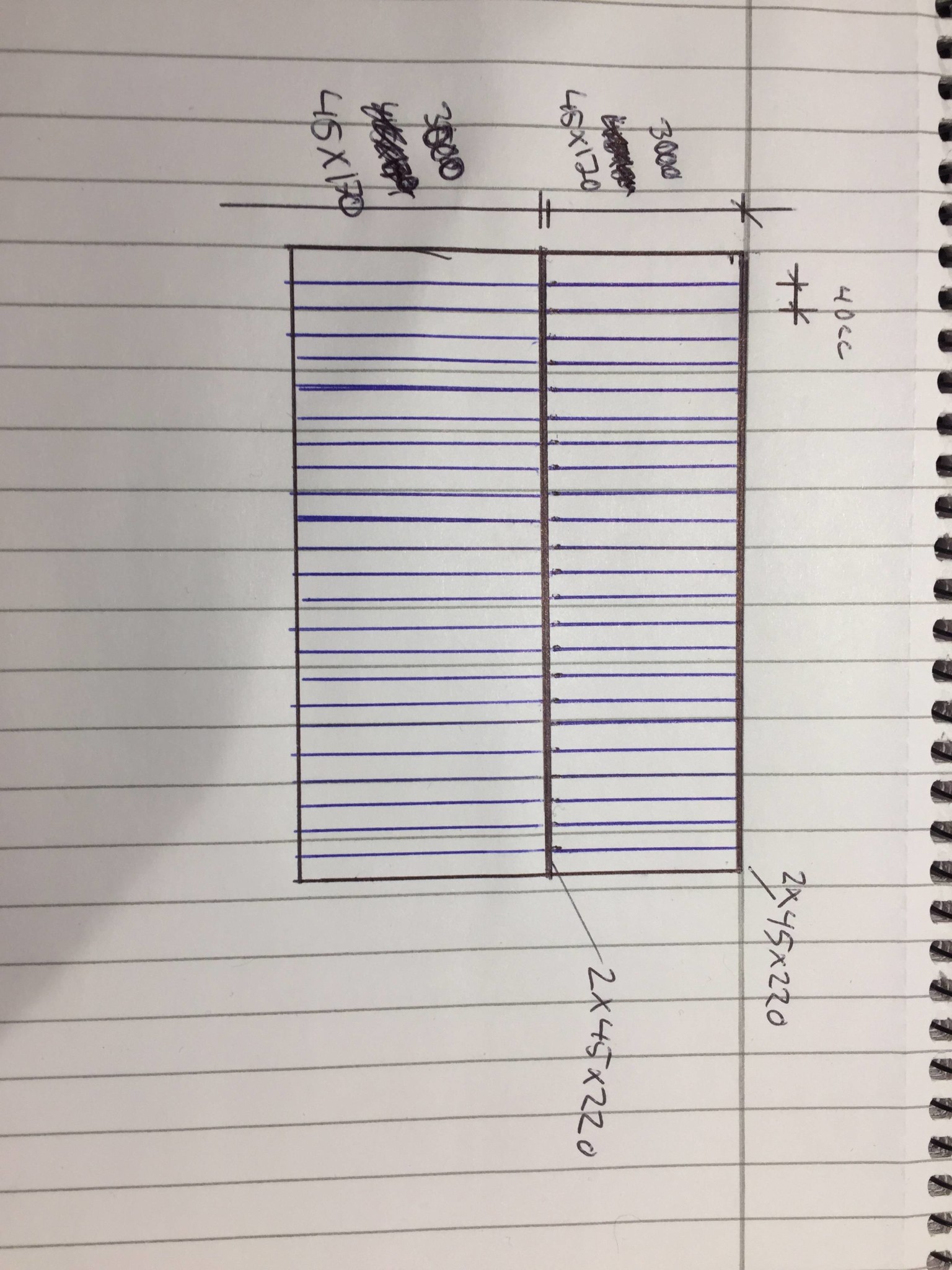
Constructing a deck is a kind of zero-sum game. Spans that are too large to save on footings cost in the form of larger timber dimensions. To limit the bounce in the deck, it is primarily the span of the floor joists that needs to be controlled. Reducing their c/c spacing has a marginal effect and has the greatest impact on the choice of decking dimension. For the beams, it is also important to pay attention to the shear forces at the footings. This is regulated by footing spacing or beam dimension. If you want three beams so that the floor joists have a span of 3 meters, they need to be 45x220 C 24. A suitable c/c distance is 600 mm for 28x120 decking. For 34x145 decking, it can be increased to 750 mm. With 2 m footing spacing (and the other choices you have made), the beams must consist of double joists. However, 2 pieces of 45x145 that are screwed and glued are sufficient.
see post #12
https://www.byggahus.se/forum/threads/naesta-projekt-traedaeck.340945/
I dug away grass and topsoil down to the moraine, dumped a load of 10 tons of 8-16 crushed stone which was leveled out and compacted.
Old garden slabs c-c about 1200 cm on this, carrying beams 45x145 then joists also 45x145. Finished with proper decking 34x145 which was screwed into every other joist with hidden stainless A4.
post #4
https://www.byggahus.se/forum/threads/utformning-traedaeck.302611/#post-2796263
https://www.byggahus.se/forum/threads/naesta-projekt-traedaeck.340945/
I dug away grass and topsoil down to the moraine, dumped a load of 10 tons of 8-16 crushed stone which was leveled out and compacted.
Old garden slabs c-c about 1200 cm on this, carrying beams 45x145 then joists also 45x145. Finished with proper decking 34x145 which was screwed into every other joist with hidden stainless A4.
post #4
https://www.byggahus.se/forum/threads/utformning-traedaeck.302611/#post-2796263
J justusandersson said:Constructing a deck is a kind of zero-sum game. Large spans to save posts cost in terms of larger timber dimensions. To limit the bounce in the deck, it is primarily the span of the floor joists that you need to keep in check. Shortening their c/c distance has a marginal effect and is most significant for the choice of decking dimension. For the beams, it's also important to pay attention to the shear forces at the posts. You regulate this with post spacing or beam dimension. If you are going to have three beams so that the floor joists have a span of 3 meters, they need to be 45x220 C 24. A suitable c/c distance is 600 mm for 28x120 decking. For 34x145 decking, it can be increased to 750 mm. With 2 m post spacing (and the other choices you’ve made), the beams must consist of double joists. However, 2 pieces of 45x145 that are screw-glued are sufficient.
Thanks for your response! The beams can be 2 pieces of 45x145 screw-glued but the floor joists should be 45x225, have I understood you correctly?
I will use 34x145 decking, by the way.
Yes, but the dimension is 45x220 now.
It depends a bit on the criteria you use. If you assume that it is important to limit the deflection, I would say 3.2 meters. From there to the point where the beam fails due to fracture is a long way off. Decking differs from indoor joists as the decking boards have gaps and therefore interact poorly.
Thank you so much for your help, are you possibly a structural engineer?J justusandersson said:
I am an older architect with training in building construction.
A cheat solution if you don't feel like digging more post rows could be to add two extra load-bearing beams that you just support with 45x70 down into the ground at a suitable center-to-center distance. Depending on the condition of the ground, it might be enough to sharpen them and hammer them more in. This adds a lot in terms of counteracting flex. The post rows will keep the deck in place anyway, but flex is annoying. Save money by going for larger center-to-center distances on the nail boards.
