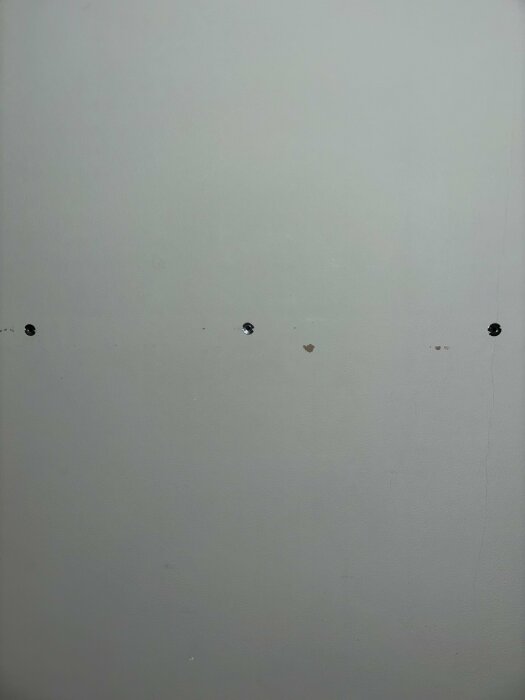
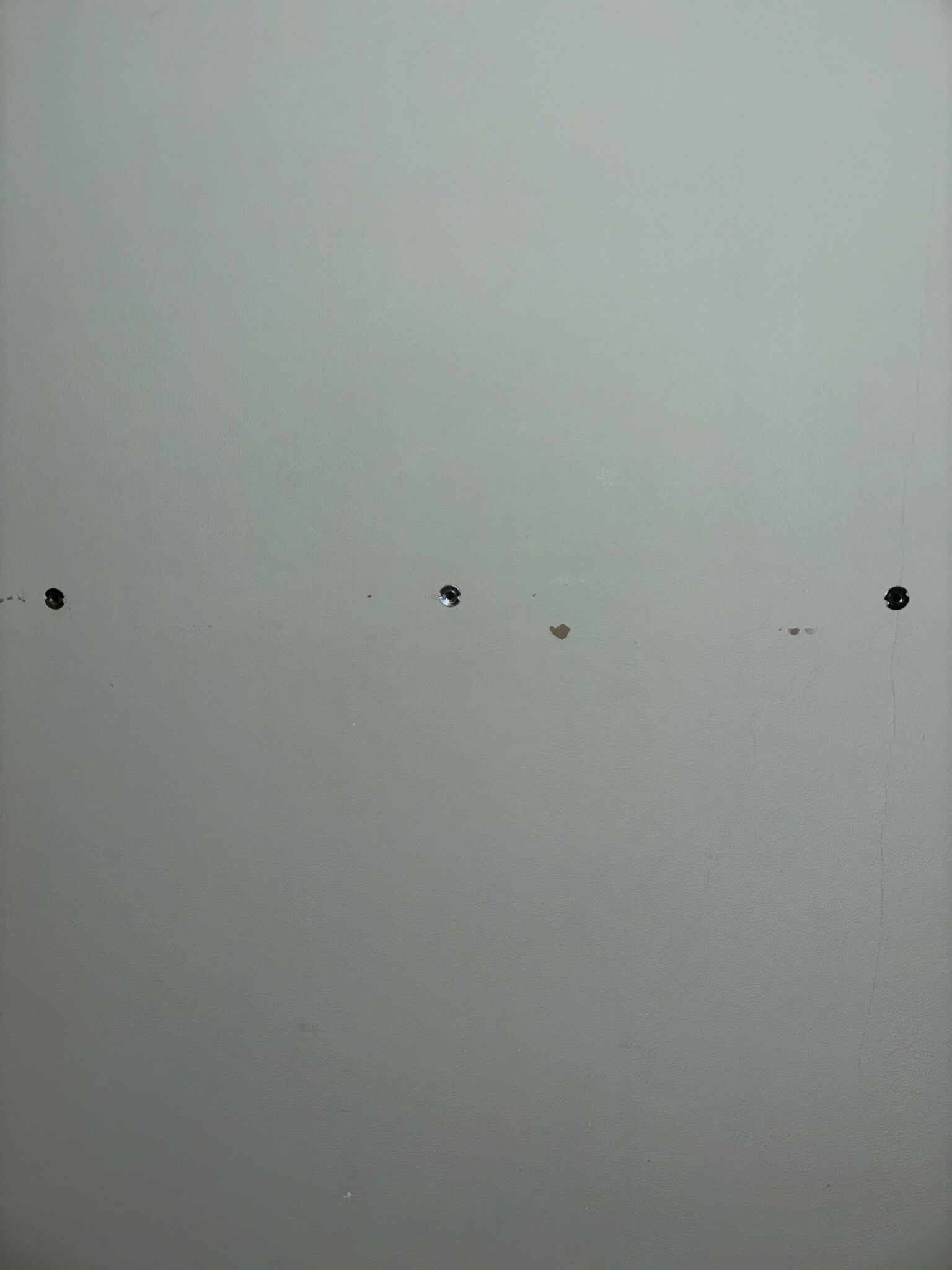
Going to mount a TV (58 inches, 18 kg) on a drywall. No studs as far as I can tell. There are 3 molly bolts (m4) horizontally spaced about 25 cm apart in the wall now (see picture), where a (somewhat smaller) TV was mounted before. What do you think? Can this hold the TV as it is with a suitable bracket, or should I add more expanders to sleep soundly? Grateful for any input.
A molly plug can handle up to 20 kg. If you can use all three holes for your bracket, it's definitely fine. If you have a new TV with a new bracket, you probably want to place it where you want it, often with four mounting points. It works without any issues in a drywall if you have the right plug.
Thank you! It's very possible there is osb, but hard to know since the person who did the renovation is two owners back.
You can check the thickness by bending a paperclip into an L shape, insert it into the hole, and pull back so it gets stuck. But regardless, I've lived in an apartment with a 65” TV with three Molly just like your example, and it hasn't been a problem at all.
A molly bolt can handle close to 20 kg. If you can use all three holes for your mount, it's definitely safe. If you have a new TV with a new mount, you surely want to place it where you want it, often with four mounting points. It works without problems on a plaster wall if you have the right plugs.
Most standard wall mounts fit excellently with current mollys.
Drill an 80 hole (so a dose cap fits), feel for studs if there aren't any, insert osb or a piece of wood, mollys and hinge straighteners are for janitors.
It can be difficult to find studs even with single drywall, and even harder with double drywall and insulation. It might also be that they are metal studs, which should be easy to find with a metal detector.
If you can't find any studs, you need to figure out the type of wall, single, double, OSB, plywood? The picture shows a vertical crack along the right molly plug; if there are cracks in the drywall, the strength is likely significantly reduced.
Drill a small test hole, is there sawdust coming out? Insert a nail or screw head to determine the thickness.
If it's single drywall, I would want 2-3 molly plugs, mainly to be on the safe side. How much a molly plug can hold depends mainly on the wall material and thickness but also on the size/design of the molly plug. Generally, I believe they can hold around 20-30 Kg under good conditions.
If you want to be completely sure, test the weight, hang equivalent weights (plus a little more) in the TV mount overnight before the TV goes up.
It can be difficult to find studs even with single plaster, but even more challenging with double plaster and insulation. It could also be that there are metal studs, which should be easy to find with a metal detector.
If you don't find any studs, you need to figure out what kind of wall it is, single, double, OSB, send? In the picture, it looks like there's a vertical crack along the right molly plug; if there are cracks in the plaster, the load-bearing capacity is likely significantly reduced.
Drill a small test hole; does any sawdust come out? Insert a nail or screw head and determine the thickness.
If it's single plaster, I would want 2-3 Molly plugs, mainly to be on the safe side. How much a Molly plug can hold depends primarily on wall material and thickness, but also on the size/design of the Molly plug. Generally, I think they can hold around 20-30 kg under good conditions.
If you want to be completely sure, test the weight by hanging equivalent weights (plus a little extra) on the TV mount overnight before the TV goes up.
It can be difficult to find studs even with single drywall but even harder with double drywall and insulation. It could also be that there are metal studs which should be easy to find with a metal detector.
If no studs are found, you must figure out what kind of wall it is, single, double, OSB, skicka? In the picture, there appears to be a vertical crack along the right molly plug, if there are cracks in the drywall, the strength is likely to be significantly reduced.
Drill a small test hole, does any sawdust come out? Insert a nail or screw head to determine the thickness.
If it is single drywall, I would want 2-3 Molly plugs, mainly to be on the safe side. How much a molly plug can hold mainly depends on the wall material and thickness but also on the size/design of the Molly plug. Generally, I think they can hold around 20-30 Kg under good conditions.
If you want to be completely sure, test the weight, hang equivalent weights (plus a little more) in the TV mount overnight before the TV goes up.
Thank you very much! Indeed, a vertical crack at the right plug. No cracks at the other 2 though. If the two can handle, say, 15 kg each, I'm good with a margin. Weight test sounds like a good idea.