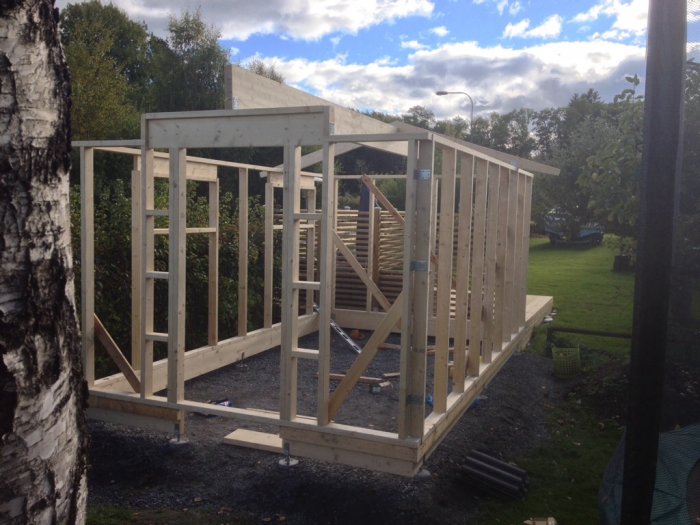
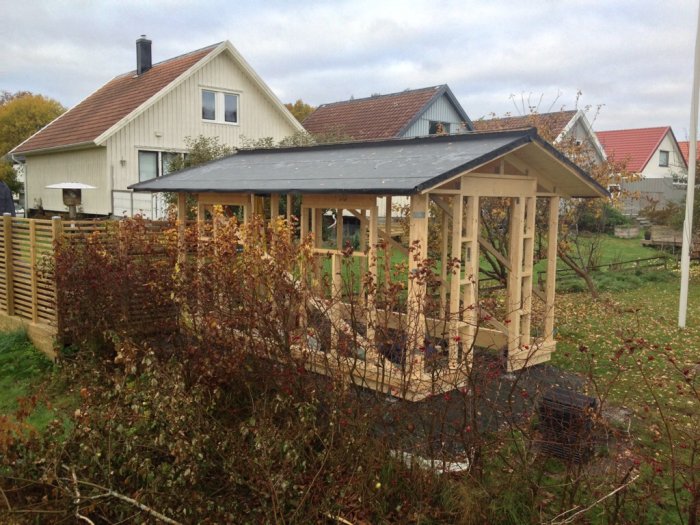
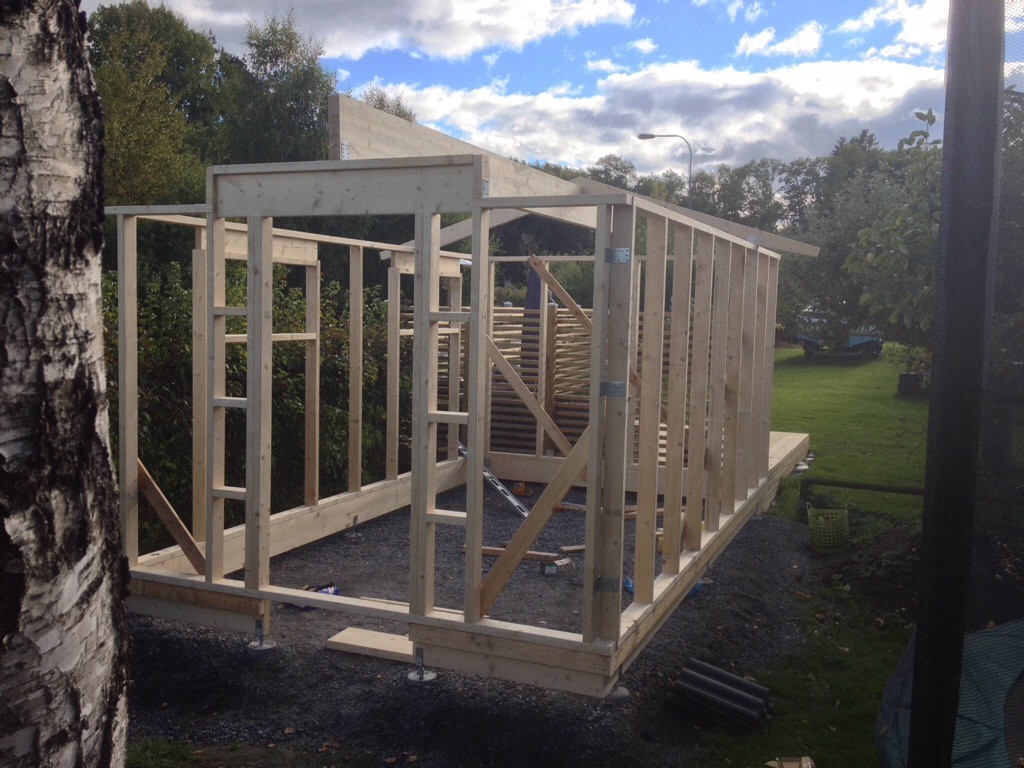
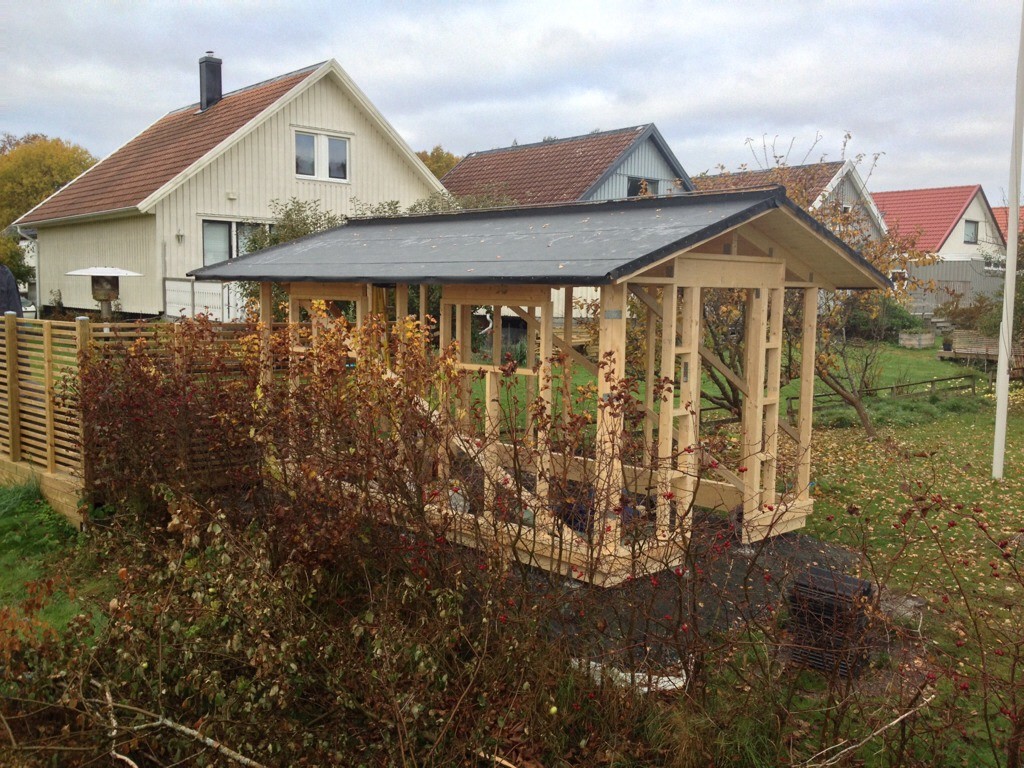
I am in the process of building a custom-designed shed from loose timber! I've just put on the roofing felt. The roof is designed for concrete roof tiles and has a sturdy glulam ridge beam. Ideally, I would like to complete the roof as the next step, but I feel a bit unsure if the lateral stability is sufficient with only standing studs in the walls. The tiles will weigh near 1000kg. I have placed temporary braces on all walls, and after that, it feels very stable. Essentially nothing happens if I stand and shake the ridge hard (I weigh over 90kg). But with an autumn storm like Gudrun, I'm a bit uncertain, what do you think? Does the nailing batten stabilize much? I was thinking of using 28x70 at 600 centers.
It may take a while before I insulate and clad the inside with OSB.
I'm building a custom-designed shed with loose timber! I've just put on the roofing felt. The roof is sized for concrete roof tiles and has a sturdy laminated beam as the ridge beam. I would prefer to complete the roof entirely as the next step but I'm a bit unsure about the side stability with just the standing studs in the walls. The tiles will weigh nearly 1000kg. I've placed temporary side braces on all the walls, and after that, it feels very stable. In principle, nothing happens if I stand and shake the top of the ridge (I weigh over 90kg). But with an autumn storm like Gudrun, I'm a little unsure, what do you think? Does the nailing battens stabilize a lot? I was thinking of using 28x70 on 600 centers.
It may be a while before I insulate and cover the inside with OSB.
[image]
[image]
Shouldn't the facade go on? It also stabilizes quite a bit.
Diagonal braces on the inside until it's time for OSB/gypsum?
Shouldn't the façade be installed? It also stabilizes a bit.
Diagonal braces on the inside until it's time for osb/gypsum?
Does a standing façade really stabilize that much? Of course, the façade should be installed, but I want to paint it first, and it's a bit cold to stand outside and paint now. I was thinking of finishing the roof first before the snow comes!
It's good (but not entirely necessary) to have two on each wall, sloping in opposite directions, i.e., a total of 8 braces.
They can be placed on the inside as well as the outside.
They should stay in place until at least one interior wall panel (gypsum, for example) is mounted on the wall.
The outer panel usually also provides good bracing, but with some risk of slight movement, which can lead to crooked walls.
Make sure that the frame is truly straight everywhere and in every way before you proceed.
Thanks for all the answers! I feel more secure now. The frame is straight in every way (or at least it was a week ago). The Hultafors MST 180 is good, but the precision can drive you crazy compared to a regular level. If a stud leans 5mm over 2 meters, it looks completely off with that level.
Since all corners, door studs, and posts center the bubble on the MST 180 in both directions, it should be quite straight now! I will triple-check again before I start screwing in the nailers.
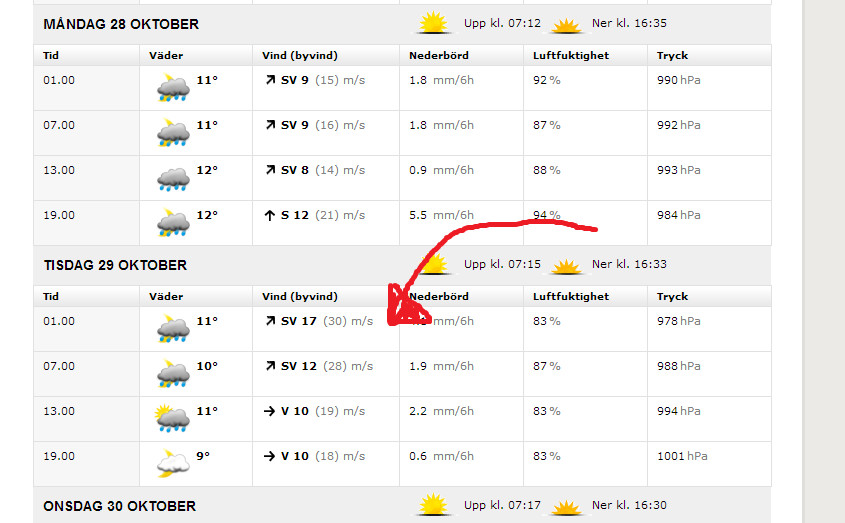
I haven't managed to get the concrete tiles on yet, but I do have windproof fabric. However, there are no battens yet. Now it looks like a storm is coming on Monday. The SMHI app says 29 m/s in the gusts here. If that happens, will the fabric withstand it or will it break? It's stapled with wide-thread staples according to all the rules, but as I said, no battens yet. Should I be worried?
Can't you insulate a couple of compartments on three interior walls and put up a board on each? That would stabilize... Otherwise, maybe a temporary diagonal nail brace on each wall.
Can't you isolate a couple of slots on three interior walls and put up a board on each? That would stabilize... Otherwise, perhaps a temporary diagonal stud on each wall.
Maybe a bit unclear, but if you read the whole thread then.
Yeah, I'm not worried about the house anymore. This time it was specifically about the windbreaker!
Damn it! It was expensive as hell. What should I do to save it? Tell the family I'm busy all weekend and put up the panel for dear life, maybe?
What I might manage to do is put up nail battens at the joints, then I actually think it will hold. It's really tough (T-Vind Super).
I'm doubtful it would hold. I've experienced several instances where it's blown apart.
By the way, I've never used T-Vind Super, or is it the one with green text and green rectangles? If so, it has never blown apart for me, but I don't know if it's been that windy when I've used it.
The best idea is probably to tell the family that you're occupied and hammer up the panel over the weekend.
What is your wind situation? Is it somewhat sheltered by trees, buildings, etc.?
But if you can reinforce it with some nails and studs, etc., that might help a bit. It should be pretty quick to put up almost all the nail studs, right?
If you have any lightweight tarpaulins left over, you could use them to reinforce/protect maybe.
If you already have insulation and drywall at home, you give the fabric good support if you press in the insulation and then put on a drywall. This way, you provide support to the wind barrier from the inside, and there won't be significant forces on the fabric. Just make sure that the seams on the fabric have nail battens on them, so the wind doesn't break any seam. The drywall doesn't need to be fully screwed in.
Vi vill skicka notiser för ämnen du bevakar och händelser som berör dig.