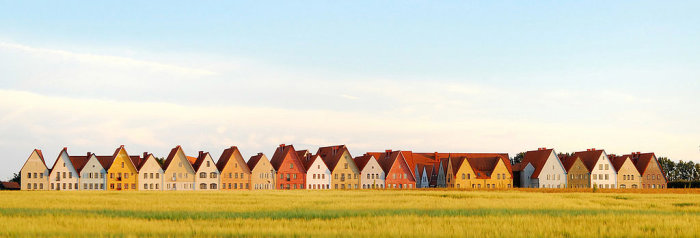
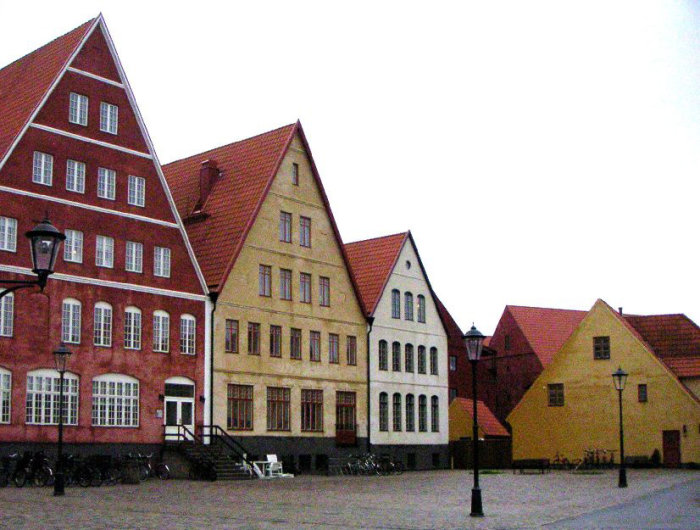
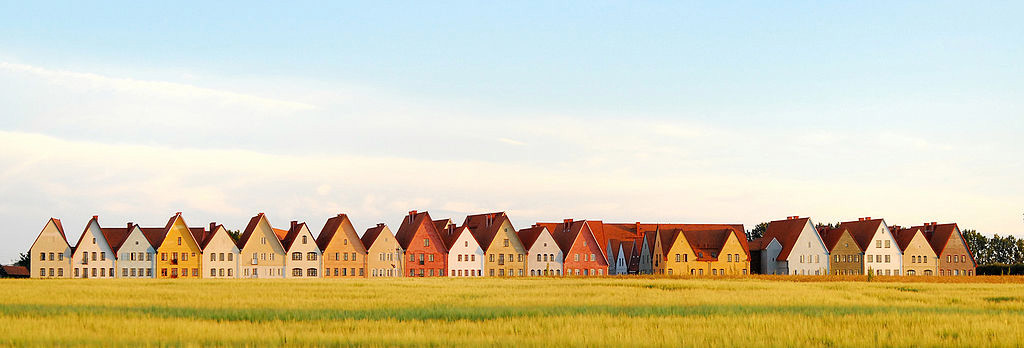
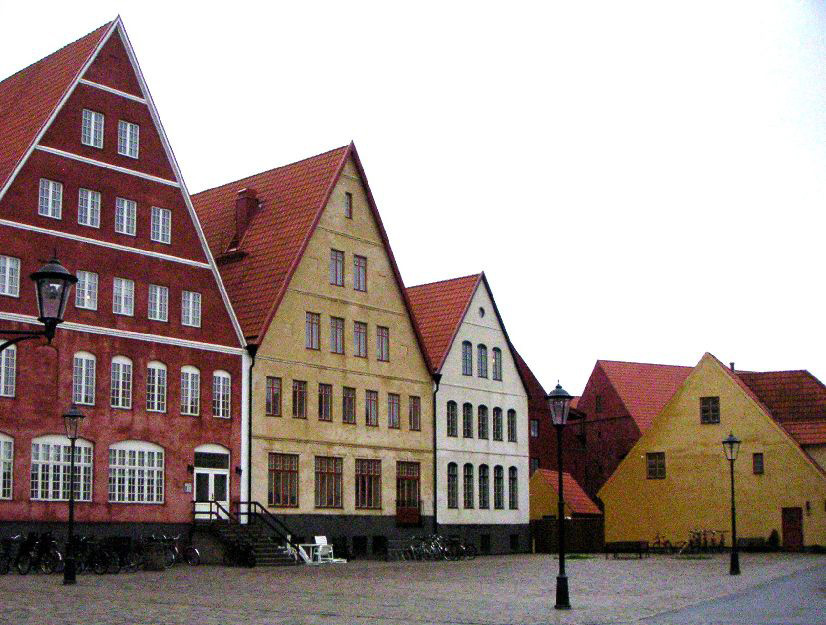
We have the residential area Jakriborg here not far from where I live. A residential area in old Hanseatic style that has been gradually built up from the 1990s onwards. What do you think about it? I like it!
In 130 years, only the houses from today that are beautiful will remain; all others will have been demolished.
Just as it is with the houses from 1885.
jimih said:
I recently read somewhere (can't remember where) about how much the prices of condominiums can vary between different construction years, where the 1800s were most value-enhancing, and ~1970-1990 least value-enhancing. So I don't seem to be alone in liking homes with high ceilings and moldings, and buildings with beautiful facades with fine ornaments.
But if you look at all the new constructions, they aren't exactly in the 1800s style. And it hasn't been like that if you look back a few years. What on earth were the architects thinking behind the houses built from, say, the 50s onwards? And I can even easily find examples of ugly buildings from the 30s.
Then perhaps it's one thing if you're building up an entirely new area from scratch, but when you can easily find ugly "new constructions" (relatively speaking) right in the middle of a lot of beautiful buildings, then it's just a crazy mistake in my view.
Then you can also wonder why those living in these existing ugly buildings aren't doing more to make them beautiful. I mean, it can't cost a fortune to renovate a facade and make it really nice, can it? Now I’m mainly thinking of condominiums in multi-family houses, as there are several households that can share the cost, and they are the ones living there who jointly own the building (instead of a separate owner renting out apartments) and thus have a vested interest in having a nicer facade. Rental apartments could also be included if there was free rent setting, as it could be a competitive advantage to offer rentals in a beautiful building, and thus be able to get higher rental income, but that's perhaps a separate discussion...
What do you think? Aren't the majority of the buildings from the turn of the last century considerably more beautiful than an average building from the 50s or later? And did people really think that the new constructions in the 50s, 60s, and 70s, and later, were beautiful when they were built? Or did the beautiful have to give way to the functional and cheap?
I did feel some hope, however, when I saw this article:
Getting stuck in an 1800s style with cramped housing and poor layout is not something you want. Putting "ornaments" etc. on existing facades is nothing but bad taste. Lifestyle and architecture evolve over time, thank goodness.
I agree with roughly 100%. The advantage of old houses is mainly the location. The best locations were taken first. Modern houses are much more adapted to modern lifestyles and modern technology. In the 1800s, houses were built around the chimney stack with a circular flow around it, which doesn't fit very well today. Additionally, more single-story houses are being built, which is more suitable for the elderly. Old houses are also often drafty with cold floors. It's much nicer with underfloor heating.
Modern houses can be made very attractive. There is a lot of beautiful modern architecture (completely without cherubs and ornaments on the facade).
Regardless of what style you like, I think today's homes lack variation, a residential area with 100 villas in perhaps 3 different models with minor small details that might differ. Streets, placement, etc. often seem not to be well thought out in terms of where rooms and windows face. Even though everything used to be built in the same style, it still feels like more effort was put into individualizing each house...
In the new residential areas here in Falun, there is a total lack of consistency. All the houses are different and situated differently on the plots. Additionally, the plots are too small for the houses, so there's often not much yard left.
In the new residential areas here in Falun, there is a total lack of consistency. All the houses are different and placed differently on the plots. Moreover, the plots are too small for the houses, so often there isn't much plot left.
Are the plots too small for the houses, or are the houses too big for the plots?
Many of the reasons seem to be economically based. But what I'm talking about is primarily the surface layer. For me, there's no added value in having the entire building made of brick or equivalent. I'm only referring to the outermost layer on the facade, and ornaments that can be added afterward. And how much more can it really cost? Let's say it costs half a million for the facade of a building with 20 apartments in it. That's 25,000 SEK per apartment, which can easily be incorporated into a loan the association takes if desired.
Just the facade of a medium-sized villa with, say, 200 sqm costs about 200,000-300,000 SEK extra to have it plastered compared to painted wooden facade... and then there are no other decorations or details, just plastered instead of painted wood. Higher ceiling heights cost about 100,000 SEK per floor for an extra 20cm (same house size as above), so for example, getting an extra 40cm on the ground floor and 20cm higher on the upper floor costs about 300,000 SEK extra. Not insurmountable if included in the zoning plans, but still considerable for a house that already costs around 4 million SEK total, built and ready.
Any changes from a simple rectangular shape also cost quite a bit, for example, dormer windows at least 50,000 SEK each, all extensions/angles on facades, etc., cost significantly extra. Switching from a simple gable roof to a curved mansard roof on the same house size seems to cost at least 50,000 - 100,000 SEK as well.
- Then nothing has been spent yet on those nice pure decorative details in craftsmanship that you're talking about...
Most of us building houses today cannot afford the house alone to cost 8 million SEK instead of 4 million SEK for such a stunning appearance. Then a minimum of 4 million SEK more for the plot and all other building costs... it's simply a matter of cost, aside from the fact that there are many other attractive styles than just 19th-century/turn-of-the-century stone houses with ornaments. Anything that isn't the simplest and fastest form/material to build costs extra, and it quickly adds up to a lot of money when combined.
Kitsch is a word for modern buildings that are adorned with details from earlier architectural styles. Pale imitations that are a poor substitute for the real thing. The feeling in old houses is not a style. It is a result of all the thoughts and the work of the people who have lived and died in the houses, leaving behind. It reflects the conditions during the times they were produced.
The location, planning (how the house is placed on the plot and compass directions), quality, craftsmanship, variation, ceiling height - I think all are better with older houses. Besides the charm and the sense of history. And that "old" residential areas or, for that matter, multi-family residential quarters are often less densely populated precisely because of the size of the plots, the larger ceiling heights, and the fewer number of floors, larger stairwells, etc.
Sure, some older houses may offer slightly less comfort, and sometimes the layout of newer houses might better suit many modern lifestyles. I grew up in a house from 1924 and I have never frozen my feet or been uncomfortable in any other way, but I have never felt at home in newer houses. However, I do think there are really beautiful "modern" houses with lovely roofs up to the ridge, open floor plans that allow for social interaction, etc. - and there are many modern, thoughtfully designed, well-planned, and well-located houses. Unfortunately, these have not been among those I know who bought a house where all are built in a new area by the same company, but rather houses built by private individuals on an "own plot."
A modern house in an old style, with the right proportions and good material choices - not PVC windows with fake muntins, 240 cm ceiling height, slab on grade - I don't think is kitsch, perhaps more pastiche - but it's really just a style feature. Today's functionalist houses aren't innovative either; they are just industrialized (affordable) houses inspired by the functionalist era with some new style features.
There are many examples of beautiful houses from almost every era, just as there are many ugly houses from most eras.
It's true, as someone wrote, that today's "ugly" houses will likely not survive into the future in 100 years. Probably, the beautiful houses won't either live for 100 years. It was recently stated that houses today have an economic lifespan of 50 years, which I really hope isn't true. But history has shown that houses built in the "old way" can be several hundred years old, although surely not all old houses survive.
I personally believe the key to more attractive houses lies in allowing individuals more control over how houses should be constructed. When large companies do it, the economy and profit interest come first, leading to solutions that are cheap and appealing enough to sell the house - but perhaps not long-term and individually well-crafted. You buy the show house, and that your house ends up with the kitchen facing south and the living room to the north, no evening sun on the garden side, and no storage space for the roof box, skis, and bikes, you won't notice until you move in...
Just the facade on a medium-sized villa of say 200 square meters costs about 200-300,000 SEK extra to have plastered compared to a painted wooden facade... and then there are no other decorations or details, just plaster instead of painted wood. Higher ceiling height costs about 100,000 SEK per floor for an extra 20cm (same house size as above), so for example, getting 40cm more on the ground floor and 20cm higher on the upper floor costs about 300,000 SEK extra. Not insurmountable if you can get it into the planning regulations, but still quite a bit on a house that already costs around 4 million SEK in total, built and finished.
All changes from a simple rectangular block shape also cost quite a bit, for example, dormers at least 50,000 SEK each, all extensions/angles on facades, etc., cost a lot extra. Changing from a simple gable roof to a broken mansard roof on the same house size seems to cost at least 50,000 - 100,000 SEK as well.
- You still haven't spent anything on those nice clean decorative details in craftsmanship that you're talking about...
Most of us building houses today can't afford to let the house alone cost 8 million SEK instead of 4 million SEK to have such a nice appearance. Then there's at least another 4 million SEK for the plot and all other building costs... it's simply a cost issue, besides the fact that there are many other stylish styles than just 1800s/turn-of-the-century stone houses with ornaments. Anything that is not the simplest and quickest form/material to build costs extra and it quickly becomes a lot of money when you add it all up.
But you live in Stockholm, which is a small minority on amphetamines in Sweden. Most people manage with under 1 million SEK for a really good plot.
Vi vill skicka notiser för ämnen du bevakar och händelser som berör dig.