I'm a bit curious and eager to learn more, so this is an honest question. When must or should you use pressure-treated wood?
When I've read about, for example, log houses and old buildings (e.g., a barn or storage building), they can last a very long time without pressure-treated wood as long as they are built properly. Now it feels like it's used everywhere as soon as it's something that will be outdoors. Perhaps out of fear/uncertainty, lack of knowledge, or because it's being marketed by the building supply stores?
So what do those of you with more experience think? When is it really needed?
I'm a bit curious and eager to learn more, so this is an honest question. When must or should you use pressure-treated wood?
When I've read about, for example, log houses and old buildings (like a barn or a storehouse), they can survive for a very long time without pressure-treated wood as long as they are built sensibly. Now it seems like it's used everywhere the moment something is to be outdoors. Maybe out of fear/uncertainty, ignorance, or because it's sold by the builders' merchants?
So what do you with more experience think? When is it actually needed?
It is needed when the construction has ground contact in some way. It is also needed if you have end grain that is unprotected.
I'm pretty convinced that a deck would function almost as long if it were built from untreated pine as from pressure-treated decking. The joists for the deck are probably sensibly made from treated wood, especially if they have ground contact.
The problem with comparing to old buildings is that those which rotted away are no longer standing for that very reason. So you primarily see those that had the best conditions.
Also, the timber today is generally of lower quality than before.
When I read about, for example, log cabins and old buildings
But these are not exposed to moisture in the same way as, for example, a deck. The base timber/framework of a building, for instance, usually never gets wet. Even today, buildings are typically not made with pressure-treated wood.
But sure, a deck can definitely work entirely with untreated wood, but naturally, the durability will be shorter (I wouldn't dare guess how much) and since the price difference is quite small, why not use what lasts best?
If the timber is in close contact with water/damp soil/vegetation, it will eventually deteriorate, and you extend its lifespan by using pressure-treated wood.
If it's dry/under a roof/can dry out, timber of good quality can last indefinitely.
I'm a bit curious and eager to learn more, so it's an honest question. When must or should one use pressure-treated wood?
When I've read about, for instance, log houses and old buildings (like a barn or storehouse), they can last a very long time without pressure-treated wood as long as they are built sensibly. Now it seems like it's used everywhere as soon as it's something meant to be outdoors. Perhaps out of fear/uncertainty, lack of knowledge, or because it's promoted by building supply stores?
So what do you with more experience think? When is it actually needed?
Wood exposed to rain does not last very long.
In the past, heartwood was used, which lasts longer.
Then there's a difference in quality between wood. For example, compare pine that has grown in Norrland with pine that has grown in the southern part of the country, and you'll find the growth rings are much tighter, which is a sign of more durable wood.
There are types of wood suitable for decking, such as larch, cedar wood seems to be popular in the states.
Water and ground contact I understand, that seems quite reasonable. I also read a bit about the different classes of pressure-treated wood.
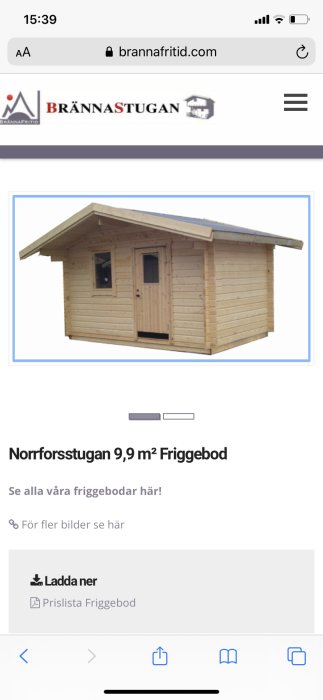
But in cases like these, it shouldn't be necessary:
on the shed, there is a baseboard of pressure-treated wood
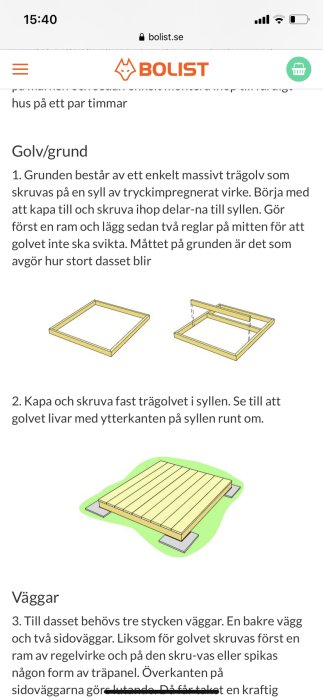
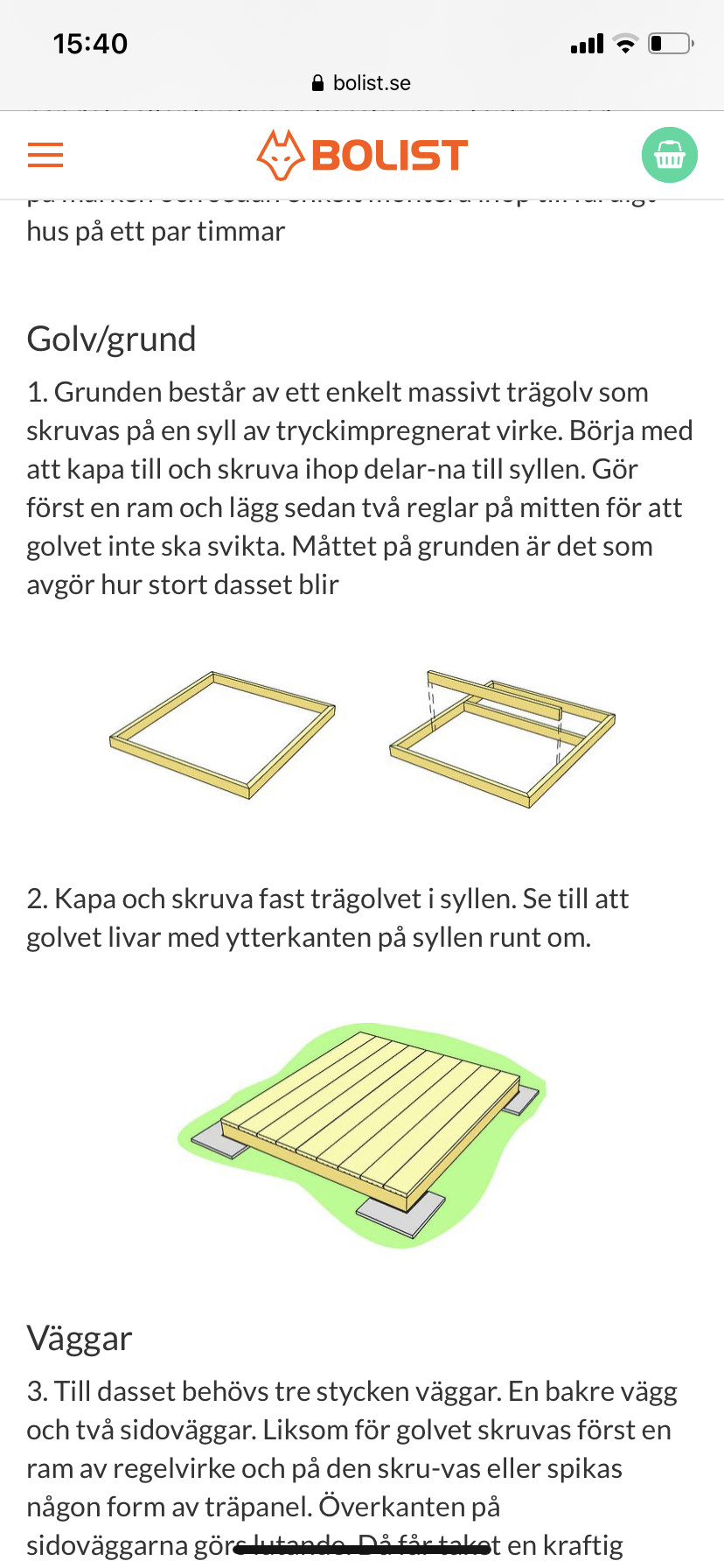
On this outhouse, the base is pressure-treated wood.
If they rest on pillars or something similar, with a sealing strip underneath, regular wood should work, right?
And different kinds of fences and trellises, shouldn't everything without ground contact work with regular wood if you protect or bevel the end grain (so it becomes a drip edge)?
By the way, I have dug up some old telephone poles that have been used as a boundary for a potato plot. They have been underground for 15-20 years. Still in very good condition, there must be some serious impregnation in them. Probably something that is banned nowadays.
By the way, I have dug up some old telephone poles that have been used as a boundary for a potato patch, they've been underground for 15-20 years. Still in very good condition, must be a substantial impregnation in them. Surely something that's banned nowadays.
Old telephone poles treated with creosote from coal tar, which are carcinogenic substances.
I have, by the way, dug up some old telephone poles that have been used as a border for a potato field, they have been underground for 15-20 years. Very good condition still, must be a solid impregnation in them. Surely something that's prohibited nowadays.
Yes, creosote. It's terribly effective. But also very toxic.
Prohibited today except for just telephone poles and railway sleepers.
Water and ground contact I understand, that makes perfect sense. I also read a bit about the different classes of pressure-treated wood.
But in cases like these, it shouldn't be necessary:
[image]
on the shed, it is a baseboard of pressure-treated wood
[image]
On this outhouse, the base is treated wood.
If they rest on pillars or similar, with sill strips underneath, then regular wood should work, right?
And different kinds of fences and trellises, where anything without ground contact should work with regular wood if you protect or bevel the end grain (to create a drip edge)?
The reason for using treated wood is because some use patio stones, bringing it very close to the ground/grass.
If you use pillars, the need decreases...
and telephone poles last a long time and are made from good wood from the start.
I might be thinking wrong then, but shouldn't it in most cases be possible to build so that you wouldn't need pressure-treated wood? But for example the right distance from the ground, that horizontal wood has a certain slope and drip edge, treat with oil or tar mixture, etc.? Of course, it becomes extra work and sometimes cumbersome (and perhaps doesn't fit aesthetically or economically everywhere).
I might be thinking incorrectly, but shouldn't it in most cases be possible to build in such a way that you wouldn't need pressure-treated wood then? For example, by having the right distance from the ground, sloping horizontal wood with a drip edge, treating with oil or tar mixture, etc.? Of course, it becomes extra work and sometimes cumbersome (and maybe doesn't fit aesthetically or economically everywhere).
Yep. That's how it is.
It all depends on...
how you build with what and how you treat the material.
People have built wooden boats without pressure treatment for a long time...

Tovetorvan said:
I'm a bit curious and eager to learn more, so this is an honest question. When must or should you use pressure-treated wood?