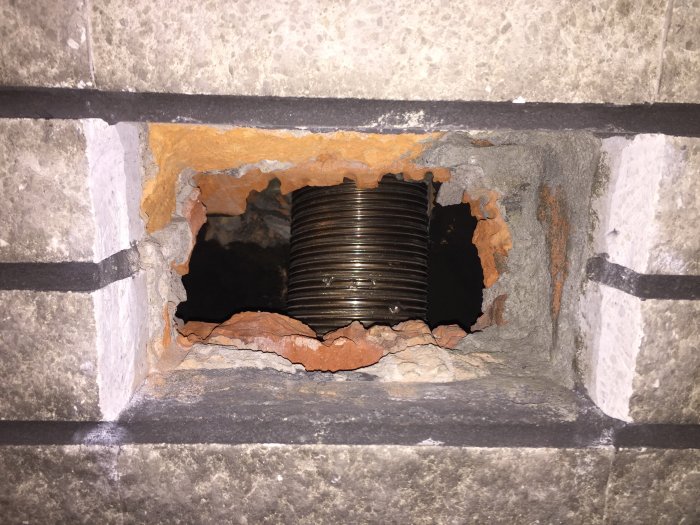
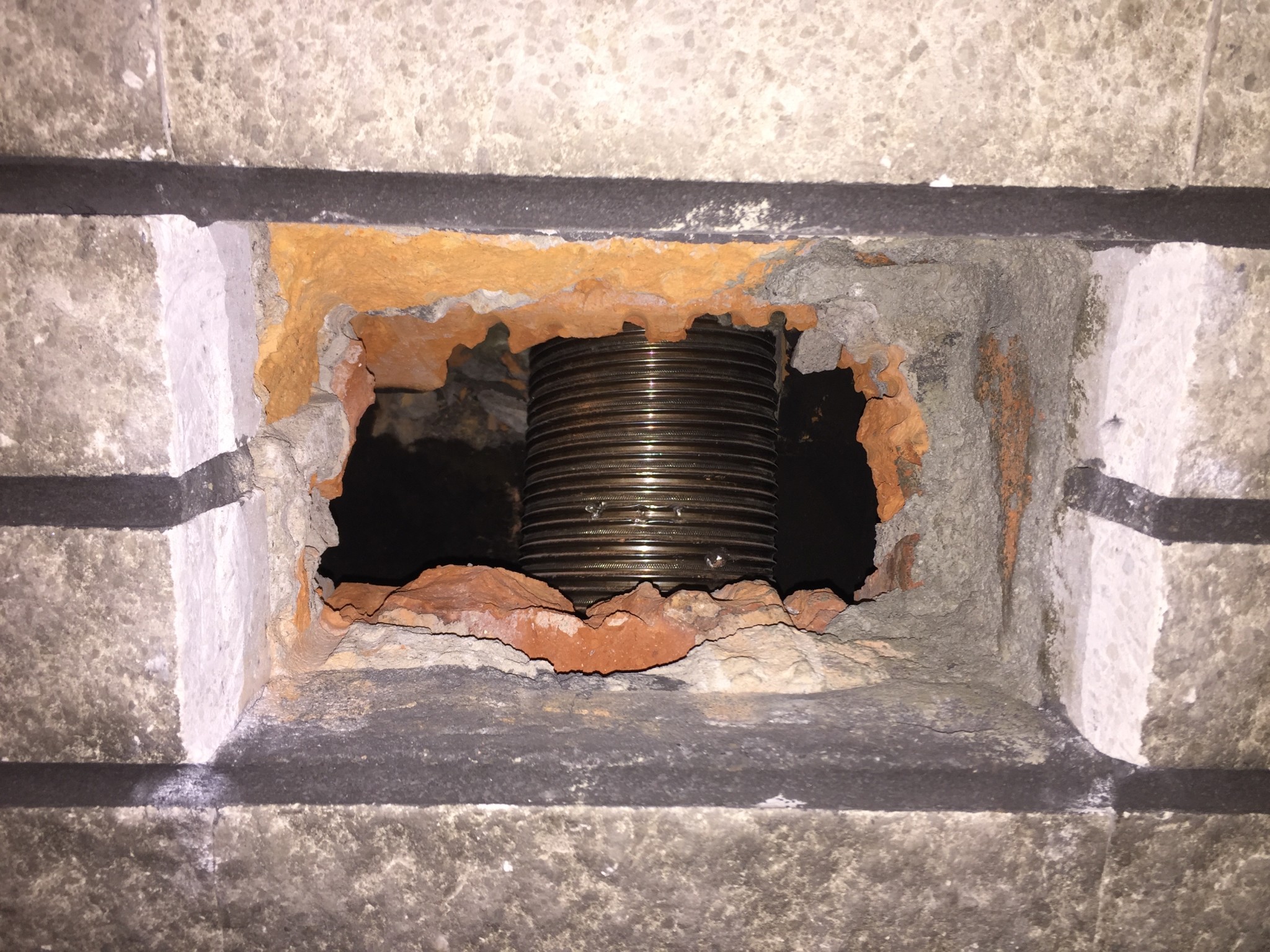
I've done a real "hack job" to open up the chimney breast to get some boost for the wood cassette's hot air. I've got a cast iron grate that's going to be mounted, but before that, I want to smooth out the incredibly ugly hole I've created.
I have no experience at all with how chimneys are usually constructed, but this one was completely crazy to me. There are cavities here and there, different stones, and in some places very thick joints... so it was not easy to enlarge the hole. I simply didn't know what to expect as the drill worked its way in. I'm also afraid to remove more material... worried that a lot could collapse, and I think the opening is sufficient enough to get a bit more circulation.
Anyway, now I want to even it out a bit. I happen to have two opened bags of mortar that I would like to use if possible. One is "Gjuta grov" from Byggmax, which I used to cast a pillar for a mailbox. I also took the opportunity to embed a few stone pieces in the chimney breast to seal against a large cavity (visible in the picture, right side of the hole).
The other bag is Weber Base 135, which is a rendering mortar.
I found Gjuta grov quite difficult to use in the hole, as it had rather poor adhesive properties to the materials. I've read that Base 135 should not be applied thicker than 5 mm.
Somehow, it feels like I actually need a mortar that lies between Gjuta grov and Base 135, but it would be nice to use one of the ones I have, so I don't have to buy another bag that needs to be stored somewhere since I will never use that much mortar for this project.
We're not talking about any strength issues here. The mortar just needs to stick and withstand some heat, not bear any loads. I plan to glue the grille with Tec7 sealant.
What do you others say? Can I go with Base 135, even though it will be much thicker than 5 mm in some places? What happens to it when applied in thick layers?
What is that hole behind, you can see the flue pipe which is an insert, is it sealed there, has the chimney sweep pressure tested and approved the hole in the chimney flue, it must be tested before you can put any grille. Think for yourself, smoke gases in the house are not good.
The cassette installation is 100% correct, so we don't need to discuss that in this thread since it doesn't concern the choice of bruk for tidying up the edges of the hot air hole.
The cassette installation is 100% correct, so we don't need to discuss that in this thread as it doesn't pertain to the choice of mortar to tidy up the edges of the warm air hole.
Sorry then for asking, it wasn't clear in the first post how it is constructed behind the chimney, so I'll refrain from further comments in this thread. I hope you get a good answer.
No reason to apologize. However, it is customary on forums to respond to the original poster's question, if one has something to contribute, and not to ask other questions. Your question implies that I am not aware of the parts of my installation that are not related to the hole for the hot air, which is completely incorrect. The grill also has nothing to do with the rest of the installation.
However, it is customary on the forum to respond to the original poster's question, if one has something to contribute, and not ask about other things. Your question suggests that I am unaware of the parts of my installation unrelated to the hole for the hot air
I would rather use fine concrete for this.
But I agree with Rävlyan's considerations:
What goes through the insert pipe?
What should be conducted through the chimney around the insert pipe, hot air you say?
Where do the smoke gases from the stove insert go then? Don't they go in the same chimney?
Honestly, why should I need to explain how the cassette installation is done when I'm just wondering which plaster to use to tidy up the hole for the warm air? The cassette has been there for five years and has been used a lot, it was checked by the chimney sweep when it was newly installed by the company we bought it from and has been swept twice since then. Isn't that enough?
Sometimes I wonder if the "rewards" for the number of written posts are such a good idea on a forum...
If they are old bags, I would have bought new ones. Mortar tends to go bad, full of lumps and lose strength quite quickly if it's just lying around. There's a best before date on the bags. Since it only seems to be about appearance and doesn't need to have any specific strength, the stucco mortar you have will probably work. Do you need to apply it thickly? Can't you try to even out the hole with an angle grinder? One of those cuts through brick like butter. However, it does create a lot of dust.
The bags aren't particularly old, so they're probably OK for this purpose. The plaster mortar happens to be the oldest, so I probably wouldn't use it for plastering an exterior wall, but for the hole, it's probably fine because as you mentioned... it doesn't need to be very durable or particularly pretty either. I thought about using some charcoal to blacken it after it has set, so it's as black as possible when you look through the grille.
I don't want to use a grinder, precisely because it creates so much dust. Just the drilling has left red dust that's impossible to remove from some surfaces with a bit of texture, and the entire wall with the chimney in the rec room is white Mexitegel. So, yes... I'll need to apply the mortar quite thickly in some areas to achieve a somewhat smooth surface.
Do you know what happens to the plaster mortar if I apply it, say, 5 cm thick in one spot? Is it just a risk of cracking, or will it crumble apart?
There is probably a risk that it cracks or detaches from the substrate. I hardly think it will crumble apart. Mortar isn't exactly within my expertise, so you shouldn't listen too much to what I say However, I have heard from experienced masons that for the best results, one should use a "weaker" mortar than existing when renovating an old wall. Like limestone mortar or clay mortar.
Click here to reply
Vi vill skicka notiser för ämnen du bevakar och händelser som berör dig.



 However, I have heard from experienced masons that for the best results, one should use a "weaker" mortar than existing when renovating an old wall. Like limestone mortar or clay mortar.