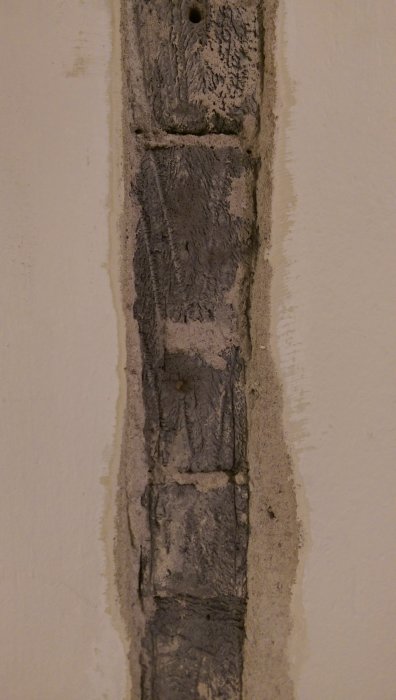
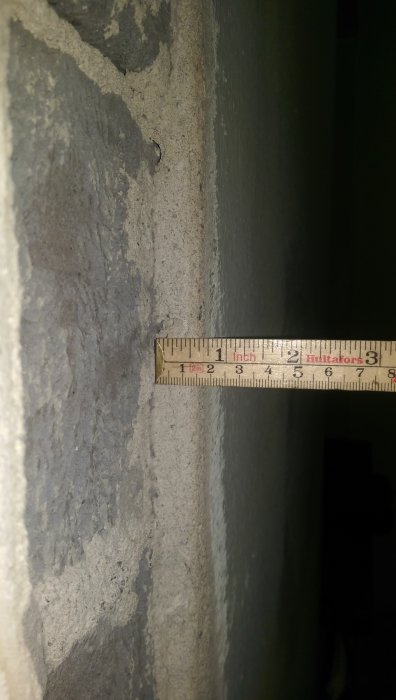
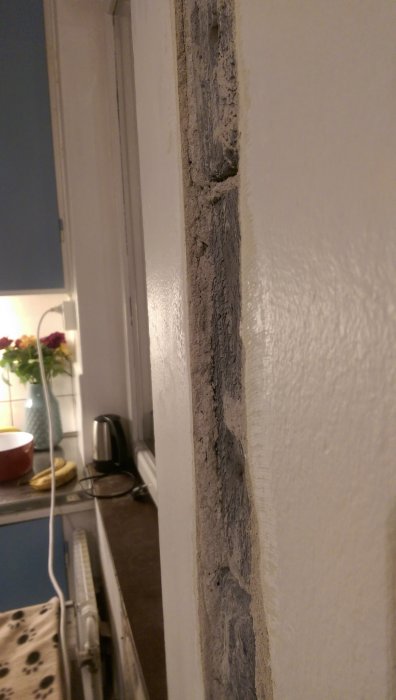
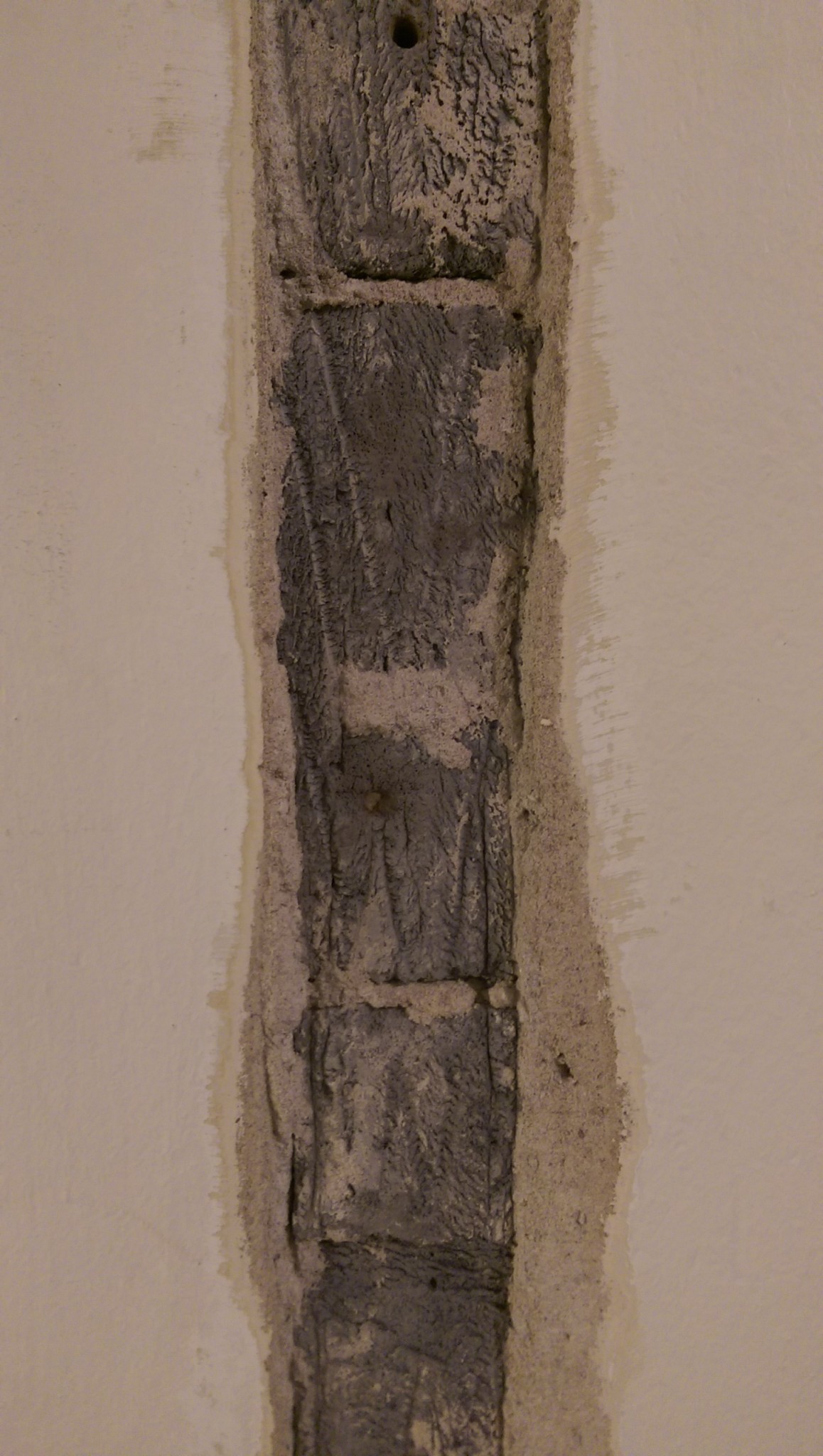
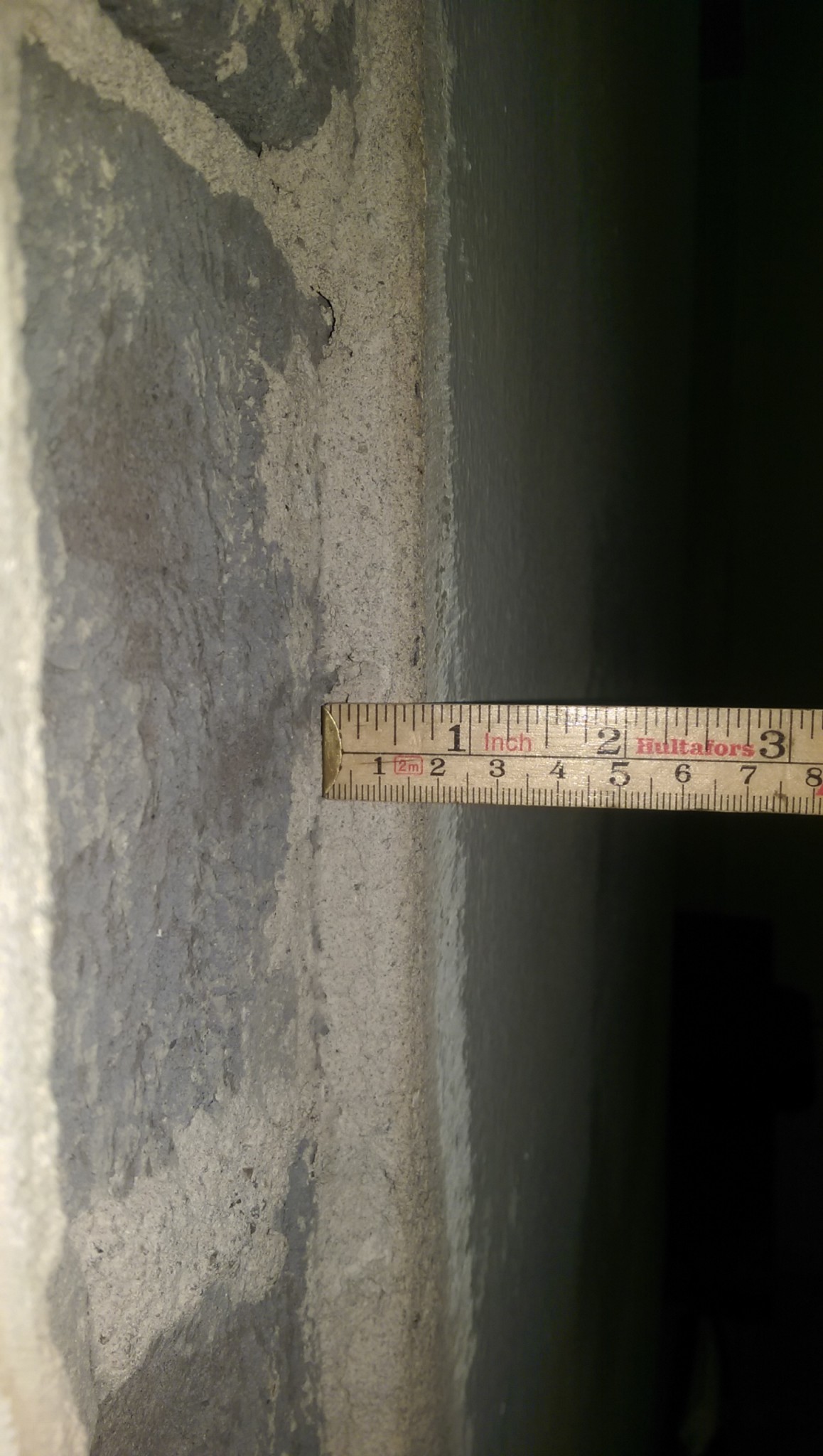
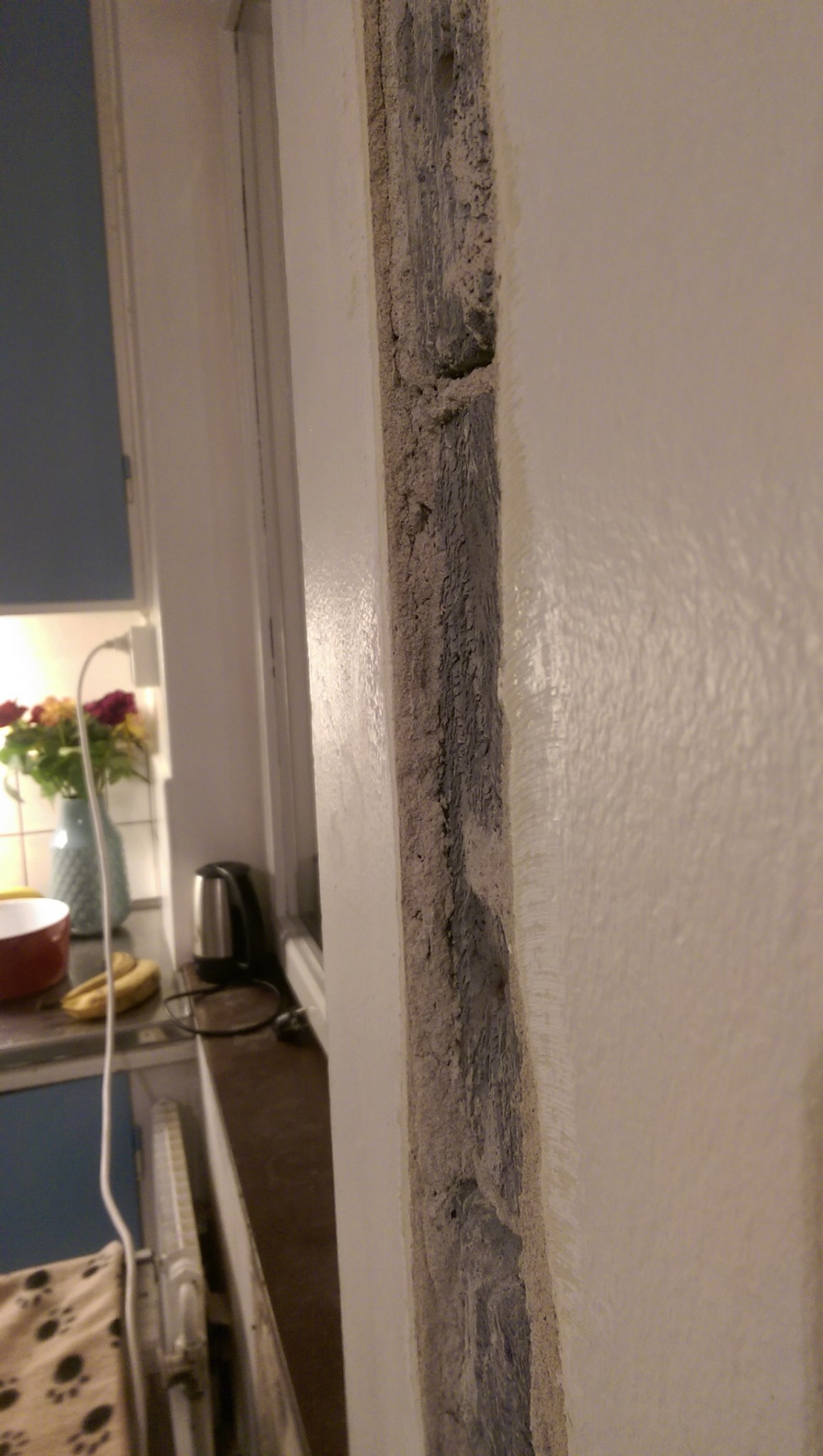
We have taken down a half-wall that partially divided the kitchen and dining room, so it is now a unified space. It is a multi-family house built in concrete 1950-1951 with walls of lightweight concrete (or blue concrete? see pictures below), and plastered both externally and internally.
Where the wall was, we have scraped off the loose plaster and it needs to be "repaired" and filled in with some type of plaster. I have read that if the plaster is grayish, it contains cement. If it is only lime plaster, it is whiter. From the 50s, lime/cement plaster would have started to be used. The color of the plaster and the year make us conclude that it is a lime/cement plaster.
Now to the question. We have received different suggestions on what to use. A carpenter thought we should use gypsum plaster and just wet the surface before with water. At Fredells, Finja's "Laga vägg" with accompanying primer was recommended first.
We want to avoid primers and plastics, etc., as much as possible. People built without it in the past, so why shouldn't it work now? Firstly, we don't even know exactly what Laga Vägg contains. What class does it correspond to (A-E)? I think it shouldn't be too hard a mortar, but neither should it be pure lime mortar since it already seems to be plastered with a lime/cement mortar. The question is just in what proportions.
Additionally, when comparing Finja's Gypsum Plaster with Weber's Gypsum Plaster (Nordic Swan Ecolabelled), they have different contents.
According to the building product declaration, Finja's contains:
Calcium hydroxide (Binder) 0-5%
Natural sand (Aggregate) 15-30%
Gypsum (Binder) 40-50%
Minerals (Filler) 25-35%
According to the safety data sheet, Weber's contains only:
Calcium hydroxide 2-5%
Calcium sulfate Conc > 65%
If you want to repair it as it was originally built, it should be plastered in two layers: roughcast and smooth cast. First, apply something like C-mortar as the roughcast (the bottom layer) and then smooth cast with a fine C-plaster with fine aggregate (sand) for the top layer. Smooth the surface with a steel trowel so that it resembles the rest of the wall.
If you choose the right aggregate (sand size and distribution) and surface treatment, you can make the repair resemble the rest of the wall.
But is it worth doing it original? You don't have weather and wind to consider indoors. For example, gyp plaster is apparently quick and easy to work with.
Thank you for your response. Interesting info. No, of course, maybe it's not worth doing it exactly like the original. But should one choose Finja's gipsputs over Weber's, since it also contains sand? I think it should resemble "regular" plaster more than Weber's? However, we are inclined to choose Svanenmärkt when it's possible to do so. A bit of a dilemma 😊
I have used Gypsum, easy to work with. A bit of a plaster feel, it feels like sand although it could be something else, but I guess both work well. If you want to smooth the surface afterward, you might consider a microlit which you then paint.
I would have chosen gypsum or alternatively naturgips depending on what the dealer has in stock. It's possible to achieve a similar surface as the rest of the wall, cost-effective and easy to work with.
Ok, it's definitely leaning towards Gypsum with your recommendations! Does it stick to the ceiling as well without gypsum primer? Just wet it with a spray bottle before? Thanks for your answers!
Logic, isn't Ardex protein-based? OT maybe, but oh well. Have heard of husfix, but now it's leaning towards gypsum plaster. Thanks anyway for your reply!
Does it stay attached to the ceiling without gypsum primer?
If the surface is suitable, the adhesion is very good, so absolutely, no problem using it on the ceiling.
Regarding primer, the point is to prevent the water in the gypsum from being absorbed by the substrate, so if it absorbs a lot, it may be appropriate to water several times and let it soak in between, so that the substrate gets somewhat saturated.
Another question. We also have a hole in the floor, where the wall was, with a lot of loose material. We have removed all the loose material and will fill it with concrete. The hole is about 10 cm deep. Does it matter which concrete to use? Fine concrete is only for up to 10 cm in a layer, according to several manufacturers' products. The hole is slightly deeper in one spot. Can we still use fine concrete, or should it be coarse concrete that can be laid in a single layer of up to 30 cm? How quickly do the different types of concrete dry? I know that you should cover it immediately after to prevent it from curing too quickly. Some products say you need to water it at least 1 day in advance, while for others it's enough to water it shortly before. What is the correct approach?