I have a disaster of a house that has been lifted by a settlement company using foam. After 4 attempts, the house might be saved or they may have destroyed it, we'll see. It's an enormously heavy house made of stone, brick, and concrete.
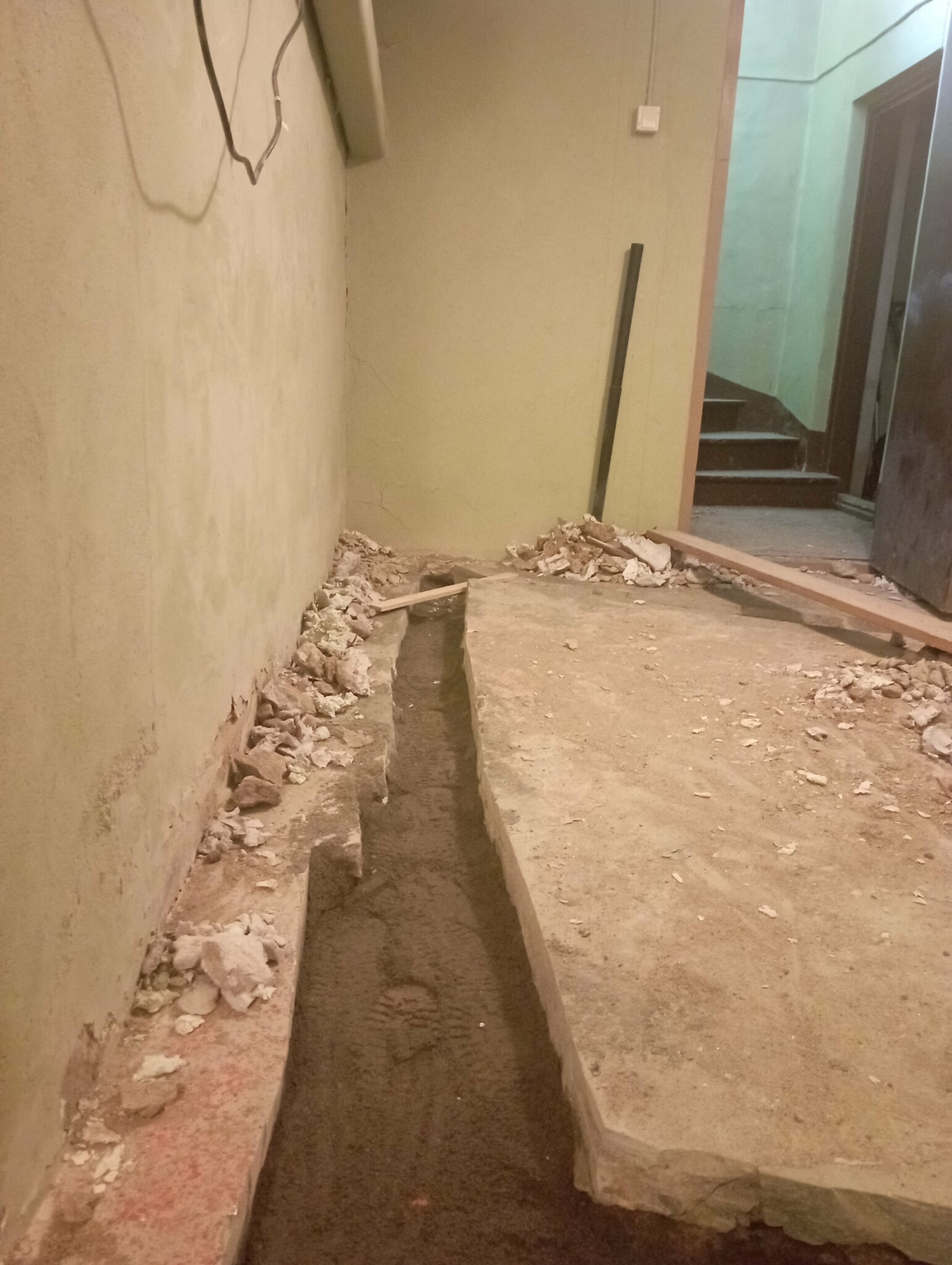
Part of this process involved replacing the drains under the 8 cm thick unreinforced concrete floor in the basement. Now that's done and it needs to be recast. When they lifted the walls, they managed to break and bend the concrete floor, so I now need to make as simple and cheap a solution as possible to cast the channels again and raise the floor a section 10 cm.
What I will cast will be like a plateau between two heart walls, in addition to the chiseled channels, where it continues to move at the moment. The plateau should both cover the old sloping floor and broken floor from the wall and provide stability to the walls. I was thinking of reinforcing the whole thing. But I'm unsure which concrete I should choose to prevent poor quality. The house was built in 1926, and the walls are partially on rock, partially on stones in clay.
Everything should be done as cheaply as possible as it's unclear if the house can even be saved. Expensive solutions are pointless because it's better to buy a new house.
Coarse concrete costs 1/3 of what expanding concrete costs, but I'm unsure if expanding concrete would be dangerous to use between the heart walls if it moves differently than the rest of the house. Meanwhile, the coarse concrete shrinks and might not even support between the heart walls?
It's a series of unfortunate circumstances that put me in this position of dealing with such advanced things despite the lack of knowledge, but I have no choice and ask for help.
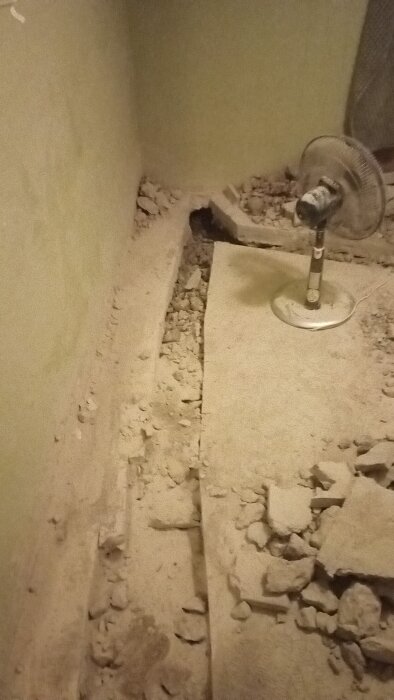
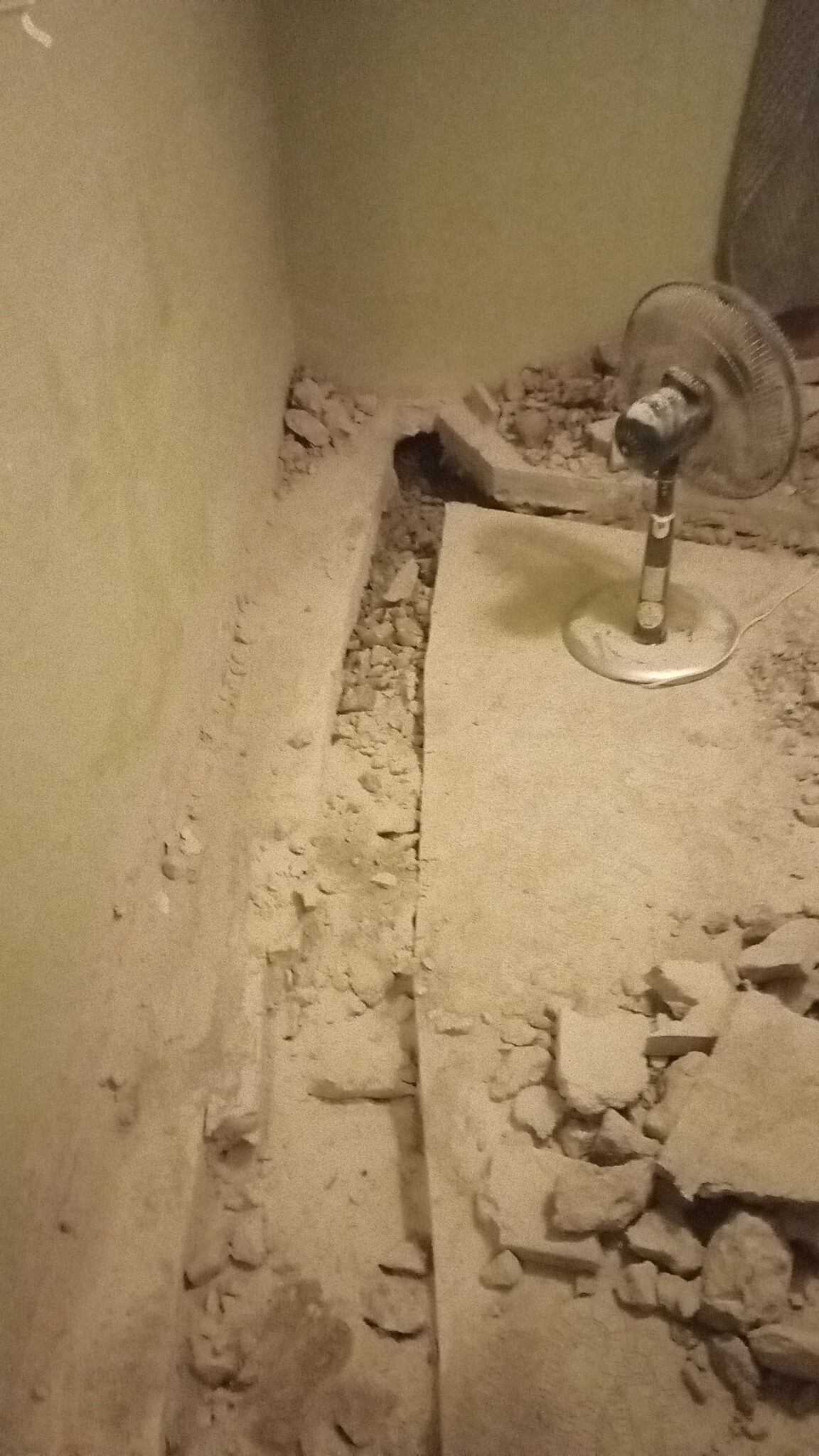
What the settlement company managed is to lift the entire floor flap that the fan stands on + lift the wall to the right of it, but not the wall to the left, so nothing aligns on the floor. At the same time, they managed to break off the piece of concrete floor that was left to the left so it detached from the wall (The picture is old from May).
But my goodness, person. What was the company you hired? And why couldn't they lift the entire house, which I assume was the intention? Did they try once, without succeeding in more than destroying the entire foundation?
Why haven't they redone it and done it correctly?
I think the concrete should have been included in the company's execution. If you're not knowledgeable in construction, I would say you really need help as it involves the whole building's existence or non-existence. Getting a construction technician who knows and can assess what is appropriate with the conditions is probably a must.
Have you applied for a building permit for this? If so, contact the building permit officer and consult with them and contact your insurance company and ask for advice.
If you are going to save the house, it should also not just be patched up but actually be able to stand proudly for many years to come?
But my goodness, what kind of company did you hire? And why couldn't they lift the whole house, which I assume was the intention? Did they try once without succeeding in doing more than destroying the entire foundation?
Why haven't they redone it and done it right?
I think the concrete should have been included in the company's performance. If you're not knowledgeable in construction, I would say you really need help as it concerns the entire building's existence. Getting a building technician who knows and can assess what is appropriate given the conditions is probably a must.
Have you applied for planning permission for this? If so, contact the planning officer and consult with them, and contact your insurance company for advice.
If you're going to save the house, it shouldn't just be patched up but actually be able to stand proudly for many years to come?
Hi, as previously mentioned, an expensive solution is not of interest. The question was about the choice of concrete during restoration.
I understand that, but I'm still wondering what happened to the company that accomplished this? And what responsibility
Well, that's a discussion in itself. The method didn't suit my house, but it's too late to think about that now. The damage their intervention causes to other things is disclaimed, except for movements. But as mentioned, foam doesn't work on my house. They've been here 4 times, at least 60 injection points, lots of discounts. To underpin instead would cost more than it's worth, so I'd rather see the house torn down than spend money on it. Sure, I could call them and tell them to come here and spray in more foam, fail with the solution, and ruin the new sewage and drainage I've done.
It's a very long story, but I assume I can't get money from them or the insurance company since the house is almost 100 years old. Then it's not worth shelling out a bunch of money, better to save it, do something makeshift myself, and then buy a new house when I can afford it. If you demolish the floor and dig it out, you'll be met with a massive lump of foam that will take days to remove. Better to cut 10 cm of ceiling height and finish faster, then maybe it will move less too. Big risks if you destabilize more. I've pretty much given up as well. Two years of "professional help," half a million poorer, but everything gets worse. An apartment is tempting, I hate my house.
Well, that's a discussion in itself. The method didn't suit my house, but it's too late to think about that now. They disclaim responsibility for the damage their intervention causes to other things, except for movements. But as I said, foam doesn't work on my house. They've been here 4 times, at least 60 injection points, lots of discounts. If you were to re-pile instead, it would cost more than it's worth so rather see the house torn down than spend money on it. Sure, I can call them and tell them to come here and inject more foam, fail to fix it, and ruin the new sewage and drainage I've done.
The whole thing is a very long story but I assume I can't get money from them or insurance companies since the house is almost 100 years old. In that case, it's not worth spending a lot of money, better to save it, do something sloppy myself, and then buy a new house when I can afford it. If you have to break up the floor and dig it out, you'll be met with a massive lump of foam that will take days to remove. Better to cut 10 cm of ceiling height and finish faster, maybe it would move less then. You take big risks if you destabilize more. I guess I've kind of given up too. Two years of "professional help," half a million poorer, but everything gets worse. An apartment is tempting, I hate my house.
60 injection points is an understatement I realized, it's become 100 of them. I have a guarantee that it won’t move, two years, but what help is it? Everything they do makes it worse. I've had a structural engineer here who wasn't worried, but I have no faith in "professional" people anymore. I have nightmares about the house collapsing and killing my family, so I want to cast concrete as soon as possible, but it's not easy to manage everything with a family and full-time job. You can hear on a daily basis now how the house makes cracking sounds as it slowly collapses on itself. Drives you mentally ill. I've been lying awake thinking all night.
Besides not knowing what type of concrete I should use, I understand that I need to grind off the paint on the old concrete, drill in reinforcement bars, and chip away the plaster along the walls to cast against the brick. I'll build a mold and lay in a reinforcement mesh. The previous "slab" was 5 cm thick in places and unreinforced, so I don't know how important it was for the construction, which makes you even more worried since it moves so much and likely won’t even improve after it's recast. One wonders if they're just wasting their time trying to put lipstick on this pig.
Do the walls stand on the floor? Maybe even load-bearing walls? That is, is the floor part of the load-bearing structure, like a poor man's slab on grade?
I think that casting with concrete in this situation won't have any effect on the actual load-bearing capacity.
The first thing I would do is to have an inspection of the house's structure, the load-bearing structure, by a building technician. Such a person can also suggest a remedy.
I understand that you want a cheap solution, but buying a hundred bags of concrete and pouring/spreading it out in this situation won't solve the problem, I think. It's work in vain.
Depending on what an inspection would say and what you agreed upon with the foam company, it might also be worth pursuing legal action.
But considering how they've left your house, it's probably a scam company.....😞
I believe that what you pour with concrete in this situation will not have any effect on the bearing capacity itself.
The first thing I would do is to have an inspection of the house's construction, load-bearing structure, by a building technician. Such a person can also suggest a course of action.
I understand that you want a cheap solution, but buying one hundred bags of concrete and pouring it out/sloshing it on in this situation will not solve the problem, I think. It's wasted work.
Depending on what an inspection would say and what you've agreed with the foam company, it might be worth pursuing a legal case as well.
But considering how they've left your house, it's probably a scam company.....😞
Hi, the house is a week before the 3rd action from the settlement company inspected by both a structural engineer and an inspector. They have no major remarks. Ordinarily, it's true that the floor doesn't provide bearing capacity, but as you can read, 100 points have been injected over 4 occasions. There is nothing normal left with this house. The company is not a scam, and no major damage has occurred to the house, but I don't want to spend a lot of money on a house I hate. I just want a laundry room. Moreover, all other floors in the basement are cracked.
Yes, the ceiling in the basement is the house's "real" slab. The floor is really thin
Same construction in my basement (made in the '50s). Works well here with ideal ground conditions, but I also have experience of how the same construction behaves with less ideal ground conditions, and it just results in cracks and uneven settling in the floor and collapsing interior walls.
I'm not an expert on this, but I doubt that the floor, as it is, will provide more load-bearing capacity than the substrate it rests on. A more sophisticated solution is needed to tackle this.
Same construction in my basement (done in the 50s). Works fine here with ideal soil conditions, but I also have experiences of how the same construction behaves in less favorable soil conditions, and it becomes a mess with cracks and uneven settlements in the floor and interior walls that collapse.
Not an expert on this, but I doubt that the floor, as it is, will provide more load-bearing capacity than the ground it's on. Some more sophisticated solution is required to address this.
Thanks for the response. Yes, half of the house is built into rock, the other half on stones that were probably on bedrock during construction. The side with three floors has sunk, but the top two floors have not followed. Because of that, the house only stood on the outer walls plus half of the inner walls before, which gave everything a sense of being a springboard. Now, the inner walls have been lifted twice, but something continues to sink while others remain stable. But since this house doesn't have a slab to lift up, it becomes really difficult for the company to lift the walls everywhere. In some places, it's only 80cm to the rock along one of the inner walls.
So it seems I've been lucky in my bad luck. I don't want to live here much longer, so I don't really care, the house won't sell for large sums anyway, so investing in "saving" it is wasted. Maybe I should put it up for sale now and see if someone loves it and wants to take over. Based on the responses here, it seems like I should chip away at the flap a bit and then have an uneven floor, maybe level it with some self-leveling compound later. You can see in the picture in the far left corner how much height difference there is at most.
Thanks for the reply. Yes, half of the house is built into rock, the other half with stones that were probably also on rock during the construction. The side that has three floors has sunk, but the top two floors haven't followed. Because of this, the house was previously only supported by the exterior walls plus half the load-bearing walls, which gave everything a springboard feeling. Now the load-bearing walls have been lifted twice, but something continues to sink while others remain still. But since this house doesn’t have a slab to lift up, it becomes incredibly difficult for the company to lift the walls everywhere. In some places, it's only 80cm to the rock along one of the load-bearing walls.
So it sounds like I've had some luck in misfortune. I don’t want to stay much longer, so I don't really care; the house doesn't sell for any large amounts anyway, so investing in "saving" it is wasted. Maybe I should put it up for sale now and see if someone loves it and wants to take over. Based on the answers here, I guess I'll grind away the flap a little and then have an uneven floor, maybe level it out a bit with some leveling compound afterwards. In the picture, you can see in the far left corner how much the height difference is at most.
I know there's too much stone dust, but I wanted to give the wall as much support as possible before finishing the work, so I put it there for that. I'll throw on some gravel later.
But since this house doesn't have a slab to lift up, it becomes damn difficult for the company to lift the walls everywhere. In some places, it's only 80cm to the rock along one of the heart walls.
What method was used for the lift? Injection of concrete into the ground?
One alternative is to dig out and underpin at least the load-bearing walls. Then the distance to the rock is an advantage.
If you just want to "close the bag" and restore it cosmetically in the simplest way, I would just drill in some reinforcement and cast the ditch as it is with regular coarse concrete. The stone dust there would be great to cast on. But that doesn't solve any problems.
Which method has been used for the lift? Injection of concrete into the ground?
An alternative is to excavate and underpin at least the load-bearing walls. Then the distance to the rock is an advantage.
If you're just looking to "seal the deal" and restore it cosmetically in the simplest way, I would just drill in some reinforcement and fill the trench as it is with regular coarse concrete. But that doesn't solve any problems.
Injection of foam. However, the rock falls quickly and the problem arises further out where it is unclear how deep it is to the rock. 30 cm outside the wall, I know geothermal heating was installed a bit further away and it was 6 meters to the rock, so it's not so easily solved. Maybe a strong slab would help but as I said, half the house is solid on rock while the other floats on clay.
At the same time, I have no intention of living here in this house, why I own a house I don't even want is another story I won't tell here, I bought it on the recommendation of an expert when I wasn't living in Sweden. But investing 2 million in the house to fix all the floors, walls, ceilings, and windows is not something I am going to undertake when I don't even like it. The top floor's joists are wooden and are a bit of a rollercoaster now after all the dealings. No, I'll just patch it up to get a laundry room, not going to increase the losses that already exist. It's a very special house and one of the few Swedish houses in stone, brick, and concrete with grandiose elements, but I want a regular villa. I'll probably end up giving the thing away or renting it out.
Vi vill skicka notiser för ämnen du bevakar och händelser som berör dig.

4774 said:
But my goodness, what kind of company did you hire? And why couldn't they lift the whole house, which I assume was the intention? Did they try once without succeeding in doing more than destroying the entire foundation?FörvirradAkademiker said:
Well, that's a discussion in itself. The method didn't suit my house, but it's too late to think about that now. They disclaim responsibility for the damage their intervention causes to other things, except for movements. But as I said, foam doesn't work on my house. They've been here 4 times, at least 60 injection points, lots of discounts. If you were to re-pile instead, it would cost more than it's worth so rather see the house torn down than spend money on it. Sure, I can call them and tell them to come here and inject more foam, fail to fix it, and ruin the new sewage and drainage I've done.
Farstatjej90 said:
I believe that what you pour with concrete in this situation will not have any effect on the bearing capacity itself.