
5,945 views ·
40 replies
6k views
40 replies
When does a beam start to bend under its own weight?
I would probably have gone with some steel construction as well.
If you absolutely want to do it in wood, there is a difference between deflection and breaking point. Without having calculated it, it's doubtful if snow load alone can cause problems. That's a guess, admittedly. If the flex in the summer is OK, then it should in that case be easiest to remove a few of the outermost decking boards.
If you absolutely want to do it in wood, there is a difference between deflection and breaking point. Without having calculated it, it's doubtful if snow load alone can cause problems. That's a guess, admittedly. If the flex in the summer is OK, then it should in that case be easiest to remove a few of the outermost decking boards.
Yes, there are many downsides with steel beams, more expensive but above all harder to get there. Additionally, it becomes harder to secure the attachment in the rock.nino said:
But well...
Overhang 100 cm with 195 beams
https://www.byggahus.se/forum/threads/oeverhaeng-pa-altangolv.293297/
Smart! That can definitely be an alternative to removing some of the decking in the winter.N Nisse Hult64 said:I would probably also go for some steel construction. If you absolutely want to use wood, there's a difference between deflection and breaking point. Without having calculated it, it's doubtful if just snow load can cause issues. That's a guess, of course. If the flex in the summer is OK, then it might be simplest to remove some of the outermost decking boards.
What I'm wondering is if snow load and the structure's own weight can cause the cantilevered part to sag, and if so, how much over time...
What I want to avoid is building the bridge, finding the flex is okay with a 1.8m overhang, and then 5 years later realizing the overhang sags by 10 cm.
....the program will probably take into account the self-weight and snow load, but since it is a roof, it does not take into account the load of people. But it doesn't matter for the long-term deflection.
It feels very strange that due to the long-term deflection, I wouldn't be able to have a two-meter overhang with beams that are 75x200 mm.
Of course, it might become a non-issue if, before then, i.e., before two meters, it sways too much.
It feels very strange that due to the long-term deflection, I wouldn't be able to have a two-meter overhang with beams that are 75x200 mm.
Of course, it might become a non-issue if, before then, i.e., before two meters, it sways too much.
I think it starts to bend under its own weight immediately and the sway becomes acceptable. Personally, I have used power line poles, and it's not the deflection and sway that risk creating problems at my dock.

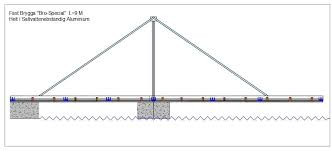
I don't think you need to make it too complicated. Attach a board with approximately the dimensions you have in mind, stand on it, and jump a little. I'm sure it will feel okay. A 200 mm beam is quite thick. Reduce the spacing if it feels unstable. Bridges are often a bit unstable, and that's perfectly fine. It will definitely hold.
In winter, it only has to support its own weight. The deflection won't be many mm, even with lots of snow.
I also guess that the mounting will be more crucial than the beam itself.
In winter, it only has to support its own weight. The deflection won't be many mm, even with lots of snow.
I also guess that the mounting will be more crucial than the beam itself.