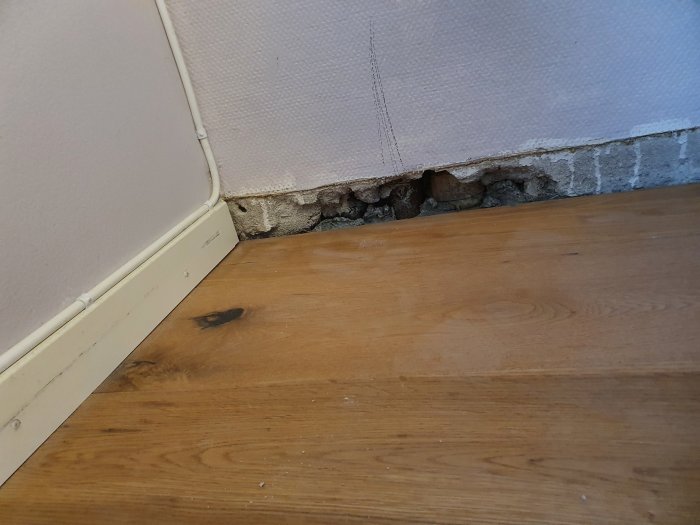
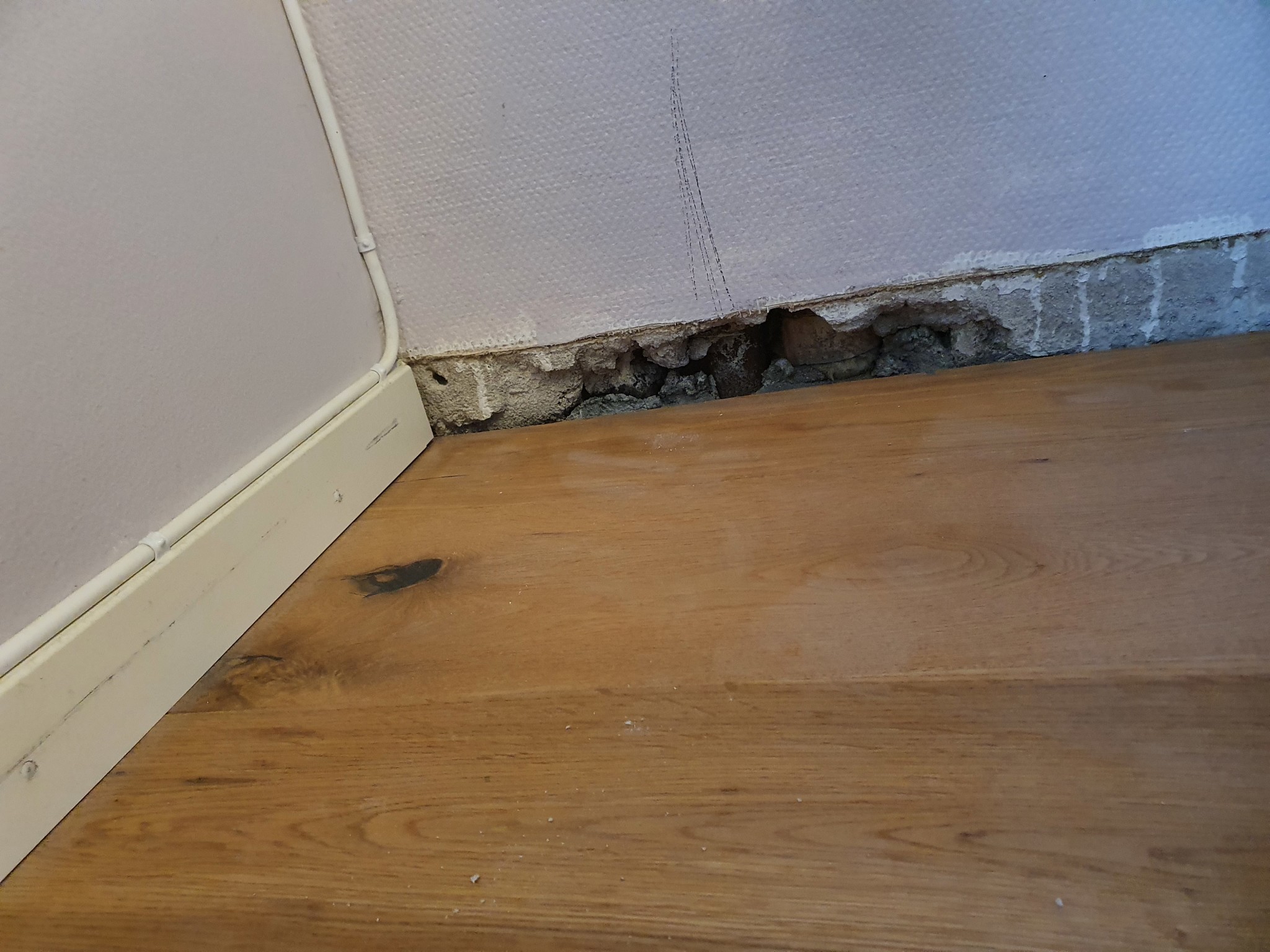
There is a hole in the wall where a baseboard used to be. The walls seem to be made of reinforced concrete, with a layer of plaster on top. However, in this spot, two pipes run vertically. One is insulated and the other felt warm, so I guess it's heating water for the apartments above. There is something slightly porous around the pipes, feels like some hard plaster or lightweight concrete.
So to the point, I want to fill in that hole and don't know what is best to use. It is on average 4-5 cm deep. More between the pipes.
Too much to use medium filler. I've been considering plaster?
Grateful for tips.
Holes in the floor yes....
But it certainly works for walls too, if you set a mold first, but then you'll still end up with a hole afterwards that you have to fill with putty, the hole that you need to get the concrete into.....
But try throwing concrete into a hole in the wall without a mold and see what happens!?
But if you use a putty, you can finish it in one go.....so don't complicate it with concrete!
Holes in the floor, yes....
But it can certainly be done on walls too, if you put a mold first, but then you'll still have a hole afterward that you have to fill with putty, the hole you're supposed to fill with concrete.....
But try throwing concrete into a hole in the wall without a mold and see what happens!?
But if you use putty, you finish in one go.....so don't complicate it with concrete!
Since I have personally used concrete to fill exactly such a hole as shown in the picture, I know it works perfectly well. What was required of me, as an average-skilled happy amateur, was a small piece of OSB board acting as a stop/edge, a weight of 25 kg, and a very simple finesse with a trowel. The last part at the top I easily filled with a fairly dry squirt of concrete that didn't run. It turned out great and smooth.
For me, it is therefore perplexing to see it referred to as a universally complex solution when it was both simple and turned out nicely.
That said, it sounds like you are absolutely right regarding the use of concrete for you, but to claim that similar holes can't be cast is nonsense.
Thanks for all the good tips. I went and bought a bag of husfix a few days ago but haven't had the time to fix it yet. I've used fine concrete and plaster mixed with filler before, but never husfix, so I thought it was a good opportunity to try it.
I'll take a picture when it's finished and share how it went.
Perfect. Husfix is very convenient in that it's easy to handle and can be purchased in small quantities. It resembles a package of cake mix more than a large sack of cement or concrete/mortar. Of course, a similar damage could be repaired with anything, as long as you have something at home that hasn't already dried into a hard clump. Husfix can be resealed in its little inner bag while waiting for the next problem.
I had bought a package of husfix. It does not shrink and is easy to mix. Wet the wall thoroughly beforehand.
Hi, I saw your response here and just want to ask. What is the risk if you do not spray the surface you are going to apply the husfix on? I had watched a video beforehand and prepared with water in a spray bottle. But I still forgot to do this step and applied husfix directly into the holes on the concrete wall instead. So what is the risk? Best regards.
Hi, I saw your response here and just want to ask. What is the risk if you don't wet-spray the surface you're applying husfix to? I had watched the video beforehand and prepared with water in a spray bottle. But I still forgot to do this step and applied husfix directly into the holes on the concrete wall instead. So what's the risk? Regards
The risk is that the surface absorbs all the water from the fix so that it dries too quickly, and you'll notice if it adheres poorly or is porous. Then it's just a matter of scraping it off and redoing it.