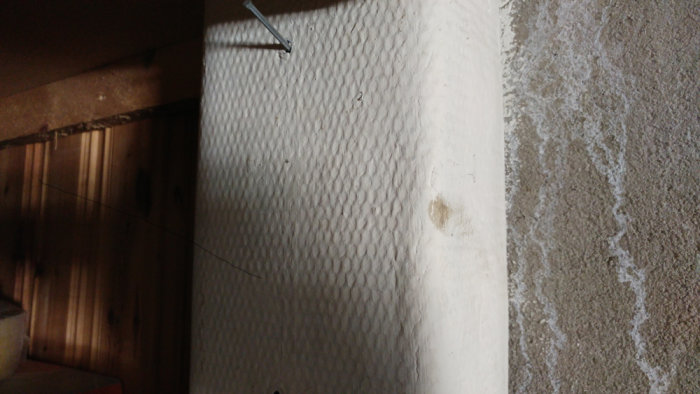
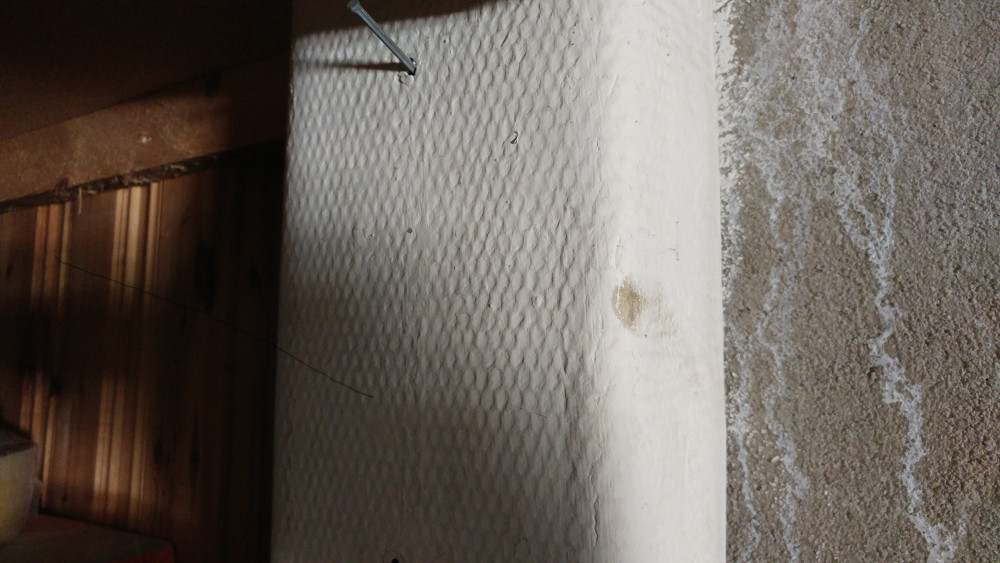
I'm working on a basement renovation and have started from the bottom, meaning the floor. Two rooms are completely chipped away, and now I've started clearing out the third and largest room. However, there is some kind of "pillar" by one wall that I don't quite understand. When I tap on it, it sounds hollow, and the pattern on it suggests "eternit," but I'm not sure about that.
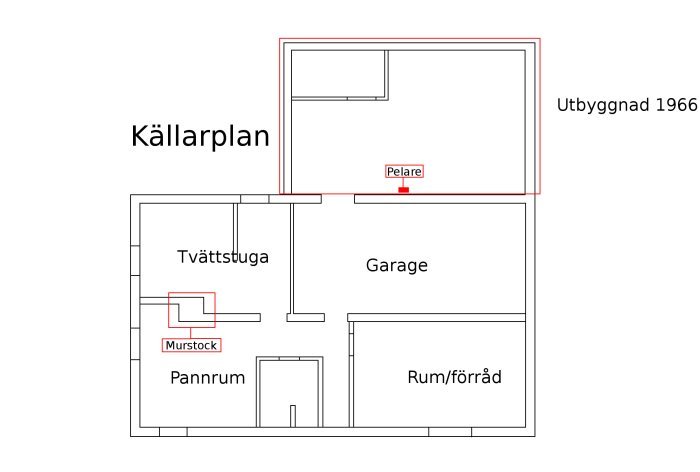
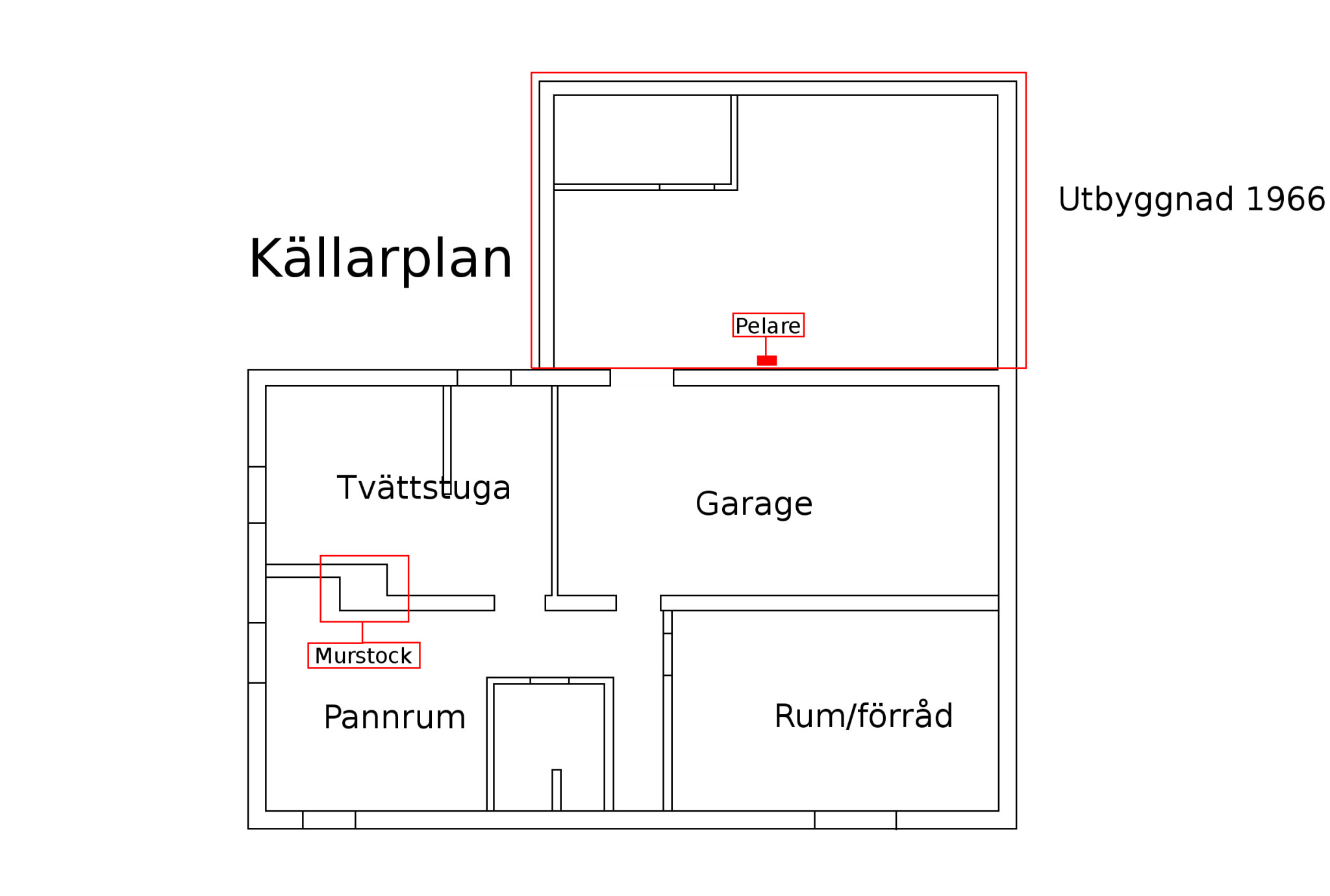
Since this room was added in 1966 (10 years after the house was built), it deviates from the other rooms in construction. For example, it has a cast ceiling, which makes me suspect that it is a support pillar of some kind, but a hollow pillar feels strange.
My thoughts are then:
Can I assume that it is made of eternit since it partly has that pattern and partly resembles one of the old ventilation pipes in the boiler room, which I am 100% sure are made of eternit?
Does it seem reasonable that it is a support pillar, or could it be something else?
Guesses?
It's obviously difficult to test if it is load-bearing in the same way that you can with studs by sawing and seeing if the saw blade gets stuck. Especially if it is eternit, then I don't want to saw into it at all.
I have building plans and technical descriptions of everything on the house except for this particular room. I have the proposal drawing that was used for the building permit in the 60s, but this "pillar" is not included there, and at the same time, that drawing is more about the ground floor, so the basement is hardly mentioned.
I mostly wanted to consult before I start the Hilti again and ruin the house or something.
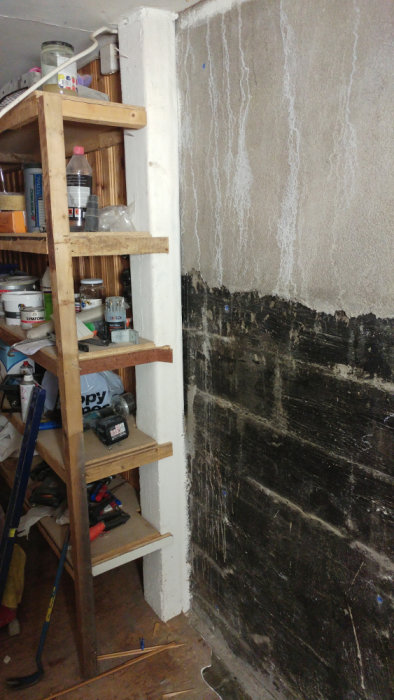
See pictures below. The black wall is the house's regular outer wall:
Could be an old asbestos cement duct used as a casting tube for a concrete pillar. What speaks against this is that TS thinks it sounds hollow. They were mainly used as ventilation ducts in the past. Could it be ventilation to another part of the house that disappeared during renovation?
What's outside the wall? Vent? Air intake for an old fireplace?
I also agree that it looks like eternit. Someone kind has put a nail in it so you can carefully pull out the nail and look at the structure and poke in a wire to see if it is actually hollow.
Undoubtedly eternit and absolutely no pillar with a load-bearing function. It probably contains something that needed fire protection. The question is what and why?
The terrace in our previous house stood on pillars cast in such pipes. It's probably not entirely uncommon for them to be used as casting pipes; in that case, they can be load-bearing.
Sure, eternitrör were used as casting molds. However, the placement of this and the execution of the basement wall as well as the fact that it is hollow argue against it.
Of course, I can't answer how the construction has looked over the 50-year life of the extension. There could have been fireplaces or other air-demanding constructions there before.
Since the basement walls are thicker than the ground floor walls, it's not a pipe that could have gone up to the attic in any case, which similar pipes do in the boiler room/laundry room via the chimney. So whatever it is, it currently runs from the basement floor to the basement ceiling as far as I can see without tampering with it.
I'll check to see if, via the nail holes, it's possible to determine if it really is hollow or if it's just some type of hollow brick concrete that's deceiving.
A drawing means a lot. I'm willing to bet that the eternit pipe contains a steel column that serves as a central support for a steel beam, which in turn supports the concrete slab along the old basement wall.
What does the floor above the basement look like, could it be sewer pipes/sewer ventilation, incoming electricity or water behind the duct
The room above has almost the same dimensions. It's a bit shorter as 190 cm of the basement room's ceiling is used for the terrace. The room above is a living room, so there's nothing incoming from the pillar's space (which I'm 100% sure of, as I've changed the surface materials throughout the house).
Jjustusandersson said:
A drawing means a lot. I'm willing to bet that the asbestos pipe contains a steel pillar that acts as the central support for a steel beam, which in turn is the foundation for the concrete slab along the old basement wall.
With a drill, I should be able to determine that. I'll give it a try and get back to you!
Asbestos warning
Harmless if left undisturbed
Life-threatening to process, drill, saw, break, that is when the sharp microscopic particles are released and can end up in your or your family's lungs
Asbestos warning
Harmless if left undisturbed
Deadly to work with, drill, saw, crack, that's when the sharp microscopic particles are released and can end up in yours or your family's lungs
Well... deadly to drill a hole?
Hardly, however, repeated contact with asbestos is clearly unhealthy, but tinkering with a single pipe is no problem if you keep it clean, take care of the dust, etc.
Drill a slightly larger hole (use a vacuum cleaner during drilling) so you can insert an inspection camera. Should be available for rent at Hyrse, Cramo, or some plumbing company.
Vi vill skicka notiser för ämnen du bevakar och händelser som berör dig.







hsd said:
