
4,308 views ·
28 replies
4k views
28 replies
What do I have in my attic?



It is a former expansion tank. The copper pipe continues out onto the roof for ventilation and over boiling line.

It might be a beam just to avoid having a wall underneath. When people remove load-bearing walls, a beam is needed for transitioning, and sometimes it can be placed in the attic instead of being visible in the ceiling below.P psu said:
Sounds reasonable. Would it be foolish to assume that these are dead lines and that one can just cut them off? Or should one need to get help from a plumber to be sure. I have followed one of the pipes down to the basement and there it goes to the floor drain. I'm not sure where the other one goes down there.D Daniel 109 said:
It is likely cut where it comes out in the ceiling of the basement. It was generally connected directly to the top of the boiler.

Düsseldorff
Building conservationist
· Bromma
· 3 130 posts
Düsseldorff
Building conservationist
- Bromma
- 3,130 posts
It would be really stupid to remove the beam anyway.P psu said:Sounds reasonable. Would it be really stupid to assume that these are blind pipes and that you can just cut them off? Or should I need to get help from a plumber to be sure. I've followed one of the pipes down to the basement and there it leads to the floor drain. The other one I'm not sure where it goes down there.
Can you upload a floor plan with the beam drawn in?P psu said:
It must have a purpose, and the only reasonable one is to avoid having support underneath?
Edit: Looking a bit more at the picture, it seems like the floor structure is hanging from the beam?
Last edited:

Fotografen said:
Assuming, as several have said here, that the span becomes too long since there is no wall underneath. But shouldn't the same problem exist on the ground floor where there is neither a wall nor a beam? The beam is at the yellow line but on the floor above then.
I had thought the load-bearing walls were just the outer walls on the long sides
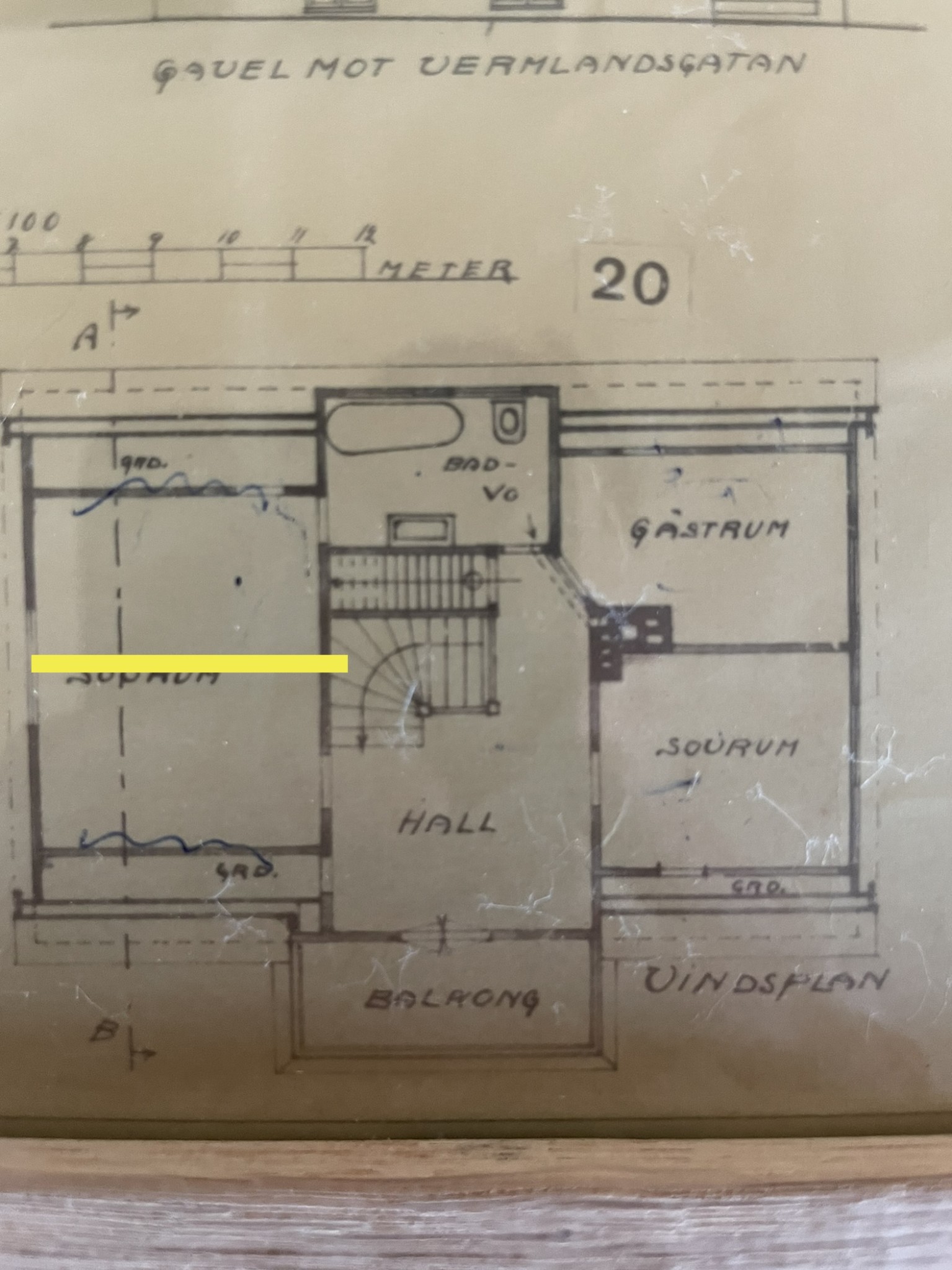
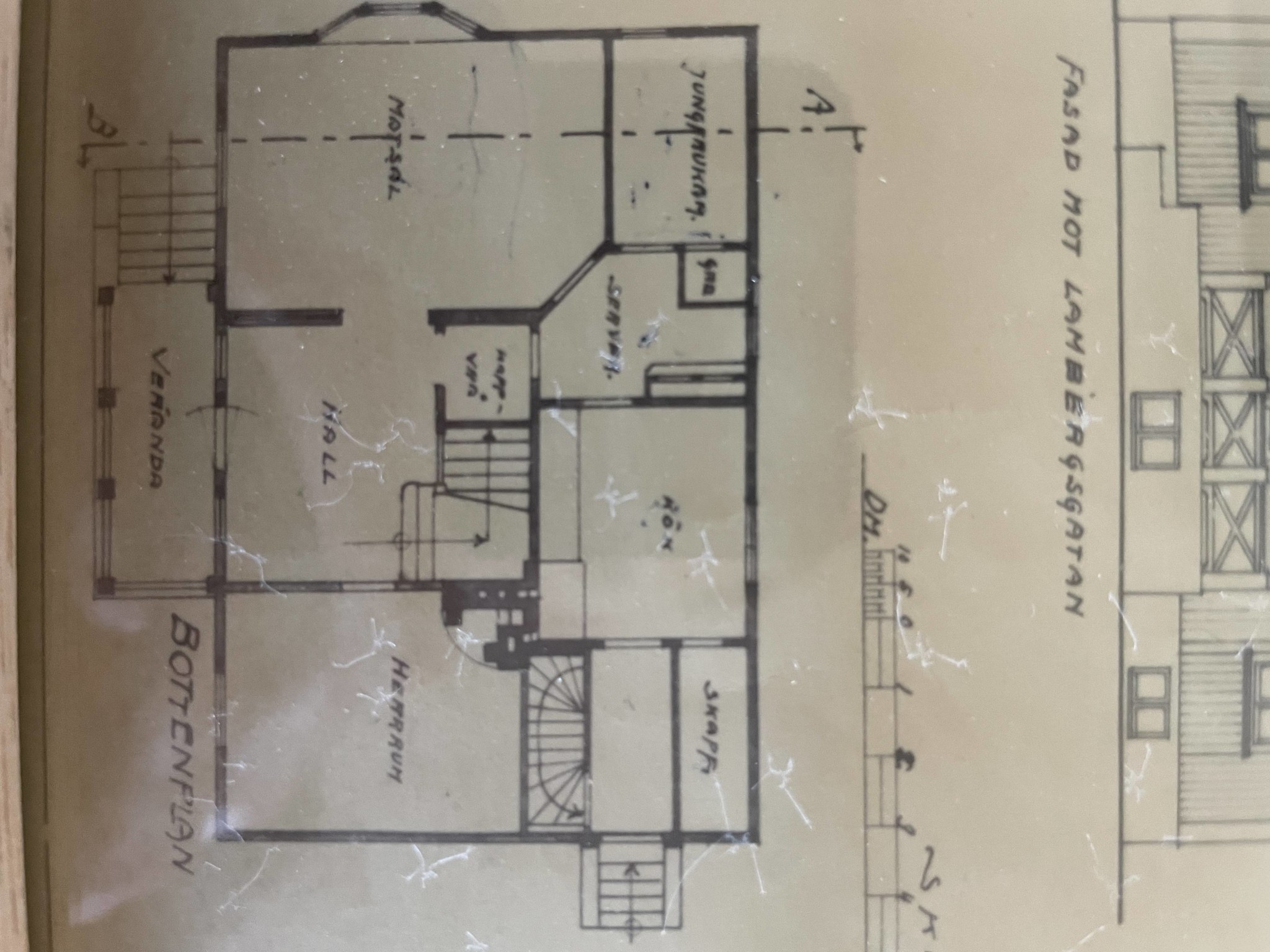
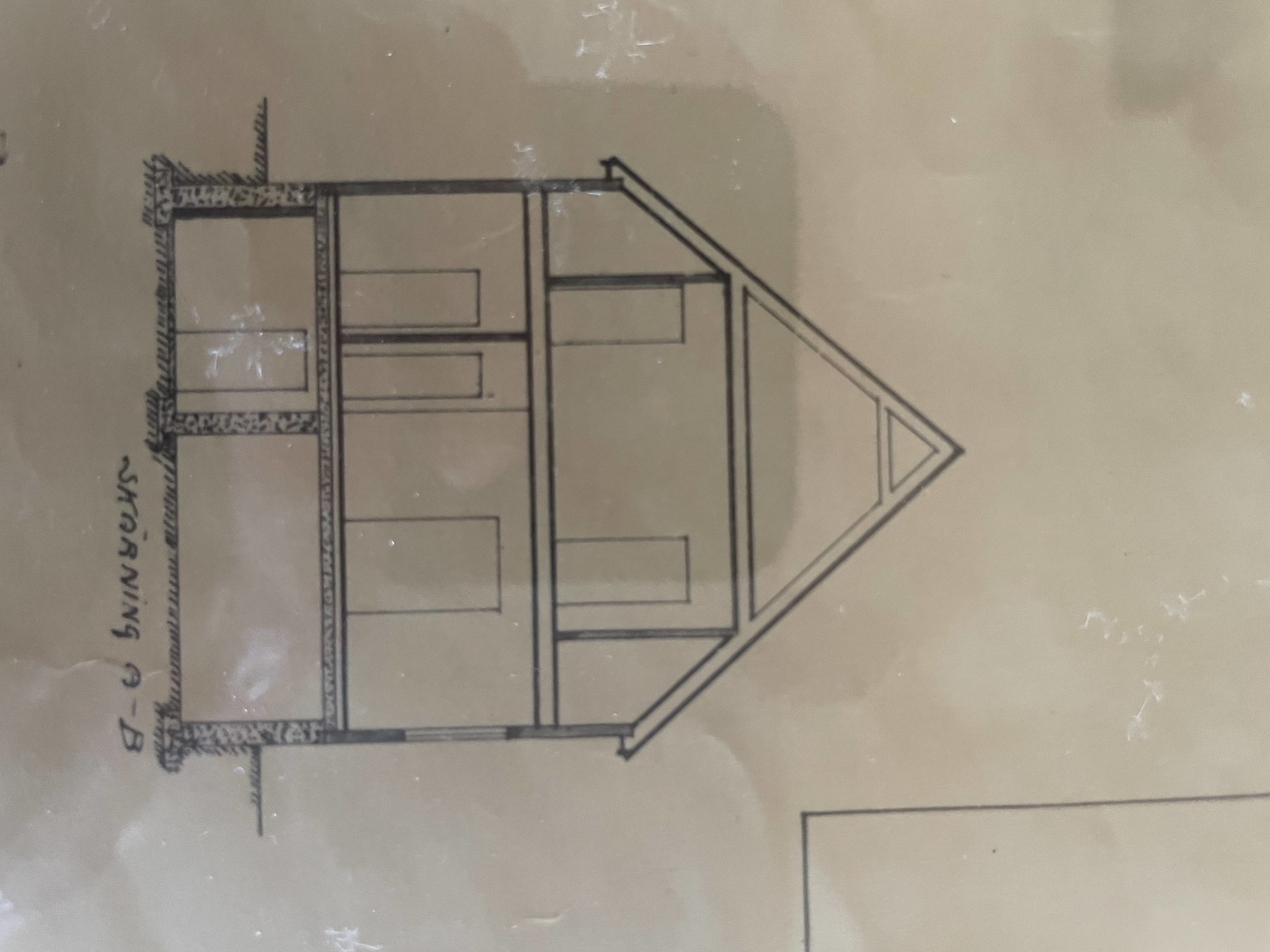
The section drawing shows a cross-section of the house right where there is a line with alternating long and short dashes. According to the section drawing, it seems to be the walls against the kattvindarna that are load-bearing, but on the floor plan, something is drawn over them. Does that mean those walls are removed there?
If so, they have probably tried to compensate for it with the beam. I don't know if it is successful or not.
On the entrance floor, it is the wall between the dining room and the maid's room that is drawn on the section drawing. That should mean that the wall is load-bearing right there. In the middle and the other end of that floor, the load-bearing is probably transferred to the wall between the kitchen and the stairs or the wall on either side of the basement stairs.
The outer walls are also load-bearing but cannot handle the load from the joists by themselves.
But houses up until the 1950s can be strangely built with load-bearing walls in tricky ways and that change direction.
If so, they have probably tried to compensate for it with the beam. I don't know if it is successful or not.
On the entrance floor, it is the wall between the dining room and the maid's room that is drawn on the section drawing. That should mean that the wall is load-bearing right there. In the middle and the other end of that floor, the load-bearing is probably transferred to the wall between the kitchen and the stairs or the wall on either side of the basement stairs.
The outer walls are also load-bearing but cannot handle the load from the joists by themselves.
But houses up until the 1950s can be strangely built with load-bearing walls in tricky ways and that change direction.
BirgitS said:
The section drawing shows a cross-section of the house at the point where there is a line of alternating long and short dashes. According to the section drawing, it appears that the walls against the kattvind are load-bearing, but something is drawn above them on the floor plan. Does this mean those walls have been removed there?
In that case, compensation was likely attempted with the beam. Whether it's successful or not, I don't know.
On the entrance level, it's the wall between the dining room and maid's room that is drawn on the section drawing. This should mean that wall is load-bearing there. In the middle and the other end of that floor, the load-bearing likely shifts to the wall between the kitchen and stairs, respectively, or the wall on either side of the basement stairs.
The exterior walls are also load-bearing but cannot support the load from the floor structure by themselves.
But houses up to the 1950s can be strangely built with load-bearing walls in tricky ways that change direction.
Thank you for a detailed responseThe section drawing shows a cross-section of the house at the point where there is a line of alternating long and short dashes. According to the section drawing, it appears that the walls against the kattvind are load-bearing, but something is drawn above them on the floor plan. Does this mean those walls have been removed there?
In that case, compensation was likely attempted with the beam. Whether it's successful or not, I don't know.
On the entrance level, it's the wall between the dining room and maid's room that is drawn on the section drawing. This should mean that wall is load-bearing there. In the middle and the other end of that floor, the load-bearing likely shifts to the wall between the kitchen and stairs, respectively, or the wall on either side of the basement stairs.
The exterior walls are also load-bearing but cannot support the load from the floor structure by themselves.
But houses up to the 1950s can be strangely built with load-bearing walls in tricky ways that change direction.
The kattvind have been removed, and instead, glulam beams and posts have been installed inside the bedroom. I thought it was to provide load-bearing support, but I believe the beam is much older than that.
One of the kattvind on the other side of the house is also removed, and a steel beam has been placed in the attic along the line where the kattvind was, with supports from the rafters down onto it. Many different solutions to the same problem, but I find it confusing. I would like to furnish the attic, and in that case, it would be nice to get rid of the trunk in the middle of the room.
It is always possible to bring in a structural engineer with good experience of 1920s houses to see what is well done, what should be redone, and if it is possible to do something so that the attic can be converted. The latter may require reinforcements as it means the floor joists will become heavier.

The expansion vessel must be disconnected; otherwise, you would have moisture above. It should be half full of water to maintain pressure, and the water becomes slightly warm.
Regarding the beam, someone has put a heck of a lot of work to get it there, so a wild guess is that it's needed then…
Regarding the beam, someone has put a heck of a lot of work to get it there, so a wild guess is that it's needed then…
Well, the beam is likely to be instead of the partition wall on the other side of the house. It's probably needed.
Click here to reply