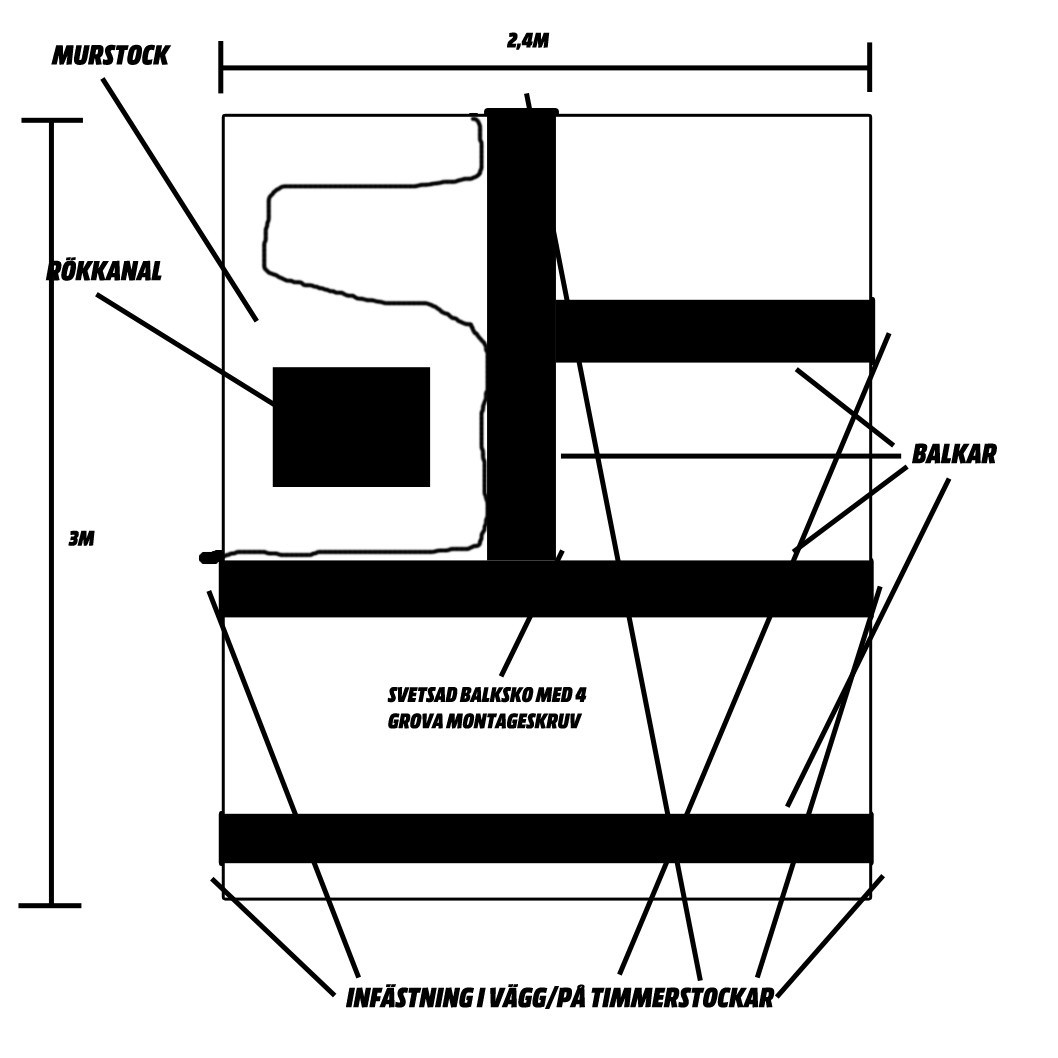
There are many here who know how to calculate the load-bearing capacity of beams and such, and I'd just like some input. I have an old house from the late 1700s and am renovating the bathroom on the upper floor. It previously had tile, flooring, and underfloor heating, but before that, there was first plank flooring, then 2 layers of gypsum board, and then a low-building heating coil was placed in the adhesive for the tiles, so it weighed quite a bit. Now that I'm arranging it, I'm thinking of chipboard flooring, then self-leveling compound with coils, then tile adhesive/tiles, so the self-leveling compound will probably weigh a bit more than the gypsum boards they had before.
The thing is, I replaced 2 of the beams in the floor structure when I renovated the kitchen that is underneath with "new" fresh ones, or rather I got hold of recovered heartwood beams that were taken down from Kalmar Castle, so they are sturdy things.
All the beams in the picture are about 20x20cm, and all those on the outer edge in the picture are either embedded in the outer wall of the house or on an inner wall that is also timbered.
I can't imagine there would be any problems supporting the weight of a modern bathroom, right? What do you think? It's over CC 30 in the picture, but between the beams, it's been cross-battened as much as possible to essentially have CC 30 the whole way (there are some recessed spotlights in the kitchen ceiling that are located between the beams that required some consideration, etc.).
You can drive a tank on that floor! A 2.4 m long beam with these dimensions and c/c 1 m can handle a distributed load of several tons per meter. 20x20 cm corresponds to a beam of 45x330 mm.
Click here to reply
Vi vill skicka notiser för ämnen du bevakar och händelser som berör dig.