63,415 views ·
127 replies
63k views
127 replies
Why did the ceiling sink, took down interior wall




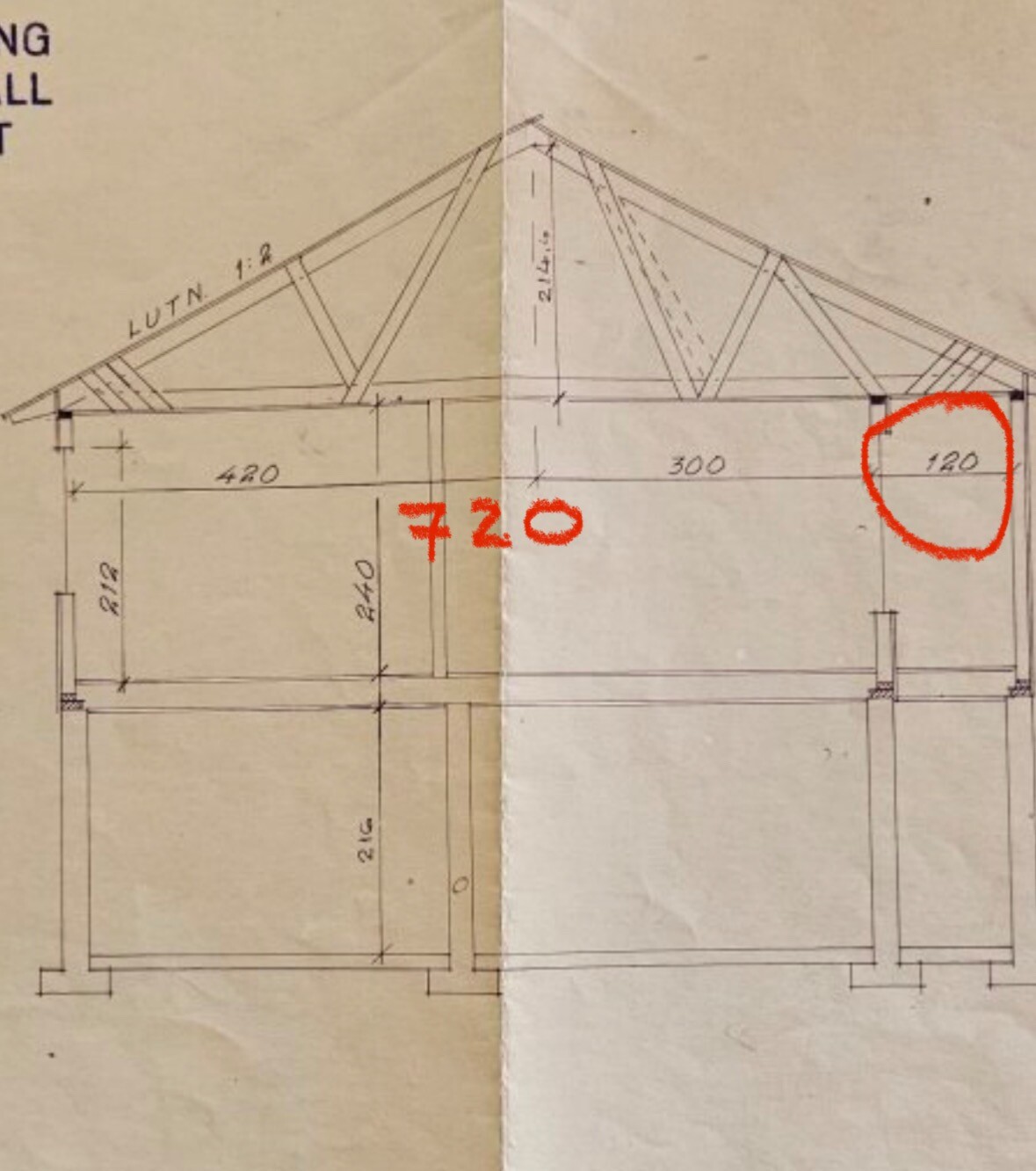

As seen from the images, the house is not completely symmetrical, which is why there are different walls in what looks like the same cross-section.
In the kitchen area, the house is 720 wide, there is a load-bearing wall approximately in the middle. In the wider part of the house, it is instead 720+120, i.e., 840 wide. Here, there are probably two load-bearing walls...
Last edited:
Yes, there are many different solutions and dimensions for load-bearing walls... In the past, calculations were not as precise as they are today, plus today we often have belts and suspenders x10...G Gullringen said:


Kan själv!
· Trelleborg
· 20 045 posts
There seem to be two types of trusses depending on whether they have an overhang or not. Based on previous experience from the forum, walls drawn in a sectional drawing do not necessarily mean they are load-bearing. Longitudinal walls can support the truss a bit and over time become "load-bearing."
I would say that it doesn't need to be load-bearing; I have a house with similar trusses and span, and our "heart wall" is not load-bearing.
But to be on the safe side, I would delve deeper into the drawings you have.
I would say that it doesn't need to be load-bearing; I have a house with similar trusses and span, and our "heart wall" is not load-bearing.
But to be on the safe side, I would delve deeper into the drawings you have.
If it sank 10 cm, then it was load-bearing. That's the definition - the wall supports forces. Whether it was intended that way originally or not is quite secondary. You live in a house and not a blueprint.

Kan själv!
· Trelleborg
· 20 045 posts
Correct me if I'm wrong, but normally it's considered that a deflection of L/300 is acceptable. In this case, it would be 720cm/300 = 2.4cm.
There may be deflection. If you don't have any evidence that the wall is not load-bearing, I would probably start looking. It's hard to take a chance on this subject.
It's also possible to create a transfer beam in the attic where you suspend the ceiling joists in a laminated timber beam, if you don't have any insulation in the attic anyway.
It's also possible to create a transfer beam in the attic where you suspend the ceiling joists in a laminated timber beam, if you don't have any insulation in the attic anyway.
Have you measured that the ceiling dropped 10mm or have you measured that the roof truss dropped 10mm in the middle?
In my house from '72 with similar roof trusses (some with full span as original), the ceiling sags a little here and there. If I were to smack up a new wall, I would prop it up 10-20mm; if I take it down again, it would sag again.
In my house from '72 with similar roof trusses (some with full span as original), the ceiling sags a little here and there. If I were to smack up a new wall, I would prop it up 10-20mm; if I take it down again, it would sag again.
Not directly relevant to this case, but worth mentioning. Our house is a wooden house over 100 years old with a tile roof, and we were going to renovate the roof. It turned out that the roof had a slight 'sag' along the long sides about 1 m above the eaves, several cm. Therefore, we had to adapt new bargeboards and drip edge (metal) to this. Apparently, it's quite normal for this to happen.
U
Utsliten och utdömd
Building conservationist
· 2 852 posts
Utsliten och utdömd
Building conservationist
- 2,852 posts
What does the construction specification for the drawing say? It should state how the different building elements (load-bearing, non-load-bearing walls, etc.) are supposed to have in terms of dimension/construction.
I suspect it's not structurally load-bearing based on the description the original poster has given about the construction. 10mm more deflection is not that much when the span becomes so much longer. As already mentioned, a deflection of L/300 is okay in most cases, and for roofs that are not connected with floors, even double L/150 is sometimes approved.
I suspect it's not structurally load-bearing based on the description the original poster has given about the construction. 10mm more deflection is not that much when the span becomes so much longer. As already mentioned, a deflection of L/300 is okay in most cases, and for roofs that are not connected with floors, even double L/150 is sometimes approved.