
Hello,
The house in question has a brick facade, with a frame structure, built around 1970.
The exterior walls seem to consist from inside out of an MDF board, followed by what I believe is a vapor barrier paper, followed by studs and glass or stone wool insulation, followed by some kind of fiberboard. Lastly, there seems to be just an air gap before the brick facade. When replacing the exterior door, I couldn't see any wind barrier paper between the fiberboard and air gap/brick facade.
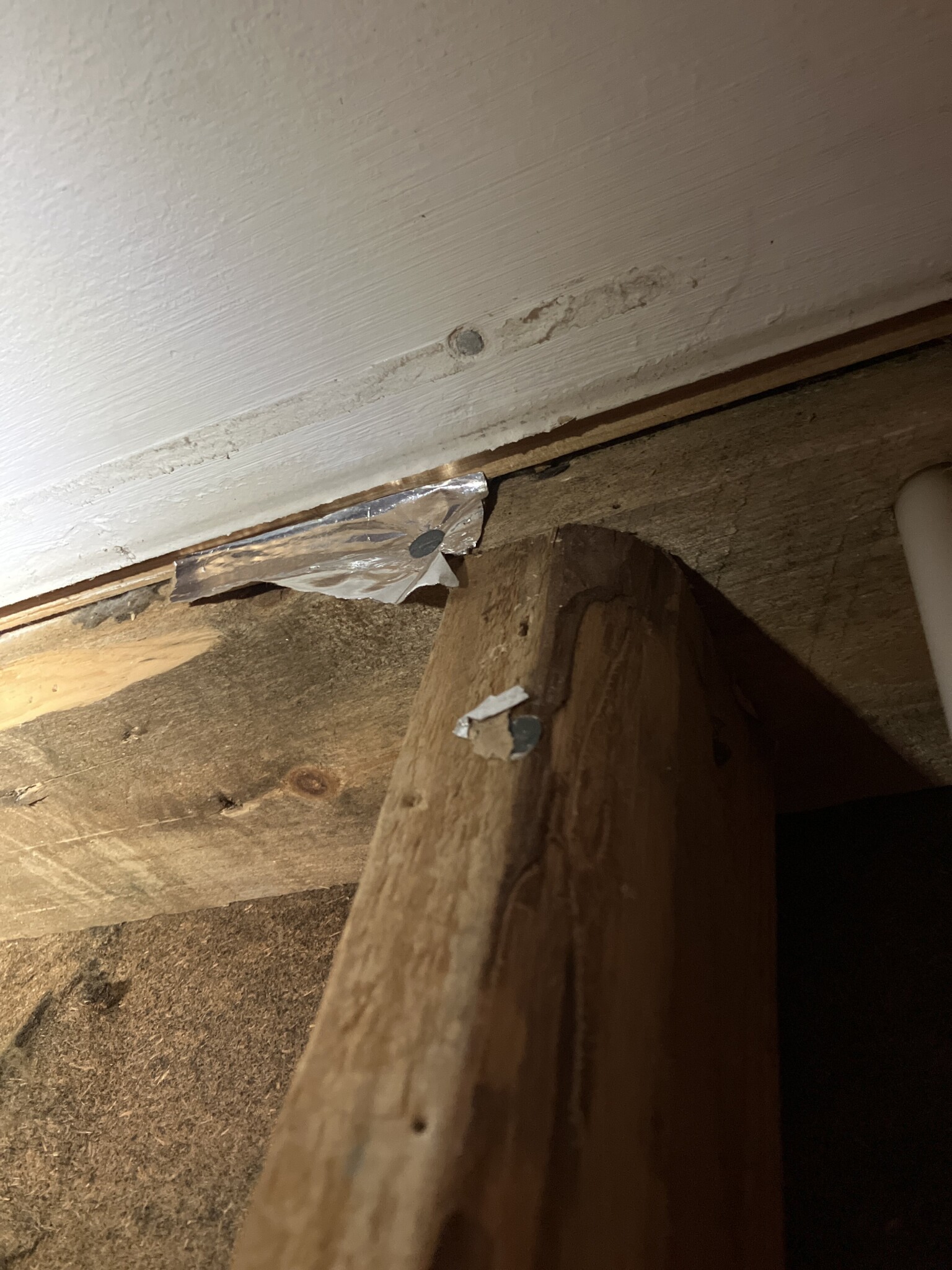
What I believe is a vapor barrier paper (silver foil on the warm side, brown paper on the cold side), was nailed in the longitudinal direction (right-left), in three rows from top to bottom. There was no tape, only an overlap of 4 cm, and it ended abruptly at the wall plate, meaning free airflow could find its way into the gap between the roof decking and the wall plate up to the cold attic.
On top of the decking in the roof (meaning in the attic) lies some black paper which I guess is also a vapor barrier, but it also ends abruptly at the wall plate.
Now I need to replace the possible vapor barrier I've removed in the exterior wall, and I'm wondering if I should just go with a wind barrier paper, or if a vapor barrier paper is still preferable?
Since the old vapor barrier wasn't taped, it could hardly have been airtight (and therefore didn't block vapor)?
The studs look healthy, so what was there seems to have worked. The exterior wall studs are no more than 100mm.
Grateful for an answer.
The house in question has a brick facade, with a frame structure, built around 1970.
The exterior walls seem to consist from inside out of an MDF board, followed by what I believe is a vapor barrier paper, followed by studs and glass or stone wool insulation, followed by some kind of fiberboard. Lastly, there seems to be just an air gap before the brick facade. When replacing the exterior door, I couldn't see any wind barrier paper between the fiberboard and air gap/brick facade.
What I believe is a vapor barrier paper (silver foil on the warm side, brown paper on the cold side), was nailed in the longitudinal direction (right-left), in three rows from top to bottom. There was no tape, only an overlap of 4 cm, and it ended abruptly at the wall plate, meaning free airflow could find its way into the gap between the roof decking and the wall plate up to the cold attic.
On top of the decking in the roof (meaning in the attic) lies some black paper which I guess is also a vapor barrier, but it also ends abruptly at the wall plate.
Now I need to replace the possible vapor barrier I've removed in the exterior wall, and I'm wondering if I should just go with a wind barrier paper, or if a vapor barrier paper is still preferable?
Since the old vapor barrier wasn't taped, it could hardly have been airtight (and therefore didn't block vapor)?
The studs look healthy, so what was there seems to have worked. The exterior wall studs are no more than 100mm.
Grateful for an answer.
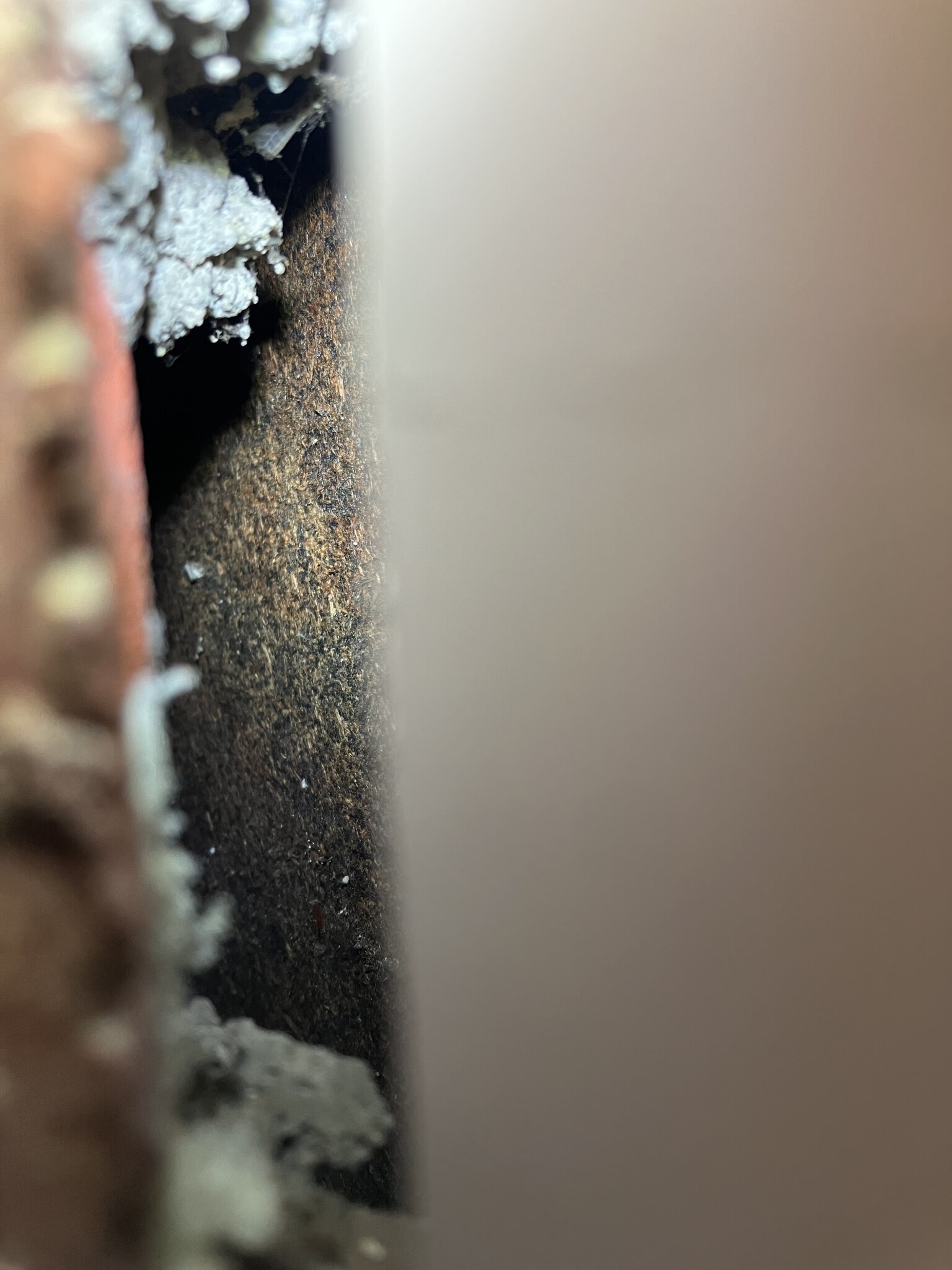
On the outside, you probably have asfaboard, the inside has likely had chipboard or thick masonite, if you have asfaboard you don't need windproof paper.
Does the house have FTX or other mechanical ventilation?
Does the house have FTX or other mechanical ventilation?
Last edited:
Hi,F fribygg said:
Thanks for the response.
It might be asfaboard; I'm attaching a somewhat poor picture.
No, no mechanical ventilation. The house originally used wood heating, but the previous owner replaced the boiler with geothermal heating 12 years ago. We only occasionally use the fireplace.
I want to emphasize that it's the old torn-off potential vapor barrier paper, on the warm side, for which I'm seeking replacement suggestions.
Edit: I read somewhere that you should have five times higher diffusion density on the warm side compared to the cold side. How diffusion-dense is an asfaboard? From what I Google, the Sd-value is 0.2 on at least a couple of asfaboard products. So I need to aim for at least Sd 1.0. That means I need a vapor barrier (the windproof paper is way down around Sd 0.08) and should even install it according to proper practice, with taping and such.
Is this reasoning correct?
Last edited:

Yes.M MånsaSven said:
In the 70s, taping wasn't done, just overlapping. It was quite new then with vapor barriers. It started to gain momentum after the big and small oil crises in the 70s when thicker insulation became common as oil became more expensive.
You should try to seal as best as you can, even in the joint between the wall and the ceiling. Otherwise, the risk of mold in the attic increases.

Steam brake did not exist then. It looks like you have some form of aluminum fabric. Not entirely uncommon back then.
Click here to reply