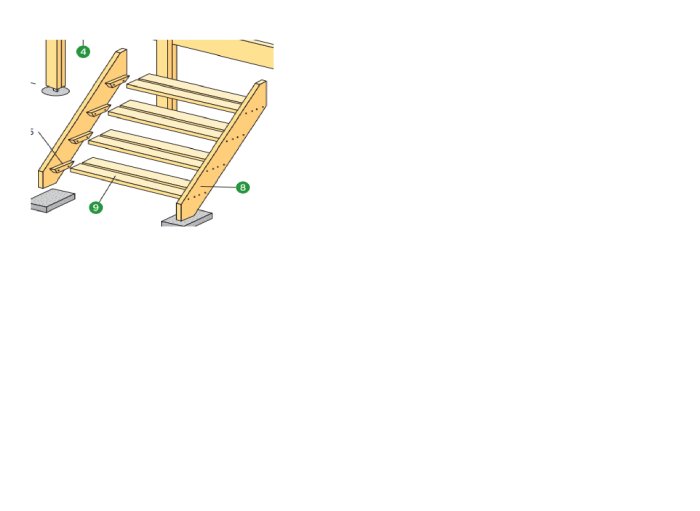
I will soon build a simple model staircase (as per the image) on a slope & in connection to a wooden deck. 45x195 as stringers, 45x120 as treads & 45x45 as support brackets for the steps. The question is what type of screws I should choose for these brackets & how many? 8mm in length & maybe 3 per bracket? Diameter 5mm, is that enough for a stable construction?
If two adult men are to meet on a step, the step must withstand a total vertical load of about 200 kg. If each bracket is screwed with three screws at each end, it results in 33 kg per screw, which most screws that are 80 mm long can handle with a margin. A 5 mm diameter is probably sufficient, 6 mm will be more stable to screw in.
If two grown men are to meet on a step, the step must withstand a combined vertical load of approximately 200 kg. If each bracket is screwed in with three screws at each end, that equals 33 kg per screw, which most screws that are 80 mm long can handle with margin. A 5 mm diameter is probably sufficient, 6 mm will be more stable to screw in.
The load on the screw won't be that. The biggest screw load will be an axial tensile load that creates tremendous friction between the 45x45 and the stringer. I would use three 6mm outdoor screws C4 of suitable length (e.g., 80mm). I think there's quite a difference in the threads and their tensile strength between 5 and 6mm.
I would have skipped the brackets entirely and routed a 10 mm deep groove (45 mm wide naturally) in the vangstycke and screwed from the side on the vangstycke.
I know that tensile load is the main issue. My intention was just to introduce a simple way of thinking about it. Unfortunately, manufacturers' product sheets are very technically oriented. A regular consumer can't glean anything useful from them.
45x45 is not an optimal measurement for the bracket. It's better with a slightly narrower variant and a shorter screw. It's important to have sufficiently high wood quality for the stringers, without knots in unsuitable places. It should be C 24. You can't buy them at Byggmax.
Edit: Ymer's variant is, of course, the nicest and the best!
I know that tensile load is the main problem. My intention was just to introduce a simple way of thinking. Unfortunately, the manufacturers' data sheets are very technically oriented. A regular consumer can't extract anything useful from them.
45x45 is not an optimal measurement for the bracket. It's better with a slightly narrower variant and a shorter screw. Then it's important to have sufficiently high wood quality for the stringers, without knots in inappropriate places. It should be C 24. You can't buy them at Byggmax.
Edit: Ymer's version is, of course, the nicest and the best!
Yes, of course, milling a groove & screwing from the side is preferable, but unfortunately, it requires tools that I don't have.
I assume that the dimension 34x45 for the brackets is preferable? I'll have to go somewhere other than Byggmax in that case since it's not available there.
If you don't have a router, perhaps you have access to a circular saw? It works just as well, but takes a little longer. Set the depth on the saw to 10mm.
How would that work, do you mean? At the front/back edge of the blade, there's zero depth. It doesn't really work well.
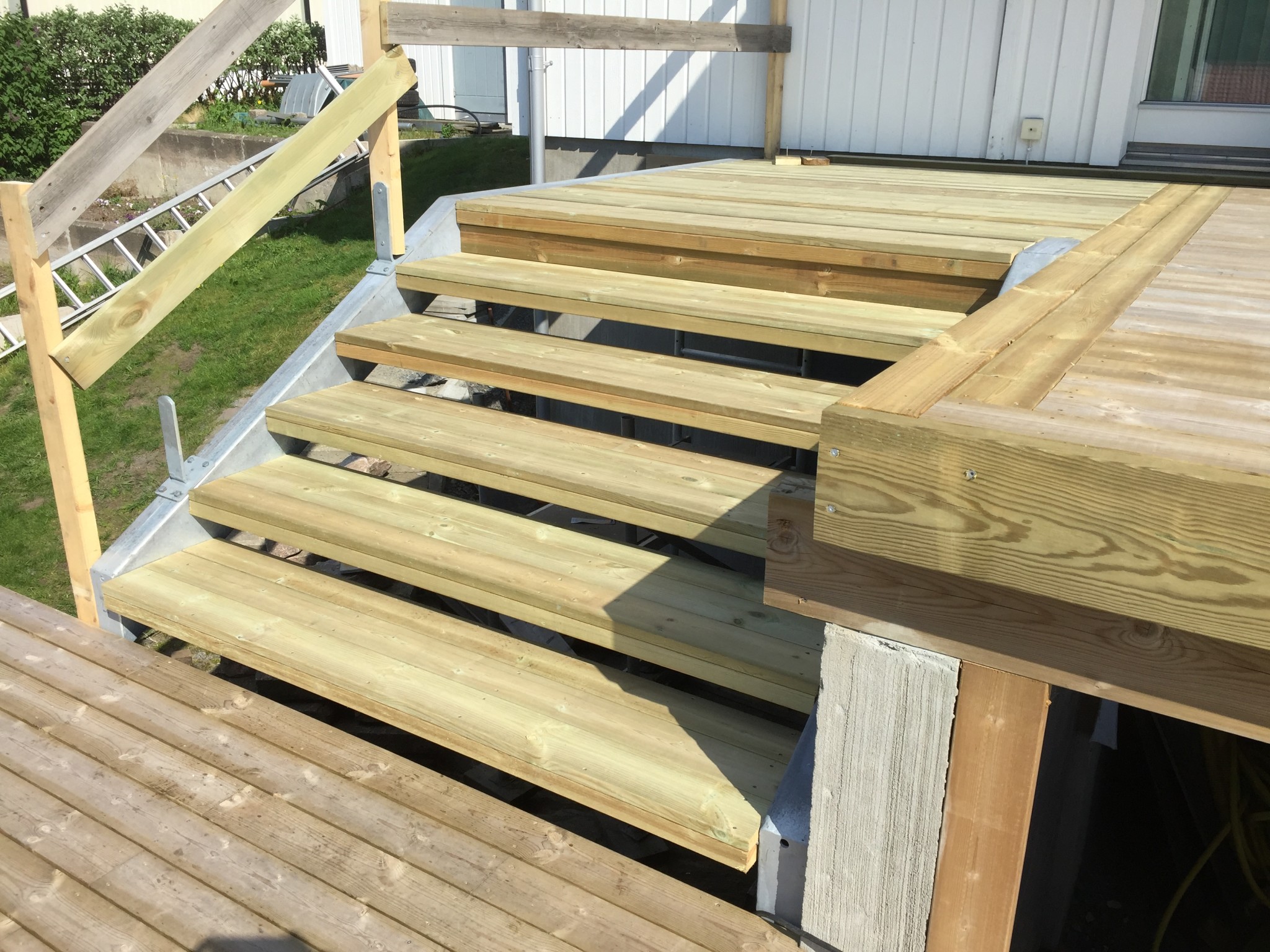
Made a similar staircase a few months ago with stringers in hot-dipped galvanized VKR 200x100x5. Step width of 1850mm.
I believe it will work perfectly fine to build as you have planned, and it will not make any decisive difference if you use a 45 or 34mm bracket. I would rather increase the profile height of the bracket to 70 or 95mm if possible. If you bevel the corners of the bracket, it might work.
A 45mm wide bracket gives a bit more wood to screw the steps into. If there are any concerns about the stringers (which I don't think there are), simply double and screw together two 45x195 so you have a stringer of 90x195.
I would absolutely not mill or saw out if there is any concern about the strength of the stringer.
How would that work, you mean? At the front/back edge of the blade, there is zero depth. It doesn't really work well.
You circular saw across the entire width of the stringer. Two precise cuts on each edge that need to be removed. Then 6-7 cuts in between so that you can break it off with your hands. Level with a chisel or knife.
Vi vill skicka notiser för ämnen du bevakar och händelser som berör dig.