
6,671 views ·
35 replies
7k views
35 replies
Walls of building board, questions
There have been original wardrobes in that corner since 1990 that probably have never been aired out, whether that can be the explanation I don't know.Z z_bumbi said:

richardtenggren
Ingen-gör
· Norrlandet
· 6 615 posts
richardtenggren
Ingen-gör
- Norrlandet
- 6,615 posts
We also had building board, now a thing of the past 
I do think it was quite suitable for screwing things into, but today we have replaced everything with OSB+gypsum, as we have basically redone everything.
I do think it was quite suitable for screwing things into, but today we have replaced everything with OSB+gypsum, as we have basically redone everything.
I've decided to try to rip out the stuff and go with the same solution as you, at least in the first room. If it becomes too much of a headache, I'll quit for the next one. Shouldn't a multitool cut staples and nails pretty easily? Or is a crowbar the way to go?
richardtenggren
Ingen-gör
· Norrlandet
· 6 615 posts
richardtenggren
Ingen-gör
- Norrlandet
- 6,615 posts
I made a cut in the middle of the wall with a circular saw, then pulled off the panels, broke them off with the help of a crowbar. Most of the staples follow the panels, while the nails often stay, so you have to clean up afterward. The panels also become more manageable in two partsM Mjolnir said:
But if you're not doing a major renovation, maybe one layer of plasterboard is enough and let the board act like "osb"?
We tore down all the interior walls and redid all the exterior walls, and did an extension, so it was natural for us
Thanks for the tips. There will be no major renovation, no. I've also discussed in the thread about blocking out the board and adding drywall. However, I don't want to risk it smelling like an old closet due to the particle board after the renovation, hence using osb instead. Am I overreacting?I made a cut in the middle of the wall with a circular saw, then pulled off the panels, pried them off with the help of a crowbar. Most of the staples come off with the panels, while the nails often stay, so you have to clean up afterward. The panels also become more manageable in two parts
But if you're not doing a major renovation, perhaps a layer of drywall is enough, letting the board act as "osb"?
We've torn down all the interior walls and redone all the exterior walls, and expanded, so it made sense for us
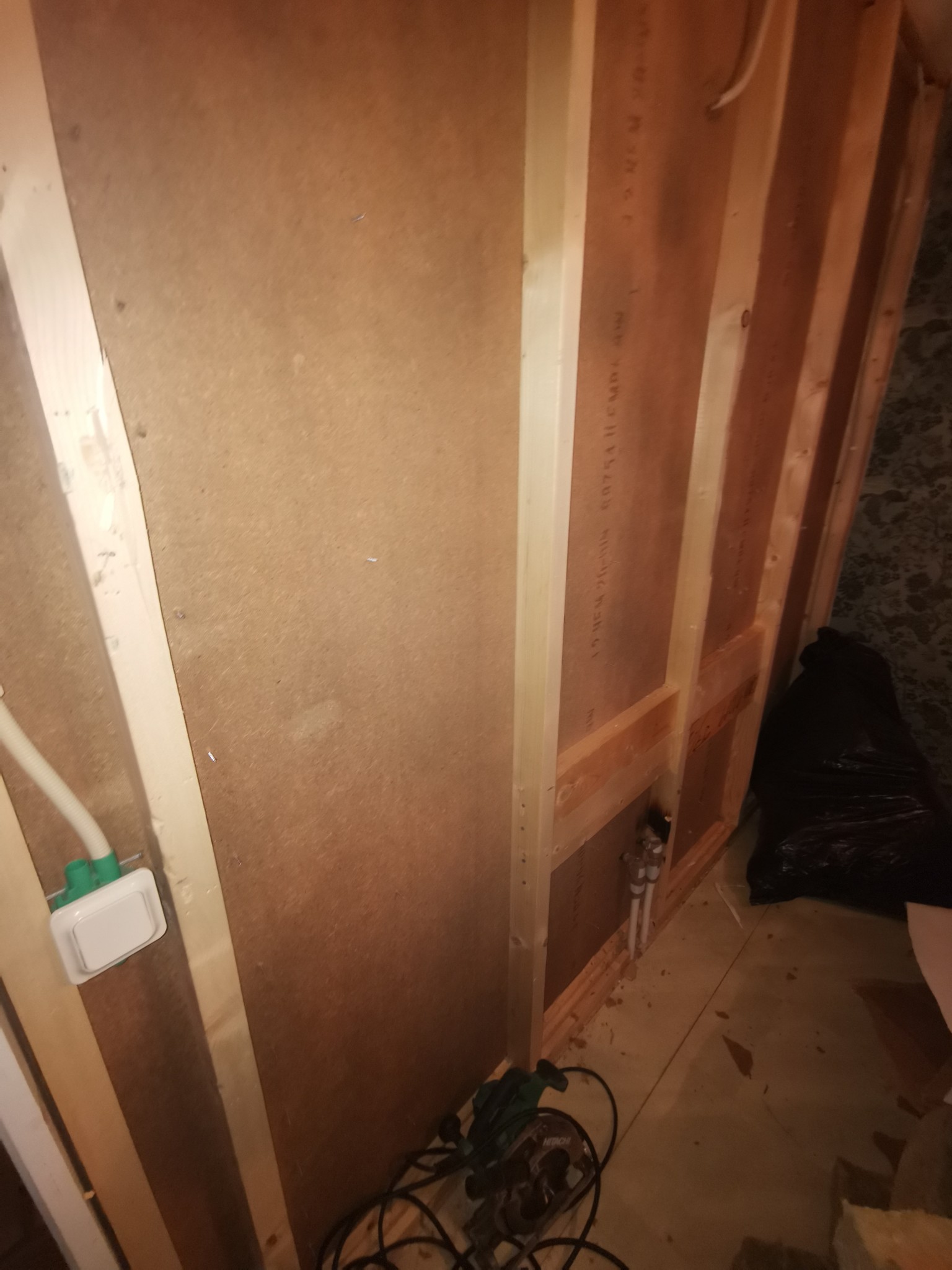
Three walls down in 3 hours, I think the panels came off fairly easily and often in large pieces. A bit tricky with some panels that were stuck between different parts, one panel was stuck between two studs in the inner wall so I had to use the multitool there.
1) Planning to add two more electrical outlets so the room will have a total of four, since the walls are already open - is there anything else I should consider doing?
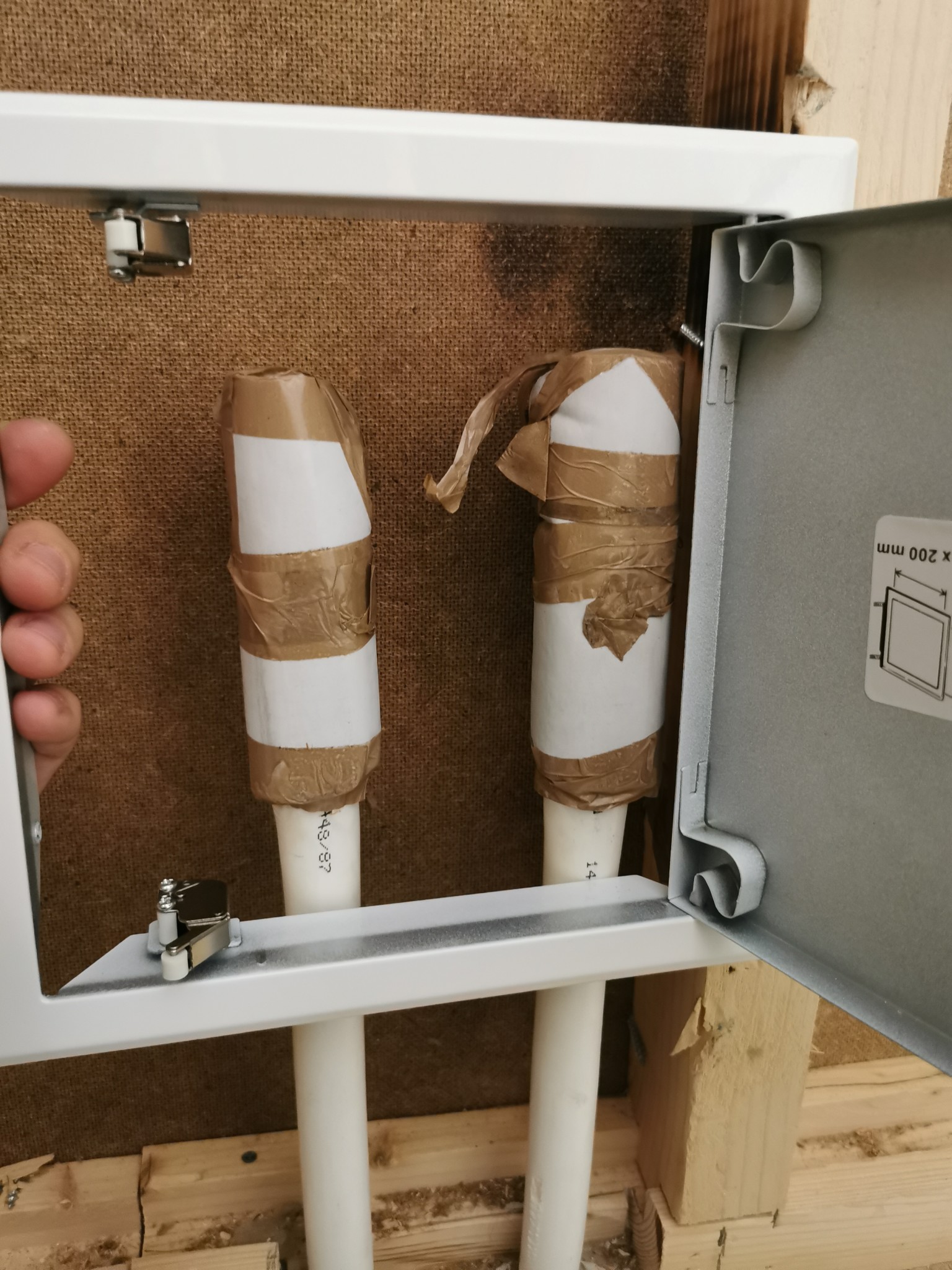
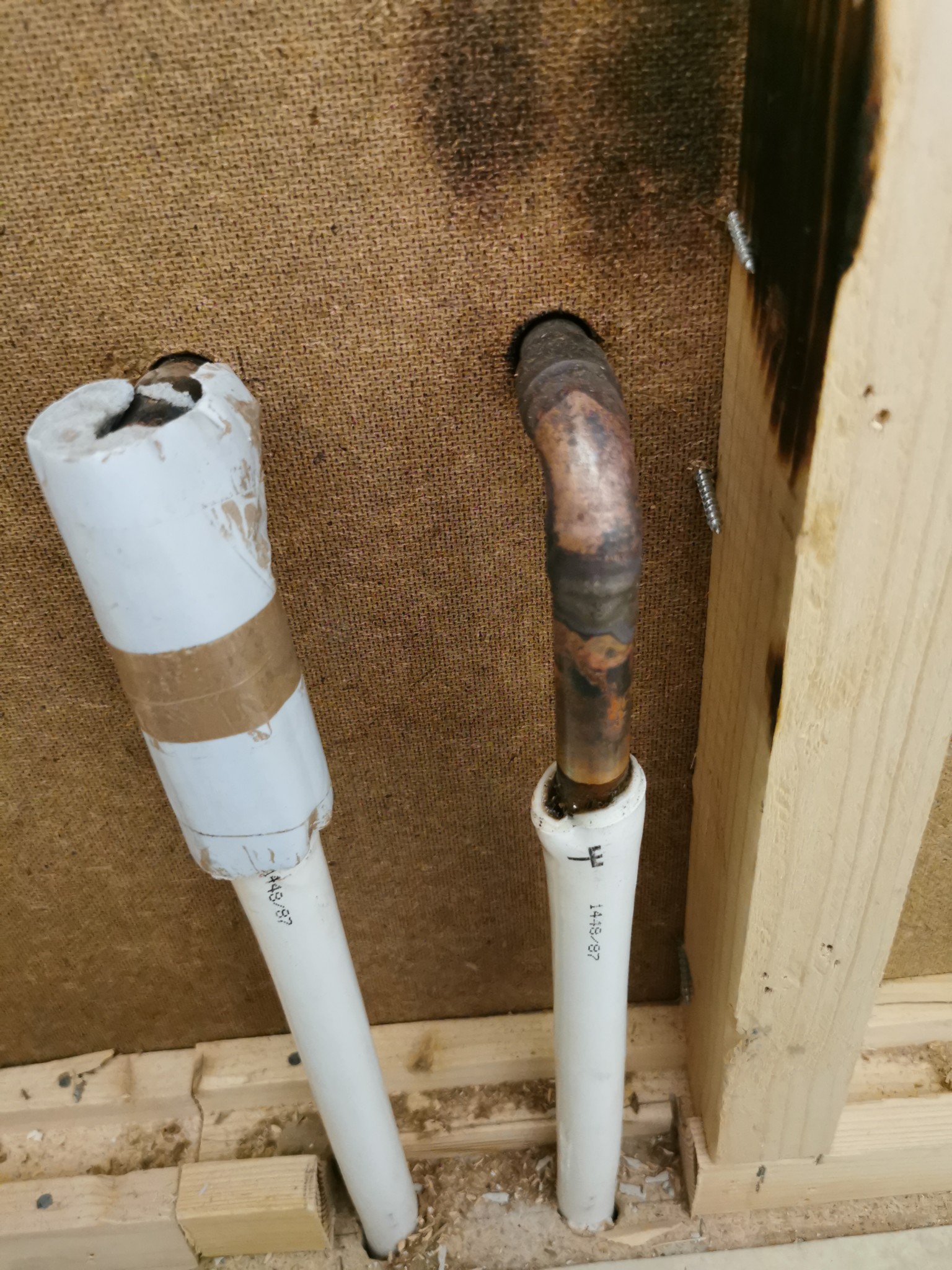
2) See picture with water pipes coming up from the floor, these go into the adjacent bathroom. The pipes didn't have a service hatch and there's also nothing to protect against accidentally drilling, screwing, or nailing into them (e.g. some metal plate?). I didn't check very carefully but I think the pipes are spliced in a 90-degree fitting, isn't it prohibited to build splices into walls? How should I handle this?
3) The wall with the district heating element is the last wall, is it safe to disconnect the radiator panel so I can tear down behind it?
1) Planning to add two more electrical outlets so the room will have a total of four, since the walls are already open - is there anything else I should consider doing?
2) See picture with water pipes coming up from the floor, these go into the adjacent bathroom. The pipes didn't have a service hatch and there's also nothing to protect against accidentally drilling, screwing, or nailing into them (e.g. some metal plate?). I didn't check very carefully but I think the pipes are spliced in a 90-degree fitting, isn't it prohibited to build splices into walls? How should I handle this?
3) The wall with the district heating element is the last wall, is it safe to disconnect the radiator panel so I can tear down behind it?



M Mjolnir said:
Yes, that's the way it is now. It might be appropriate to install a distribution cabinet with an inspection hatch towards the room if possible, and preferably also a warning pipe that opens into the bathroom. Check the industry regulations from Säker vatten.M Mjolnir said:2) see picture with water pipes out of the floor, these go into the adjacent bathroom. The pipes have not had an inspection hatch, nor have they had anything to protect from accidentally drilling, screwing, or nailing (e.g., some metal piece?). I didn't look particularly closely but I think the pipes are joined in a 90-degree pipe fitting, it's not allowed to build in joints within walls, is it? What should I do here?
Do it only when it's possible to get hold of a plumber and/or the stores are open in case something goes wrong. As I understand it, either the water must be drained from the radiator circuit (at least the part of which water can run out) or the circulation is shut off, and the pipes are frozen while the radiator is disconnected and the pipes are plugged. If it’s a one-pipe system, rather than a two-pipe system, the pipes should be bypassed instead of plugged.M Mjolnir said:
https://www.byggahus.se/forum/threads/hur-fungerar-enroerssystem.43847/
Thanks for the tips, I'll have to look into the pipes. Regarding the radiator, that will have to wait until the next weekday, I'll probably call a plumber. I was thinking of removing the chipboard on the floor, but the boards go under the inner walls and continue to the next room. I was thinking if I saw the floorboards along the inner walls' horizontal beam, all the load from the inner walls will end up at the seam, is that bad?BirgitS said:
Yes, that's how it is nowadays. It might be appropriate to install a distribution cabinet with an inspection hatch facing the room if possible, and preferably with a warning pipe that ends in the bathroom. Read in the industry regulations from Säker Vatten.
Do it only when it is possible to get hold of a plumber and/or the shops are open in case something goes wrong. As I understand it, either the water must be drained in the radiator circuit (at least the part whose water can flow out there) or you shut off the circulation and freeze the pipes while disconnecting the radiator and plug the pipes. If it's a single-pipe system, and not a double-pipe system, the pipes should be looped together instead of being plugged.
[link]
BumpM Mjolnir said:Thanks for the tips, I'll have to take a look at those pipes. Regarding the radiator, that will have to wait until the next weekday, I'll probably call a plumber. I was thinking of tearing away the chipboard on the floor but the boards go under the interior walls and continue to the next room. I was thinking if I cut the floorboards along the interior walls' horizontal stud, all the load from the interior walls will end up on the seam, is that bad?
I will start the next room which is also made of 9 mm building board panels. I will tear down 2 of the 4 walls to insulate and install more outlets. The exterior wall with windows and a radiator will have renovation wallpaper on it.
For the other exterior wall with textured wallpaper, I plan to just screw on drywall. Since it’s only 9 mm building board, will that work or is it too flimsy?
For the other exterior wall with textured wallpaper, I plan to just screw on drywall. Since it’s only 9 mm building board, will that work or is it too flimsy?