It rests on the concrete, but the boards are clamped with the help of the dowel bolt through it, have had to retighten sometime!
Great!
It feels like a solution for us. I really don't want to drill into the concrete, feels a bit risky.
So a bolt that goes from the H supports and through the post?
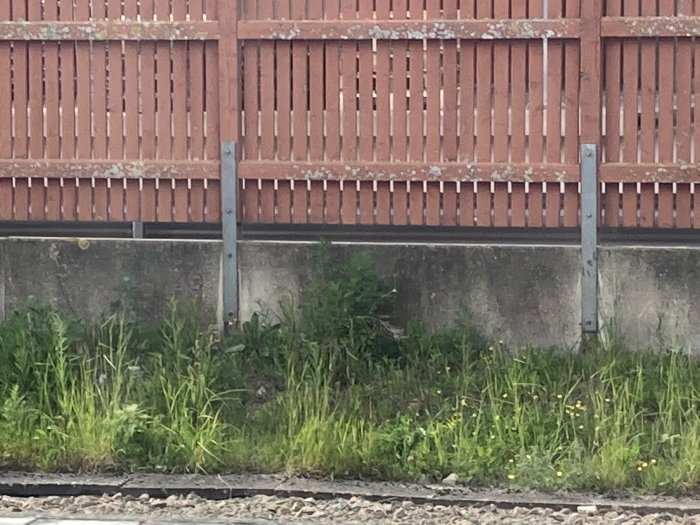
I can start by showing what it looks like at a train station that I usually pass (the picture is taken through the train window)
Seems to be a stable solution for a higher fence.
Then I can show how I solved it myself. I only built a lower fence, 60-90 cm, which is meant to prevent anyone from falling into the neighbor's garden. I didn't want to build higher or denser so that the neighbor wouldn't live with a fence as the visible part/height difference is up to one meter.
I didn't dare to drill so close to the edge and wanted to get away with drilling fewer holes than @Fredrik86 did. Then the post holder is turned 90 degrees against the load with the post bases he chose. It may not matter much on a fence, but when building a higher fence, you should consider it.
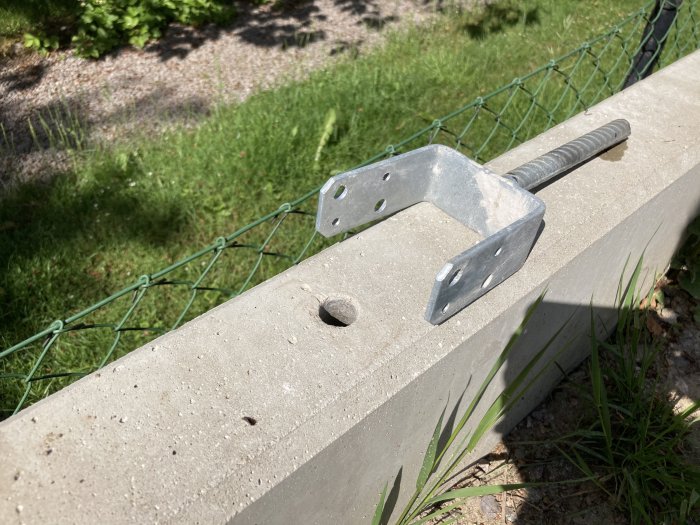
I used a U-bracket and drilled one hole. I checked with Benders whose L-support I have, and the reinforcement starts 20cm down on these. To avoid hitting the reinforcement, I only drilled 15cm. I didn't want the post bases to stick up too much, so I cut them to fit.
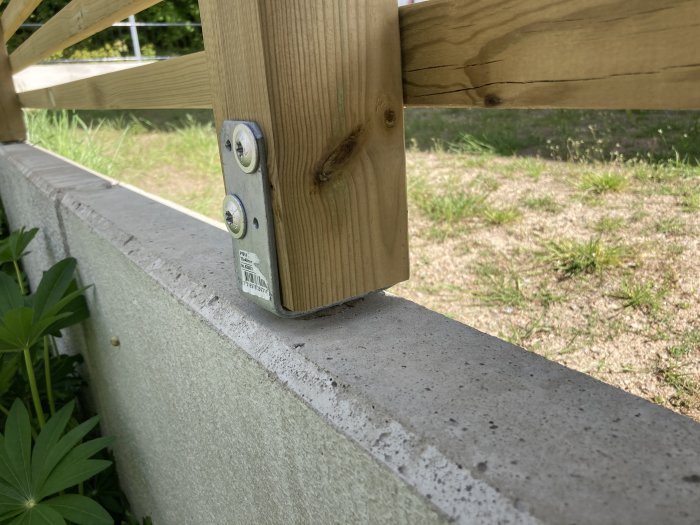
then attached the post base with anchor adhesive and then the post with WAF screws.
I think it turned out well. I'm not saying one is better than the other but just wanted to show an alternative.
Can start by showing how it looks at a train station I usually pass by (the picture is taken through the train window)
[image]
Seems to be a stable solution for a higher fence.
Then I can show how I solved it myself. I only built a lower fence, 60-90 cm, which is meant to prevent anyone from falling into the neighbor's garden. I didn't want to build higher or denser so that the neighbor wouldn't have to live with a fence as the visible part / height difference is up to one meter.
I didn't dare to drill so close to the edge and wanted to get away with drilling fewer holes than @Fredrik86 did. Then the post shoe becomes rotated 90 degrees to the load with the post shoes he chose. Maybe not so important for a fence, but if building something higher, you should think about that.
I used a U-bracket and drilled one hole. Checked with Benders whose L-supports I have, and the reinforcement starts 20cm down on these. To avoid hitting the reinforcement, I only drilled 15cm. I didn't want the post shoes to stick up too much, so I trimmed them to fit.
[image]
then attached the post shoe with anchor compound and then the post with WAF screws.
[image]
I think it turned out well.
Not saying one is better than the other, just wanted to show an alternative.
Looks nice; that's how we planned to do it, but since we will have a high fence, about 170 cm, if not higher, I think this solution won't be suitable for us.
We have also considered casting in the holes between the L-supports, we have DOVETAIL - DOVETAIL and placing a similar post shoe to yours, but have been told that it won’t work well. (for some reason, the contractor didn't set DOVETAIL-TONGUE)
Does anyone have experience with casting a post shoe in a DOVETAIL_DOVETAIL space?
If you're going to make such a high fence that can also act as a windbreak, I would go for the version from the railway station in my post above. I don't think you should be afraid to drill into the L-supports. Just rent the right equipment, and it will be quick and smooth.
How long are your L-supports? If you really want to cast in not-not, keep in mind that the distance between the posts shouldn't be too long. If you choose another solution, you can adjust the distance between the posts, but with not-not, you're locked in.
If you are going to build such a tall fence that can also become a windbreak, I would go for the variant from the railway station in my post above. I don't think you need to worry about drilling into the L-supports. Just rent the right equipment and it will be quick and easy.
How long are your L-supports? If you really want to cast in not-not, keep in mind that the distance between the posts shouldn't be too far. If you choose another solution, you can adjust the distance between the posts, but with not-not you are fixed.
Yes, exactly, we have been considering the solution at the train station that you attached a picture of. How do you know where the reinforcement is in the blocks?
If you're going to make such a high fence that can also catch the wind, I would opt for the variant from the railway station in my post above. I don't think you need to be afraid of drilling into the L-supports. Just rent the right equipment and it will be quick and smooth.
How long are your L-supports? If you really want to cast within notch-notch, keep in mind that the distance between the posts shouldn't be too long. If you choose another solution, you can adjust the distance between the posts, but with notch-notch you're locked in.
Then I'm wondering, do you run two flat bars and bolt right through? Or is one flat bar on the outside enough? And drive the bolt partly into the block and not through?
Hi. We are also going to put a fence on L-support. Has your solution worked well?
It has worked great. Sits stable and it's not even visible that the fence sways during the strongest storms.
I am very satisfied with the solution. Now, 3 years later, the holder looks like this. I can also mention that I cold-galvanized them on the outside after the posts were mounted and the bolts were tightened.
It has worked great. It's stable and you can't even see the fence sway during the strongest storms.
I'm very satisfied with the solution. Now, 3 years later, the holder looks like this. I can also mention that I cold-galvanized them on the outside after the posts were installed and the bolts were tightened. [image]
Looks great.
How high is the fence? We want it quite high (at least 170 cm) not sure if that solution works.
How high is the fence? We need it to be quite high (at least 170 cm) not sure if that solution works.
How long were the bolts you drove down?
110/180cm. I can measure exactly tonight.
If you're thinking about the threaded rods in the support, they're about 15 cm down if I remember correctly.
Just make sure to blow out the holes well before applying the chemical anchor if you're planning to do that ☺️
It was really high. Feel free to explain more closely how you did it, do you have any memory? Like step by step? We're going about that high as well and I've been afraid it will be too weak.
We have bought flat iron and will use concrete screws instead of bolting directly through. The question now is; how long should the flat irons be, i.e., how far down on the concrete and how high up on the post?
The fence will be about 180 cm high and have an attachment on the property about 2 meters into the property and parallel to the posts on the L-support. (It will have a roof over an outdoor kitchen). Then the fence continues over the L-supports but lower, 90 cm high. There we plan to have 50 cm long irons, about 40 cm down on the concrete and about 10 cm up on the post. Do you think that's sufficient?
I can start by showing what it looks like at a train station I usually pass (the picture is taken through the train window)
[image]
Seems to be a stable solution for a higher fence.
Then I can show how I've solved it myself. I only built a lower fence, 60-90 cm, intended to prevent someone from falling into the neighbor's garden. Didn't want to build higher or more densely to avoid the neighbor living with a fence since the visible part/height difference is up to one meter.
I didn't dare to drill so close to the edge and wanted to get away with fewer holes than @Fredrik86 did. Also, with the post supports he chose, the posts are turned 90 degrees against the load. Maybe it doesn't matter much on a fence, but if you're building a taller fence, you should consider it.
I used U-bracket and drilled one hole. Checked with Benders whose L-supports I have, and the reinforcement begins 20cm down on these. To avoid hitting the reinforcement, I only drilled 15cm. Didn't want the post supports to stick up too much, so I cut them to fit.
[image]
Then attached the post support with anchor adhesive and the post with WAF screw.
[image]
I think it turned out well. Not saying one is better than the other, just wanted to show alternatives.
Which anchor adhesive did you use?
You have to buy something like a pressure gun or whatever it was called…
Yes, you need a caulking gun but a manual one for 50 kr is sufficient. I modified our bike pump with an extra piece of hose to blow out the drill holes and cut an old bottle brush to fit the diameter. I didn't want to buy special tools as I probably won't do something similar again.
It has worked great. It sits stable and you can't even see the fence sway during the strongest storms.
I am very satisfied with the solution. Now 3 years later, the holder looks like this. I can also mention that I cold-galvanized them afterwards after the posts were mounted and the bolts were tightened. [image]
Many years since you did this now, but I was thinking of copying your method over the weekend.
The downside is that I probably have to set 26 holders, meaning about 100 holes on my 32m long wall.
Do you remember if you used M8 or M10 threaded rod? I was thinking of using M8 as I imagine M10 would end up a bit too close to the edge. But maybe I'm worrying unnecessarily...
Then I can show how I solved it myself. I only built a lower fence, 60-90 cm, which is meant to prevent someone from falling into the neighbor's garden. I didn't want to build higher or tighter so the neighbor would not live with a plank since the visible part/difference in height is up to a meter.
I didn't dare to drill so close to the edge and wanted to get away with drilling fewer holes than @Fredrik86 did. Then the post shoes are turned 90 degrees against the load with the post shoes he chose. It may not matter much on a fence but if one were to build a higher fence, one should think about it.
I used U-shoes and drilled one hole. Checked with Benders whose L-support I have and the reinforcement starts 20cm down on these. To avoid hitting the reinforcement, I only drilled 15cm. I didn't want the post shoes to stick up too much, so I cut them to fit.
[image]
Then attached the post shoe with anchor mass and then the post with WAF screw.
[image]
I think it turned out well.
Not saying one is better than the other, just wanted to show alternatives.
It's been a long time since you did this, but how did it turn out? Wobbly or stable?
How far do you have between the posts, it looks like you have 28x45 as battens? I don't want them to sag in the middle.
Vi vill skicka notiser för ämnen du bevakar och händelser som berör dig.



pdov said:
Can start by showing how it looks at a train station I usually pass by (the picture is taken through the train window)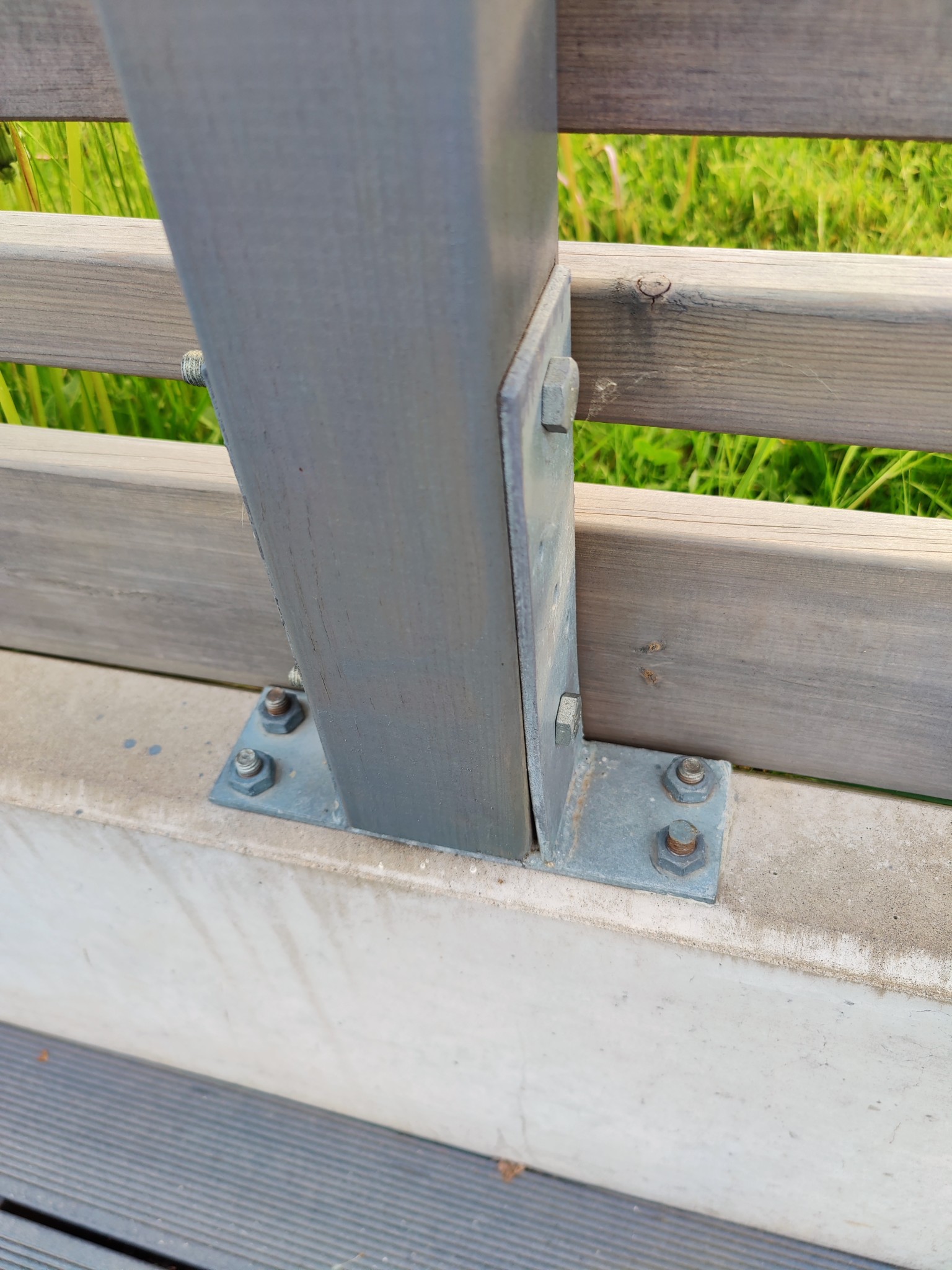
Fredrik86 said:
It has worked great. It's stable and you can't even see the fence sway during the strongest storms.