
9,775 views ·
11 replies
10k views
11 replies
Underfloor heating in sparse panel - question about bouncing floor
When installing underfloor heating in a spaced board according to Uponor's method (image), half of the spaced board ends without the support of joists. The idea is then to have chipboard on top and then any floor of choice.
Isn't there a risk that the floor will flex when there is no support everywhere? Do you need to customize the measurements so that the joints in the chipboard don't land on the spaced boards that have no support, or does it not matter? I see a risk that during installation, a smaller piece of chipboard might end up on these unsupported spaced boards, and it could be quite difficult to predict beforehand where they would end up.
Isn't there a risk that the floor will flex when there is no support everywhere? Do you need to customize the measurements so that the joints in the chipboard don't land on the spaced boards that have no support, or does it not matter? I see a risk that during installation, a smaller piece of chipboard might end up on these unsupported spaced boards, and it could be quite difficult to predict beforehand where they would end up.

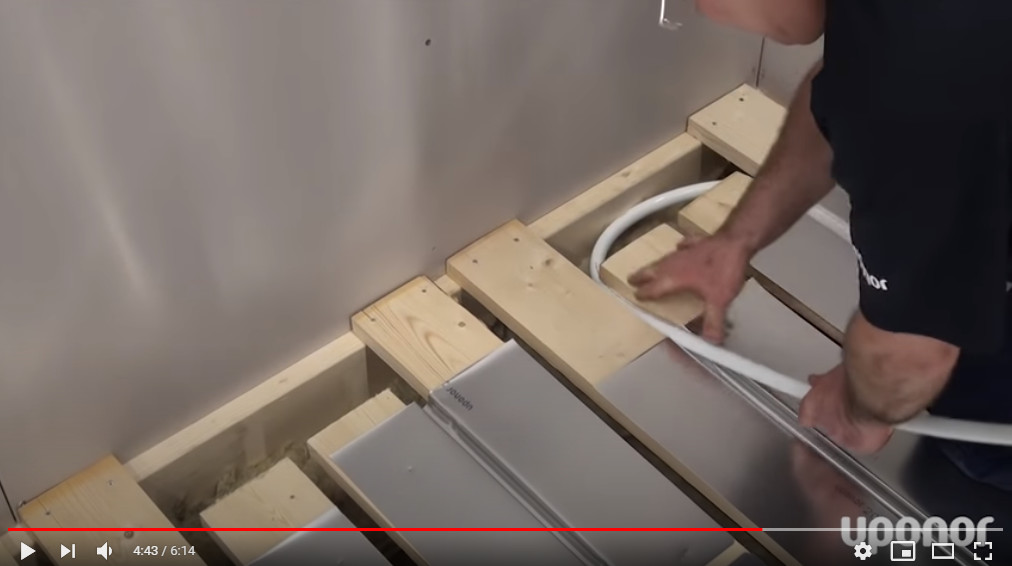
Anyone have thoughts on the placement of hoses in the pictures? What I'm wondering is if it matters that two sparse panels between the full-length ones will be unsupported if you have floor chipboard on top later anyway? Adding another stud under the short ones is tricky. And if you only use full-length panels, it seems incredibly cumbersome to roll out the hose coil and pull it under.
What do you think about placing a sparse panel lengthwise under the long ones and screwing them together for the short ones to rest on?
What do you think about placing a sparse panel lengthwise under the long ones and screwing them together for the short ones to rest on?
Last edited:
If you had placed the chipboard on the beams, it would have had support on CC 600 mm (usually).G gluecifer said:
If you had laid boards on CC 600 mm across the floor beams and then the chipboard, the chipboard wouldn't rest on the beams, but it still gets support right down through the boards on CC 600 mm.
Therefore, it doesn't really matter that there are two boards in between with no support on anything at all.



It's possible to make it much more complicated if one wishes... If the floor joists themselves have sufficient dimensions to meet deflection requirements, it doesn't matter what you place on top or in what order. Simply put, the deflection requirements mean that a 100 kg (actually 1kN) person standing in the middle of a beam should lead to a momentary deflection of no more than 1.5 mm regardless of the beam's span. If the floor joists' dimensions are somewhat insufficient, one needs the help of a floor-covering material (usually chipboard), glued and screwed, to achieve acceptable deflection. In that case, grooved chipboards are hardly suitable.

Depending on where you live, it might be worthwhile to consider pests like mice and rats. If there's a risk they could get in, they might attack the hoses. Perhaps unlikely, but a water leak from the heating system within the flooring during a cold winter isn't a risk I want to take.
I myself have chosen to place the particle board at the bottom (standard 22 mm), with the battens on top. Then a solid wood floor (15 mm parquet works too). It works just as well, but I have the hoses inside a sealed construction, less inertia, and it's easier to lay hoses in the meantime. If you also lay the hoses "room by room," meaning not under the walls, you can, if you have a damage to a hose, lift up the surface layer and repair/replace the hose. And you can regulate the temperature per room.
I myself have chosen to place the particle board at the bottom (standard 22 mm), with the battens on top. Then a solid wood floor (15 mm parquet works too). It works just as well, but I have the hoses inside a sealed construction, less inertia, and it's easier to lay hoses in the meantime. If you also lay the hoses "room by room," meaning not under the walls, you can, if you have a damage to a hose, lift up the surface layer and repair/replace the hose. And you can regulate the temperature per room.
Click here to reply