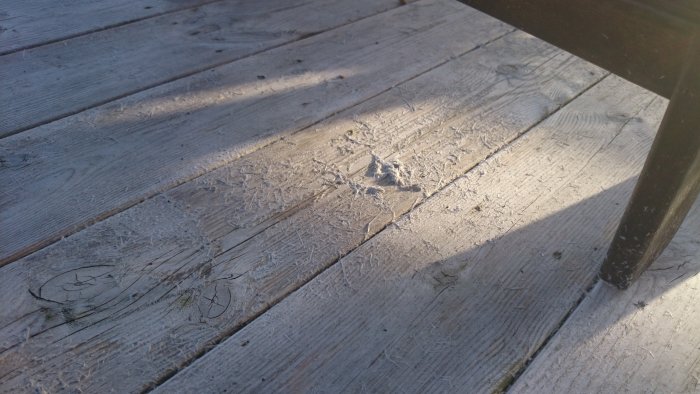
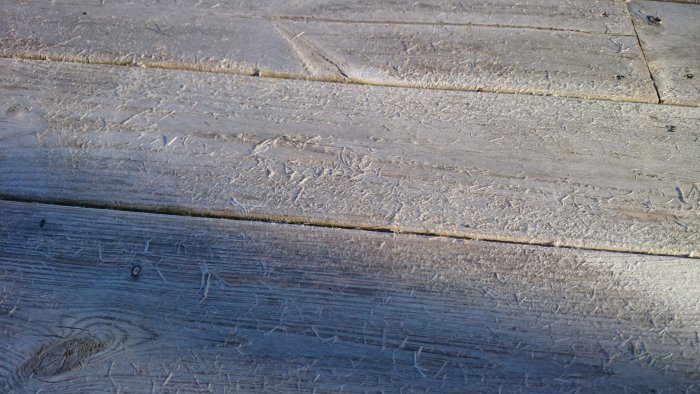
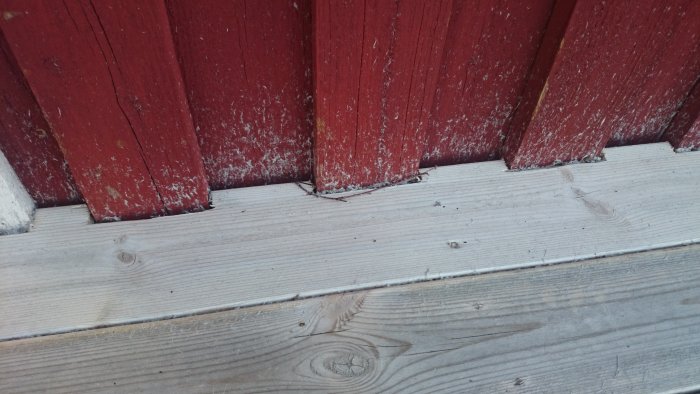
Dad built a deck last summer out of pressure-treated wood. After a "winter" in Halland it looks like this, no aftercare has been done. What the heck happened?
Yes, it's strange. It hasn't been treated or washed in any way at all, unless you count rain. I don't know exactly what type of wood it is, but it was purchased for the purpose from a local branch of a large and well-established chain.
It looks like fiber fuzz ("fiberludd") (http://www.traguiden.se/TGtemplates/popup1spalt.aspx?id=6368). The decking looks unusually gray for being six months old, so I think it's Organowood. Could it be what he bought, sold at K-rauta and XL-bygg?
The gap between the boards looks tight, and I've made that mistake too with my Organowood decking, which is delivered unusually dry and must be laid with a large gap (at least 4 mm).
Regarding the fiber fuzz, I don't know how big of a problem it is, the manufacturer suggests that it can/should be reduced by treating it with a so-called dirt- and water-repellent treatment, see the website. http://www.organowood.com/index.php/faq-v3.html
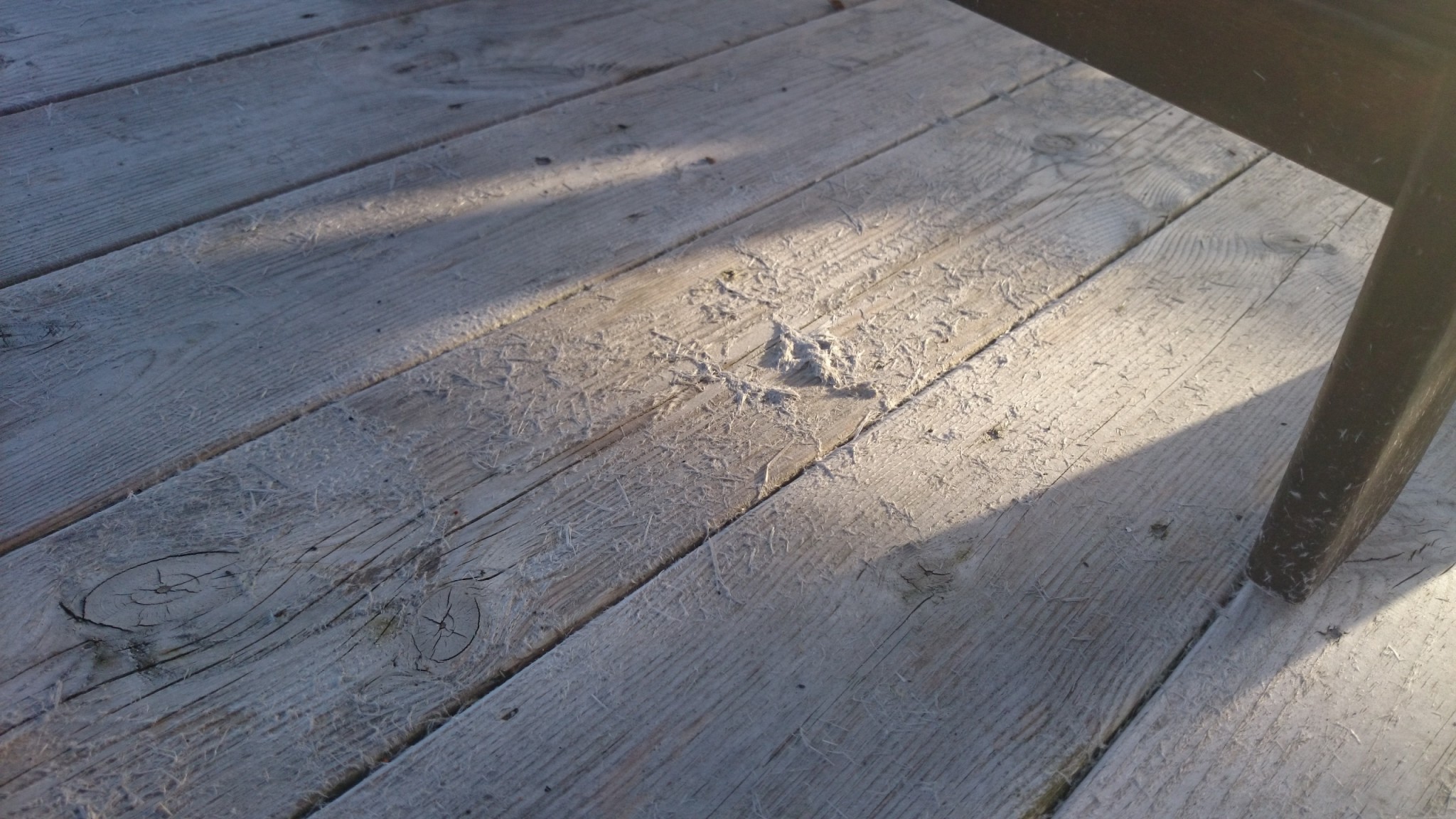
Dad built a deck last summer with treated wood. After a "winter" in Halland, it looks like this, no aftercare has been done. What the heck happened?
[image]
That is not treated wood. It is Organowood. The exact same thing happened with our 175 m2 Organowood deck. We also have acquaintances who have the same problem with their Organowood deck. Super bad. Do not buy Organowood decking if you don't want your deck to look like this a year later....
What you're seeing is chemical degradation, defibering of the wood. The wood fibers on the surface separate from each other. This is often seen when regular salt has been used to salt a product (ham, fish) in wooden houses. Here, it must be the chemicals in Organowood that have led to the degradation. The company also says that they "imitate the natural fossilization process of wood." Not something to strive for, as every fossilization of wood leads to significant degradation of the wood.
"A nice deck where you can drink your morning coffee, sunbathe and read, maybe grill or have a glass of wine. It is the dream of many homeowners and the reason to build an extension of the house in wood. But dreams, as we know, do not always come true. Olle Lundberg in Östersund, is one of several listeners who have contacted Plånboken after having problems with the environmentally classified decking wood Organowood, which according to the manufacturer is both durable and easy to maintain. Something that does not at all match the experiences of several dissatisfied consumers. Jens Hamlin from Organowood participates in the studio."
My dad built a deck last summer using pressure-treated wood. After a "winter" in Halland, it looks like this, no further treatment has been done. What on earth has happened?
[image]
.
That is Organowood. I have 180m2 of it. It looks the same every year. I have scraped, brushed, rinsed, etc., every year to no end. Nowadays, I use a pressure washer connected to a deck wash nozzle, and then the deck looks nice again, even though it takes many hours to do 180 m2. It has to be done every spring. I've had the deck for 4-5 years.
That is not treated wood. It's Organowood. The exact same thing has happened with our 175 m2 large Organowood deck. We also have acquaintances who have the same problem with their Organowood deck. Super bad. Don't buy Organowood decking if you don't want your deck to look like this a year later....
VLintott8888 said:
That is Organowood. I have 180m2 of it. It gets the same way every year. I've scraped, brushed, rinsed, etc. every year to no avail. Nowadays, I use a pressure washer connected to a deck cleaning nozzle, and then the deck looks good again, although it takes many hours to do 180 m2. Has to be redone every spring. I've had the deck for 4-5 years.
Don't buy Organowood....
If it's still growing, then it's a good deal, right?
If it's still growing, then it's a good deal, right?
Very bad deal unfortunately. Paid 25,000 more than what it would have cost for regular treated wood just because I wanted to minimize the risk of chemicals from the treated wood ending up in our salad cultivation below the deck... Expensive salad... The worst part is all the extra work every year. It's also more time-consuming to lay organowood because they are dry and difficult to straighten out and must be laid with the correct spacing. Hoping the pulp stuff in the wood runs out sometime...
I have pure pine on my terrace which also "fluffs" somewhat after the winter, though not so much that it splashes with the rain but it doesn't bother me at all, it's really just on the very outer surface, I brush it off a bit with a broom and then it looks great again.
Organowood has become somewhat known for turning gray quickly and also being rather fluffy as a result. It's hard to believe that this affects its lifespan significantly. If you follow their instructions, the decking should be treated regularly, especially in the beginning. Many just lay it down and think it will take care of itself, which isn't completely true.
All wood breaks down, even "dead or treated" wood, wood is fundamentally a living material and that’s part of its charm.
"The paper pulp sludge" at Organowood is something that can't be easily ignored. It looks really disgusting and dirty. If it rains and is wet, it becomes a slippery, gooey mass. This mass effectively clogs the gaps, and therefore drainage and ventilation are poor, which could likely affect the lifespan if you don't regularly rinse the gaps clean. It's not a small amount.
The treatment according to their instructions doesn't help. I did it for 3 years and it didn't help at all. However, Organowood made a good profit on the treatment because it was incredibly expensive.
Absolutely do not buy Organowood. It is pure fraud. No one wants recurring paper pulp sludge on their decking.
Vi vill skicka notiser för ämnen du bevakar och händelser som berör dig.